Department of Neuroscience, Biomedicine and Movement, University of Verona, Piazzale L.A. Scuro, 10, 37134 Verona, Italy.
Department of Biotechnology, University of Verona, Cà Vignal 1, Strada Le Grazie 15, 37134 Verona, Italy.
Int J Mol Sci. 2020 Jan 30;21(3):880. doi: 10.3390/ijms21030880.
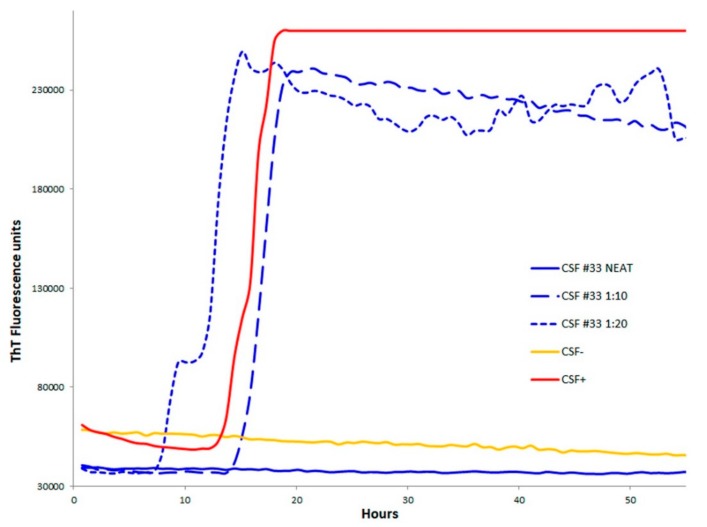
The early and accurate in vivo diagnosis of sporadic Creutzfeldt-Jakob disease (sCJD) is essential in order to differentiate CJD from treatable rapidly progressive dementias. Diagnostic investigations supportive of clinical CJD diagnosis include magnetic resonance imaging (MRI), electroencephalogram (EEG), 14-3-3 protein detection, and/or real-time quaking-induced conversion (RT-QuIC) assay positivity in the cerebrospinal fluid (CSF) or in other tissues. The total CSF tau protein concentration has also been used in a clinical setting for improving the CJD diagnostic sensitivity and specificity. We analyzed 182 CSF samples and 42 olfactory mucosa (OM) brushings from patients suspected of having sCJD with rapidly progressive dementia (RPD), in order to determine the diagnostic accuracy of 14-3-3, the total tau protein, and the RT-QuIC assay. A probable and definite sCJD diagnosis was assessed in 102 patients. The RT-QuIC assay on the CSF samples showed a 100% specificity and a 96% sensitivity, significantly higher compared with 14-3-3 (84% sensitivity and 46% specificity) and tau (85% sensitivity and 70% specificity); however, the combination of RT-QuIC testing of the CSF and OM samples resulted in 100% sensitivity and specificity, proving a significantly higher accuracy of RT-QuIC compared with the surrogate biomarkers in the diagnostic setting of patients with RPD. Moreover, we showed that CSF blood contamination or high protein levels might interfere with RT-QuIC seeding. In conclusion, we provided further evidence that the inclusion of an RT-QuIC assay of the CSF and OM in the diagnostic criteria for sCJD has radically changed the clinical approach towards the diagnosis.
早期准确的散发性克雅氏病(sCJD)的体内诊断对于将 CJD 与可治疗的快速进行性痴呆区分开来至关重要。支持 CJD 临床诊断的诊断性检查包括磁共振成像(MRI)、脑电图(EEG)、14-3-3 蛋白检测,以及/或脑脊液(CSF)或其他组织中实时震颤诱导转化(RT-QuIC)检测呈阳性。脑脊液(CSF)中总 tau 蛋白浓度也已在临床环境中用于提高 CJD 诊断的敏感性和特异性。我们分析了 182 例疑似 sCJD 患者的 CSF 样本和 42 例嗅黏膜(OM)刷检样本,以确定 14-3-3、总 tau 蛋白和 RT-QuIC 检测的诊断准确性。在 102 例患者中评估了可能和明确的 sCJD 诊断。CSF 样本的 RT-QuIC 检测具有 100%的特异性和 96%的敏感性,明显高于 14-3-3(84%的敏感性和 46%的特异性)和 tau(85%的敏感性和 70%的特异性);然而,CSF 和 OM 样本的 RT-QuIC 联合检测结果具有 100%的敏感性和特异性,表明在 RPD 患者的诊断环境中,RT-QuIC 检测的准确性明显高于替代生物标志物。此外,我们表明 CSF 血液污染或高蛋白水平可能会干扰 RT-QuIC 接种。总之,我们提供了进一步的证据,表明将 CSF 和 OM 的 RT-QuIC 检测纳入 sCJD 的诊断标准,彻底改变了对 sCJD 诊断的临床方法。