Nanni Alfredo Gabriele, Urso Daniele, Caccamo Martina, Gnoni Valentina, Giugno Alessia, Zecca Chiara, Dell'Abate Maria Teresa, Vilella Davide, De Blasi Roberto, Logroscino Giancarlo
Department of Clinical Research in Neurology, Center for Neurodegenerative Diseases and the Aging Brain, "Pia Fondazione Cardinale G. Panico", University of Bari 'Aldo Moro', Tricase, Italy.
Department of Translational Biomedicine and Neurosciences (DiBraiN), Neurology Unit, University of Bari, Italy.
J Alzheimers Dis Rep. 2024 Jul 23;8(1):1105-1110. doi: 10.3233/ADR-230173. eCollection 2024.
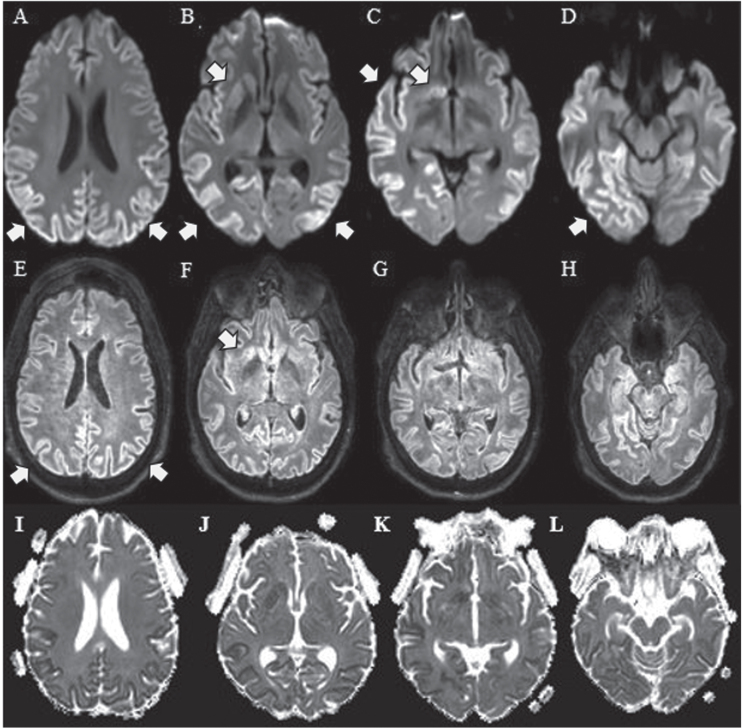
This report presents a challenging case of Creutzfeldt-Jakob Disease (CJD), a rare and rapidly progressing neurological disorder. The patient exhibited diverse and progressive neuro-psychiatric symptoms, including memory impairment, behavioral changes, and hallucinations associated with cacosmia. The diagnosis of CJD is complicated due to its variable clinical presentation, limited awareness, and the need for tissue pathology confirmation. Diagnostic tests, particularly brain magnetic resonance imaging (MRI) and cerebrospinal fluid (CSF) analysis, played crucial roles in the evaluation. The MRI revealed characteristic cortical ribboning patterns. CSF analysis initially suggested Alzheimer's disease pathology continuum. Repeated Real-time-quaking-induced assay testing (RT-QuIC) confirmed the diagnosis despite an initial negative result. This case underscores the significance of contemplating CJD in individuals exhibiting rapidly progressive dementia, even in the presence of atypical clinical features. Furthermore, it emphasizes the importance of recognizing that an initial negative result from the RT-QuIC test should not preclude consideration of CJD, particularly when characteristic MRI findings are present.
本报告介绍了一例具有挑战性的克雅氏病(CJD)病例,这是一种罕见且进展迅速的神经疾病。患者表现出多样且进行性的神经精神症状,包括记忆障碍、行为改变以及与嗅觉倒错相关的幻觉。由于其临床表现多变、认知有限以及需要组织病理学确诊,CJD的诊断较为复杂。诊断测试,尤其是脑磁共振成像(MRI)和脑脊液(CSF)分析,在评估中发挥了关键作用。MRI显示出特征性的皮质带状模式。CSF分析最初提示为阿尔茨海默病病理连续谱。尽管最初结果为阴性,但重复的实时震颤诱导检测(RT-QuIC)最终确诊了该病。该病例强调了即使存在非典型临床特征,对于表现出快速进展性痴呆的个体考虑CJD的重要性。此外,它还强调了认识到RT-QuIC测试最初的阴性结果不应排除对CJD的考虑这一点的重要性,特别是当存在特征性MRI表现时。