Kim Tae-Oh, Han Yu Kyeong, Yi Joo Mi
Department of Internal Medicine, Inje University Haeundae Paik Hospital, Busan, Korea.
Department of Microbiology and Immunology, Inje University College of Medicine, Busan, Korea.
Intest Res. 2020 Jul;18(3):297-305. doi: 10.5217/ir.2019.00105. Epub 2020 Feb 7.
BACKGROUND/AIMS: Overwhelming evidence suggests that inflammatory bowel disease (IBD) is caused by a complicated interplay between the multiple genes and abnormal epigenetic regulation in response to environmental factors. It is becoming apparent that epigenetic factors are significantly associated with the development of the disease. DNA methylation remains the most studied epigenetic modification, and hypermethylation of gene promoters is associated with gene silencing.
DNA methylation alterations may contribute to the many complex diseases development by regulating the interplay between external and internal environmental factors and gene transcriptional expression. In this study, we used 15 tumor suppressor genes (TSGs), originally identified in colon cancer, to detect promoter methylation in patients with Crohn's disease (CD). Methylation specific polymerase chain reaction and bisulfite sequencing analyses were performed to assess methylation level of TSGs in CD patients.
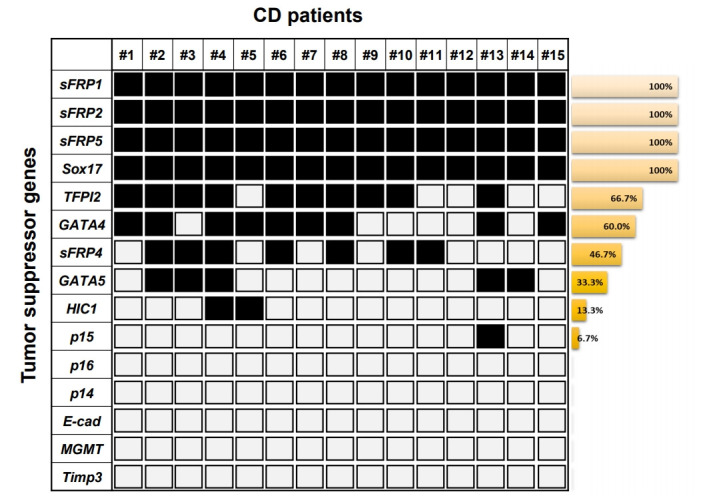
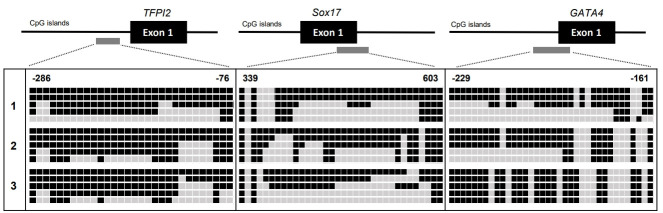
We found 6 TSGs (sFRP1, sFRP2, sFRP5, TFPI2, Sox17, and GATA4) are robustly hypermethylated in CD patient samples. Bisulfite sequencing analysis confirmed the methylation levels of the sFRP1, sFRP2, sFRP5, TFPI2, Sox17, and GATA4 promoters in the representative CD patient samples.
In this study, the promoter hypermethylation of the TSGs observed indicates that CD exhibits specific DNA methylation signatures with potential clinical applications for the noninvasive diagnosis of IBD and the prognosis for patients with IBD.
背景/目的:大量证据表明,炎症性肠病(IBD)是由多种基因与针对环境因素的异常表观遗传调控之间复杂的相互作用所引起。越来越明显的是,表观遗传因素与该疾病的发展显著相关。DNA甲基化仍然是研究最多的表观遗传修饰,基因启动子的高甲基化与基因沉默相关。
DNA甲基化改变可能通过调节外部和内部环境因素与基因转录表达之间的相互作用,促成许多复杂疾病的发展。在本研究中,我们使用最初在结肠癌中鉴定出的15个肿瘤抑制基因(TSG),来检测克罗恩病(CD)患者的启动子甲基化情况。进行甲基化特异性聚合酶链反应和亚硫酸氢盐测序分析,以评估CD患者中TSG的甲基化水平。
我们发现6个TSG(sFRP1、sFRP2、sFRP5、TFPI2、Sox17和GATA4)在CD患者样本中高度甲基化。亚硫酸氢盐测序分析证实了代表性CD患者样本中sFRP1、sFRP2、sFRP5、TFPI2、Sox17和GATA4启动子的甲基化水平。
在本研究中,观察到的TSG启动子高甲基化表明,CD呈现出特定的DNA甲基化特征,对IBD的无创诊断及IBD患者的预后具有潜在临床应用价值。