Cancer Institute, The Affiliated Hospital of Qingdao University, Qingdao, Shandong, China.
Innovative Drug Research and transformation platform, Qingdao Cancer Institute, Qingdao, Shandong, China.
Cancer Control. 2020 Jan-Dec;27(1):1073274820904694. doi: 10.1177/1073274820904694.
Gastric cancer is one of the most common malignant tumors worldwide, and for resectable tumors, the most effective treatment is surgery with chemotherapy in neoadjuvant or adjuvant setting. However, the majority of patients fail to achieve the ideal initial response and/or develop resistance to chemotherapy. It was reported that long noncoding RNA regulator of reprogramming (ROR) is highly associated with the progression of gastric cancer. However, the role ROR in multidrug resistance (MDR) remains unclear.
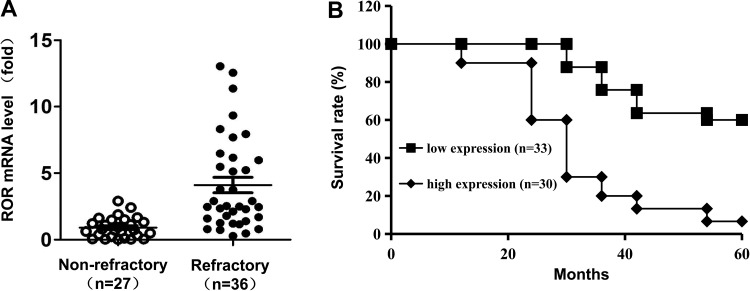
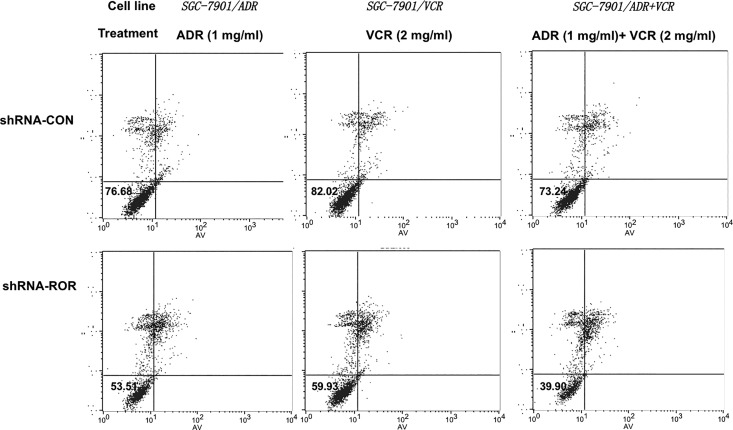
The messenger RNA levels of 63 specimens of patients with gastric cancer were determined by real-time polymerase chain reaction analysis and were correlated with drug resistance and survival of patients. To determine the cellular functions of ROR, we generated gastric cancer MDR cells. The effect of ROR depletion on multidrug resistance-associated protein 1 (MRP1) expression and cell apoptosis were examined by immunoblotting analyses, 3-(4,5-dimethylthiazol-2-yl)-2,5-diphenyltetrazolium bromide (MTT) assay, and flow cytometry.
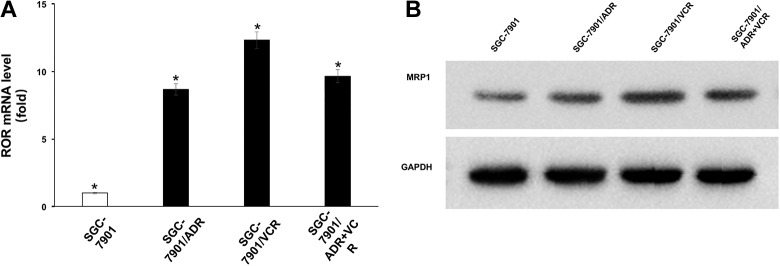
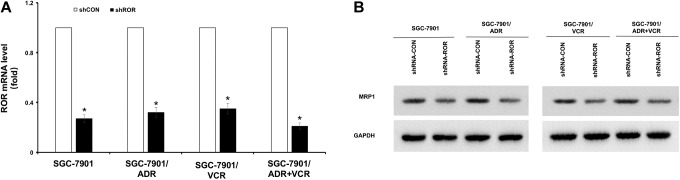
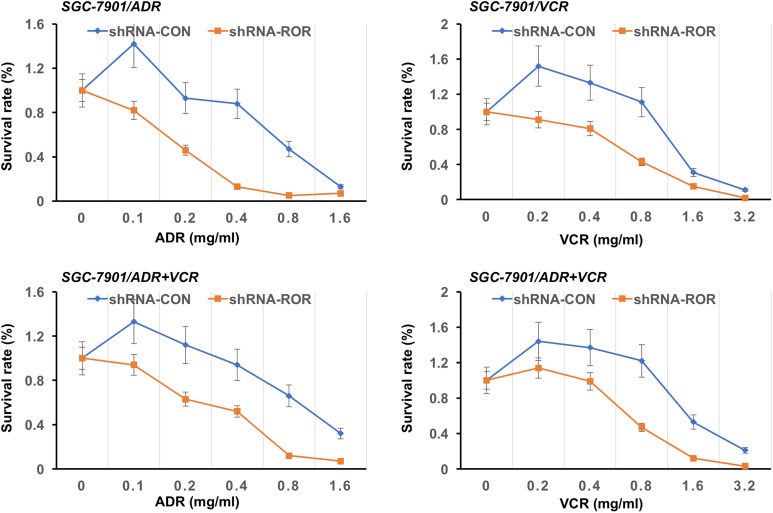
We found that ROR expression levels are positively associated with increased MDR and poor prognosis of patients with gastric cancer. Regulator of reprogramming expression is increased in gastric cancer cells resistant to adriamycin (ADR) and vincristine (VCR). Depletion of ROR reduced MRP1 expression and increased apoptosis of drug-resistant gastric cancer cells in response to ADR and VCR treatment.
We demonstrated that ROR expression promotes MRP1 expression and MDR of gastric cancer cells and is correlated with increased MDR and poor prognosis of patients with gastric cancer. Our finding highlighted the potential of targeting ROR to improve the efficacy of chemotherapy.
胃癌是全球最常见的恶性肿瘤之一,对于可切除的肿瘤,最有效的治疗方法是手术联合新辅助或辅助化疗。然而,大多数患者未能达到理想的初始反应和/或对化疗产生耐药性。有报道称,长链非编码 RNA 重编程调节因子(ROR)与胃癌的进展高度相关。然而,ROR 在多药耐药(MDR)中的作用尚不清楚。
通过实时聚合酶链反应分析测定 63 例胃癌患者标本的信使 RNA 水平,并与患者的耐药性和生存情况相关联。为了确定 ROR 的细胞功能,我们生成了胃癌多药耐药细胞。通过免疫印迹分析、3-(4,5-二甲基噻唑-2-基)-2,5-二苯基四氮唑溴盐(MTT)测定和流式细胞术检测 ROR 耗竭对多药耐药相关蛋白 1(MRP1)表达和细胞凋亡的影响。
我们发现 ROR 表达水平与胃癌患者的 MDR 增加和预后不良呈正相关。在对阿霉素(ADR)和长春新碱(VCR)耐药的胃癌细胞中,重编程表达调节剂的表达增加。ROR 耗竭降低了 MRP1 的表达,并增加了对 ADR 和 VCR 治疗有反应的耐药性胃癌细胞的凋亡。
我们证明了 ROR 表达促进了胃癌细胞中 MRP1 的表达和 MDR,并且与患者 MDR 增加和预后不良相关。我们的发现强调了靶向 ROR 以提高化疗疗效的潜力。