Department of Orthopaedic Surgery, Eastern Chiba Medical Center, 3-6-2 Okayamadai, Togane City, Chiba, 283-8686, Japan.
Department of Orthopaedic Surgery, Graduate School of Medicine, Chiba University, 1-8-1 Inohana, Chuo-ku, Chiba City, Chiba, 260-8670, Japan.
BMC Musculoskelet Disord. 2020 Feb 4;21(1):72. doi: 10.1186/s12891-020-3102-2.
Lumbar spinal disease causes disabilities in performing daily activities. Operative treatments are aimed at pain relief and rapid return to routine activity. Patient-based outcome measures are used to evaluate pathologies and therapeutic effects associated with lumbar spinal disease. Nevertheless, it remains unknown as to how much such treatment improves activity levels. The purpose of the current study was to measure changes in activity levels before and after lumbar spinal surgery using a wearable activity tracker and to analyze the differences between results and patient-based outcomes.
Sixty patients who underwent lumbar surgery were studied. The physical activity of participants was objectively evaluated using a wearable Micro-Motion logger system (Actigraph). We measured the amount of activity before and at 1, 3, 6, and 12 months after the surgery to evaluate postoperative changes. The Japanese Orthopaedic Association Back Pain Evaluation Questionnaire, Oswestry Disability Index, Roland-Morris Disability Questionnaire and visual analog scale were used to assess patient-based outcomes of pain and activities of daily living-related scores; we analyzed the relationships between scores and actual activity levels.
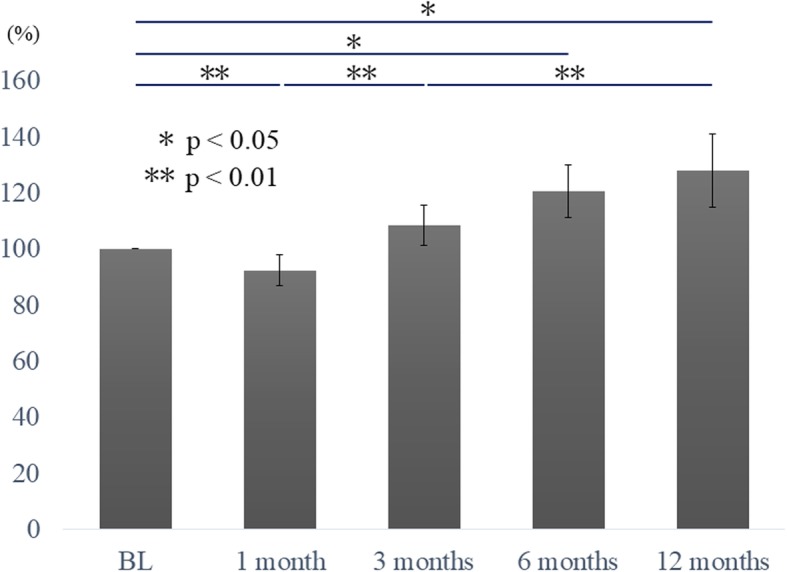
The amount of actual activity decreased significantly 1 month after the surgery compared to that during the preoperative period, which then improved after 3 months postoperatively (p < 0.01). Furthermore, there was a significant improvement 6 months after the surgery compared to that during the preoperative period (p < 0.05). The changes in activity for each period were strongly correlated, regardless of the period. In contrast, a significant improvement was observed at 1 month after the surgery in almost all items of the patient-based questionnaires (p < 0.05).
The objective activity tracker demonstrated that lumbar surgery results in the amount of activity decreasing 1 month just after surgery followed by gradual postoperative recovery within 3 months. By contrast, patient-based outcomes showed improvement in 1 month that was significantly different from the change in actual activity, indicating a gap between patient-oriented clinical scores and their actual activities.
腰椎疾病导致日常活动能力丧失。手术治疗的目的是缓解疼痛和快速恢复日常活动。基于患者的结果测量用于评估与腰椎疾病相关的病理学和治疗效果。然而,对于这种治疗能在多大程度上提高活动水平,目前仍不清楚。本研究的目的是使用可穿戴活动追踪器测量腰椎手术后活动水平的变化,并分析结果与基于患者的结果之间的差异。
研究了 60 例接受腰椎手术的患者。使用可穿戴 Micro-Motion 日志记录系统(Actigraph)客观评估参与者的身体活动。我们测量了手术前和手术后 1、3、6 和 12 个月的活动量,以评估术后变化。使用日本矫形协会腰痛评估问卷、Oswestry 残疾指数、Roland-Morris 残疾问卷和视觉模拟评分评估疼痛和日常生活活动相关评分的基于患者的结果;我们分析了评分与实际活动水平之间的关系。
与术前相比,术后 1 个月实际活动量显著减少,术后 3 个月后有所改善(p<0.01)。此外,与术前相比,术后 6 个月有显著改善(p<0.05)。无论在哪个时期,各时期的活动变化都呈强相关。相比之下,在术后 1 个月,基于患者的问卷中的几乎所有项目都有显著改善(p<0.05)。
客观活动追踪器表明,腰椎手术后 1 个月活动量减少,术后 3 个月内逐渐恢复。相比之下,基于患者的结果在 1 个月时显示出改善,与实际活动的变化有显著差异,表明患者导向的临床评分与其实际活动之间存在差距。