Department of Thoracic Surgery, Nanfang Hospital, Southern Medical University, No. 1838 of North Guangzhou Avenue, Guangzhou, 510515, People's Republic of China.
Harry Perkins Institute of Medical Research, QEII Medical Centre and Centre for Medical Research, The University of Western Australia, Nedlands, WA, 6009, Australia.
J Transl Med. 2020 Feb 4;18(1):55. doi: 10.1186/s12967-020-02233-y.
Tumour cells interfere with normal immune functions by affecting the expression of some immune-related genes, which play roles in the prognosis of cancer patients. In recent years, immunotherapy for tumours has been widely studied, but a practical prognostic model based on immune-related genes in lung adenocarcinoma comparable to existing model has not been established and reported.
We first obtained publicly accessible lung adenocarcinoma RNA expression data from The Cancer Genome Atlas (TCGA) for differential gene expression analysis and then filtered immune-related genes based on the ImmPort database. By using the lasso algorithm and multivariate Cox Proportional-Hazards (CoxPH) regression analysis, we identified candidate genes for model development and validation. The robustness of the model was further examined by comparing the model with three established gene models.
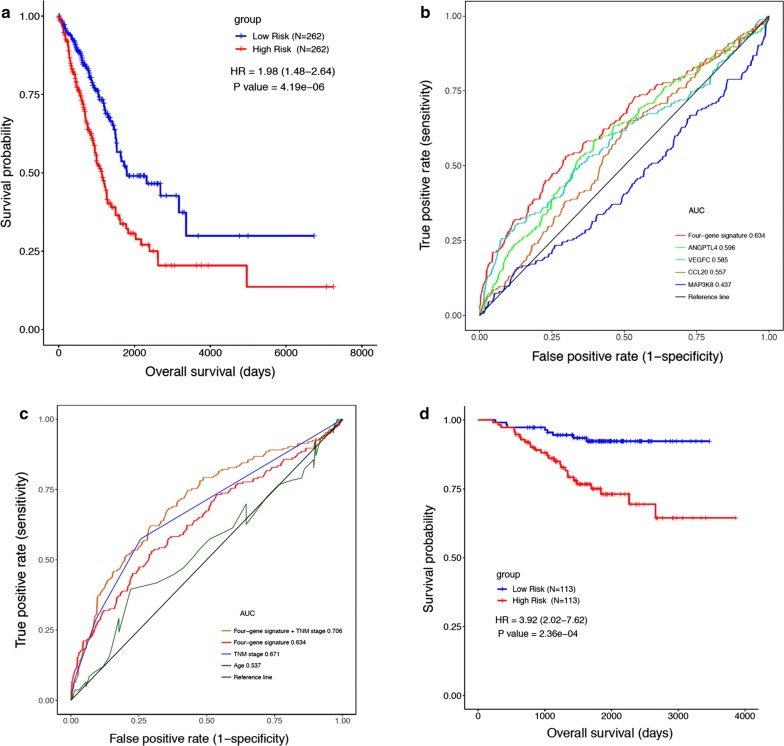
Gene expression data from a total of 524 lung adenocarcinoma patients from TCGA were used for model development. We identified four biomarkers (MAP3K8, CCL20, VEGFC, and ANGPTL4) that could predict overall survival in lung adenocarcinoma (HR = 1.98, 95% CI 1.48 to 2.64, P = 4.19e-06) and this model could be used as a classifier for the evaluation of low-risk and high-risk groups. This model was validated with independent microarray data and was highly comparable with previously reported gene expression signatures for lung adenocarcinoma prognosis.
In this study, we identified a practical and robust four-gene prognostic model based on an immune gene dataset with cross-platform compatibility. This model has potential value in improving TNM staging for survival predictions in patients with lung adenocarcinoma.
The study provides a method of immune relevant gene prognosis model and the identification of immune gene classifier for the prediction of lung adenocarcinoma prognosis with RNA sequencing and microarray compatibility.
肿瘤细胞通过影响某些免疫相关基因的表达来干扰正常免疫功能,这些基因在癌症患者的预后中发挥作用。近年来,肿瘤的免疫治疗受到了广泛的研究,但尚未建立和报道一种基于肺腺癌免疫相关基因的、与现有模型相当的实用预后模型。
我们首先从癌症基因组图谱(TCGA)中获取可公开获取的肺腺癌 RNA 表达数据,进行差异基因表达分析,然后根据 ImmPort 数据库筛选免疫相关基因。通过使用套索算法和多变量 Cox 比例风险(CoxPH)回归分析,我们确定了候选基因用于模型的开发和验证。通过将该模型与三个已建立的基因模型进行比较,进一步检验了该模型的稳健性。
我们使用来自 TCGA 的总共 524 名肺腺癌患者的基因表达数据进行模型开发。我们确定了四个生物标志物(MAP3K8、CCL20、VEGFC 和 ANGPTL4),它们可以预测肺腺癌的总生存率(HR=1.98,95%CI 为 1.48 至 2.64,P=4.19e-06),并且该模型可作为评估低风险和高风险组的分类器。我们使用独立的微阵列数据验证了该模型,该模型与先前报道的肺腺癌预后基因表达特征高度可比。
在这项研究中,我们基于具有跨平台兼容性的免疫基因数据集,确定了一种实用且稳健的四基因预后模型。该模型具有提高肺腺癌生存预测的 TNM 分期的潜在价值。
本研究提供了一种基于 RNA 测序和微阵列兼容性的免疫相关基因预后模型和免疫基因分类器的识别方法,用于预测肺腺癌的预后。