Ghimire Sudeep, Roy Chayan, Wongkuna Supapit, Antony Linto, Maji Abhijit, Keena Mitchel Chan, Foley Andrew, Scaria Joy
Department of Veterinary and Biomedical Sciences, South Dakota State University, Brookings, South Dakota, USA.
South Dakota Center for Biologics Research and Commercialization, Brookings, South Dakota, USA.
mSystems. 2020 Feb 4;5(1):e00620-19. doi: 10.1128/mSystems.00620-19.
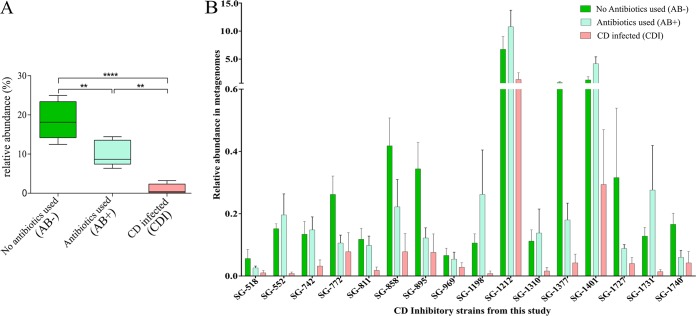
A major function of the gut microbiota is to provide colonization resistance, wherein pathogens are inhibited or suppressed below infectious levels. However, the fraction of gut microbiota required for colonization resistance remains unclear. We used culturomics to isolate a gut microbiota culture collection comprising 1,590 isolates belonging to 102 species. This culture collection represents 34.57% of the taxonomic diversity and 70% functional capacity, as estimated by metagenomic sequencing of the fecal samples used for culture. Using whole-genome sequencing, we characterized species representatives from this collection and predicted their phenotypic traits, further characterizing isolates by defining nutrient utilization profiles and short-chain fatty acid production. When screened with a coculture assay, 66 species in our culture collection inhibited Several phenotypes, particularly, growth rate, production of SCFAs, and the utilization of mannitol, sorbitol, or succinate, correlated with inhibition. We used a combinatorial community assembly approach to formulate defined bacterial mixes inhibitory to We tested 256 combinations and found that both species composition and blend size were important in inhibition. Our results show that the interaction of bacteria with one another in a mix and with other members of gut commensals must be investigated to design defined bacterial mixes for inhibiting Antibiotic treatment causes instability of gut microbiota and the loss of colonization resistance, thus allowing pathogens such as to colonize and causing recurrent infection and mortality. Although fecal microbiome transplantation has been shown to be an effective treatment for infection (CDI), a more desirable approach would be the use of a defined mix of inhibitory gut bacteria. The -inhibiting species and bacterial combinations identified herein improve the understanding of the ecological interactions controlling colonization resistance against and could aid in the design of defined bacteriotherapy as a nonantibiotic alternative against CDI.
肠道微生物群的一个主要功能是提供定植抗性,即病原体被抑制或抑制到感染水平以下。然而,定植抗性所需的肠道微生物群比例仍不清楚。我们使用培养组学方法分离出一个肠道微生物群培养物集合,其中包括属于102个物种的1590个分离株。根据用于培养的粪便样本的宏基因组测序估计,这个培养物集合代表了34.57%的分类多样性和70%的功能能力。通过全基因组测序,我们对该集合中的物种代表进行了表征,并预测了它们的表型特征,通过定义营养利用谱和短链脂肪酸产生进一步表征分离株。当用共培养试验进行筛选时,我们培养物集合中的66个物种抑制了几种表型,特别是生长速率、短链脂肪酸的产生以及甘露醇、山梨醇或琥珀酸盐的利用,这些表型与抑制作用相关。我们使用组合群落组装方法来配制对具有抑制作用的特定细菌混合物。我们测试了256种组合,发现物种组成和混合大小在抑制作用中都很重要。我们的结果表明,必须研究混合物中细菌之间以及与肠道共生菌其他成员之间的相互作用,以设计出抑制的特定细菌混合物。抗生素治疗会导致肠道微生物群不稳定和定植抗性丧失,从而使诸如艰难梭菌等病原体得以定植并导致反复感染和死亡。尽管粪便微生物群移植已被证明是治疗艰难梭菌感染(CDI)的有效方法,但更理想的方法是使用特定的抑制性肠道细菌混合物。本文鉴定出的抑制艰难梭菌的物种和细菌组合,增进了我们对控制针对艰难梭菌定植抗性生态相互作用的理解,并有助于设计特定的细菌疗法作为对抗CDI的非抗生素替代方法。