Rodriguez-Gonzalez Rogelio A, Leung Chung Yin, Chan Benjamin K, Turner Paul E, Weitz Joshua S
Interdisciplinary Graduate Program in Quantitative Biosciences, Georgia Institute of Technology, Atlanta, Georgia, USA.
School of Biological Sciences, Georgia Institute of Technology, Atlanta, Georgia, USA.
mSystems. 2020 Feb 4;5(1):e00756-19. doi: 10.1128/mSystems.00756-19.
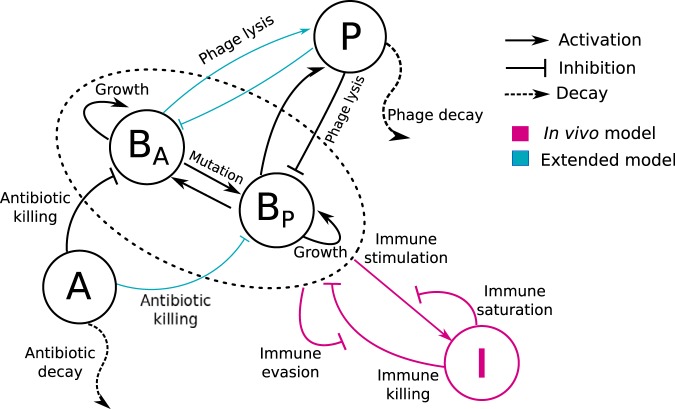
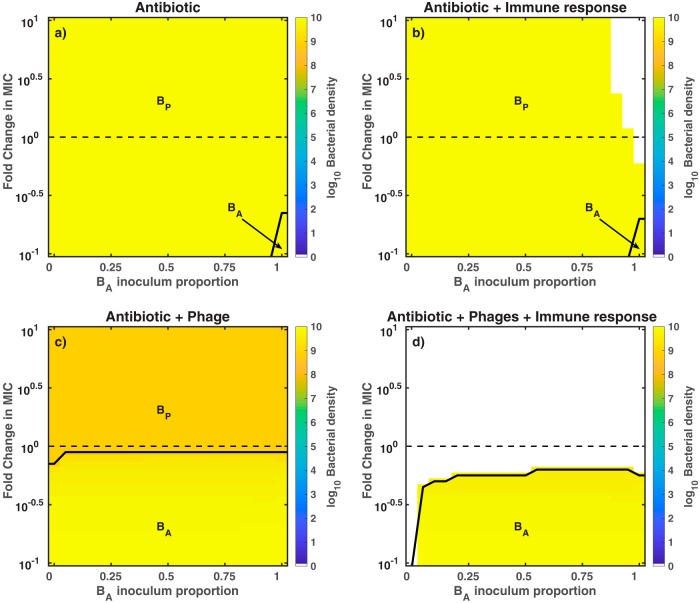
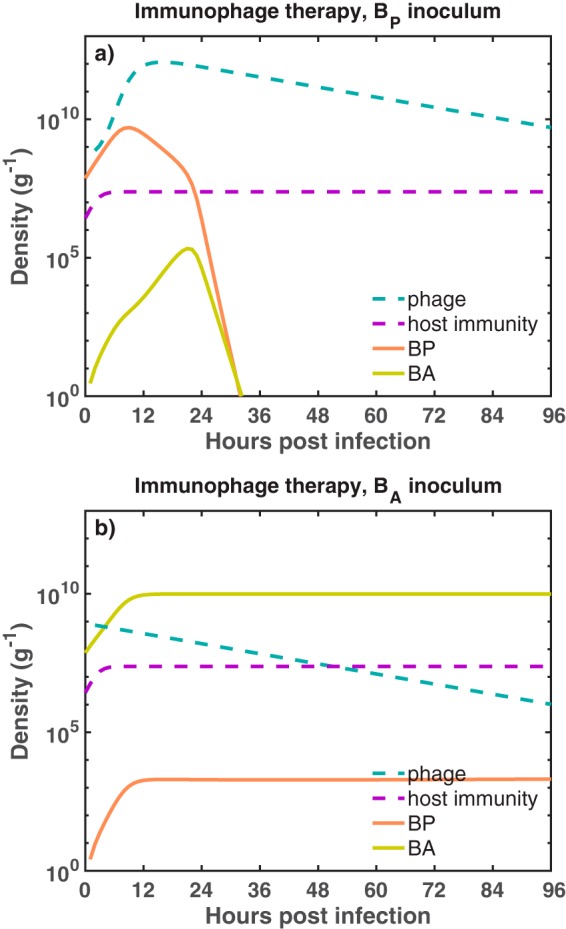
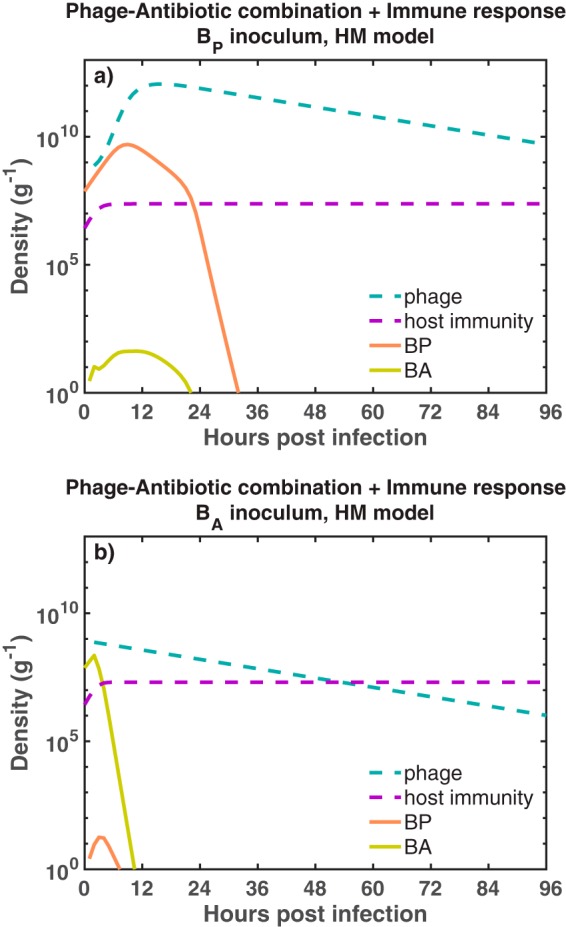
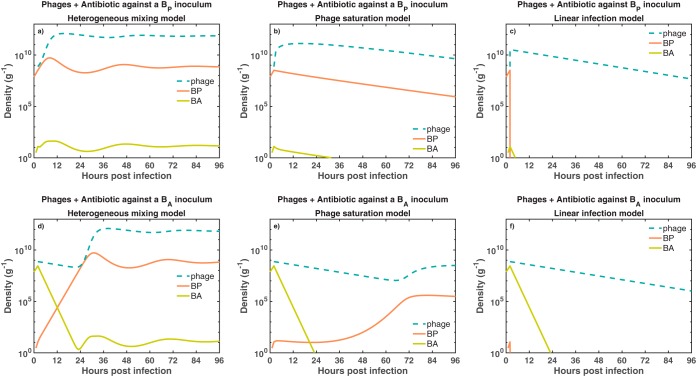
The spread of multidrug-resistant (MDR) bacteria is a global public health crisis. Bacteriophage therapy (or "phage therapy") constitutes a potential alternative approach to treat MDR infections. However, the effective use of phage therapy may be limited when phage-resistant bacterial mutants evolve and proliferate during treatment. Here, we develop a nonlinear population dynamics model of combination therapy that accounts for the system-level interactions between bacteria, phage, and antibiotics for application given an immune response against bacteria. We simulate the combination therapy model for two strains of , one which is phage sensitive (and antibiotic resistant) and one which is antibiotic sensitive (and phage resistant). We find that combination therapy outperforms either phage or antibiotic alone and that therapeutic effectiveness is enhanced given interaction with innate immune responses. Notably, therapeutic success can be achieved even at subinhibitory concentrations of antibiotics, e.g., ciprofloxacin. These findings provide further support to the nascent application of combination therapy to treat MDR bacterial infections, while highlighting the role of innate immunity in shaping therapeutic outcomes. This work develops and analyzes a novel model of phage-antibiotic combination therapy, specifically adapted to an context. The objective is to explore the underlying basis for clinical application of combination therapy utilizing bacteriophage that target antibiotic efflux pumps in In doing so, the paper addresses three key questions. How robust is combination therapy to variation in the resistance profiles of pathogens? What is the role of immune responses in shaping therapeutic outcomes? What levels of phage and antibiotics are necessary for curative success? As we show, combination therapy outperforms either phage or antibiotic alone, and therapeutic effectiveness is enhanced given interaction with innate immune responses. Notably, therapeutic success can be achieved even at subinhibitory concentrations of antibiotic. These findings provide further support to the nascent application of combination therapy to treat MDR bacterial infections, while highlighting the role of system-level feedbacks in shaping therapeutic outcomes.
多重耐药(MDR)细菌的传播是一场全球公共卫生危机。噬菌体疗法(或“噬菌疗法”)构成了一种治疗MDR感染的潜在替代方法。然而,当噬菌体抗性细菌突变体在治疗过程中进化和增殖时,噬菌体疗法的有效使用可能会受到限制。在这里,我们开发了一种联合疗法的非线性种群动力学模型,该模型考虑了细菌、噬菌体和抗生素之间的系统水平相互作用,用于在存在针对细菌的免疫反应的情况下进行应用。我们模拟了两种菌株的联合疗法模型,一种对噬菌体敏感(但对抗生素耐药),另一种对抗生素敏感(但对噬菌体耐药)。我们发现联合疗法优于单独使用噬菌体或抗生素,并且与先天免疫反应相互作用时治疗效果会增强。值得注意的是,即使在抗生素亚抑制浓度(例如环丙沙星)下也能实现治疗成功。这些发现为联合疗法治疗MDR细菌感染的新兴应用提供了进一步支持,同时突出了先天免疫在塑造治疗结果中的作用。这项工作开发并分析了一种新型的噬菌体 - 抗生素联合疗法模型,特别适用于特定背景。目的是探索利用靶向抗生素外排泵的噬菌体进行联合疗法临床应用的潜在基础。在此过程中,本文解决了三个关键问题。联合疗法对病原体耐药谱变化的稳健性如何?免疫反应在塑造治疗结果中起什么作用?治愈成功所需的噬菌体和抗生素水平是多少?正如我们所展示的,联合疗法优于单独使用噬菌体或抗生素,并且与先天免疫反应相互作用时治疗效果会增强。值得注意的是,即使在抗生素亚抑制浓度下也能实现治疗成功。这些发现为联合疗法治疗MDR细菌感染的新兴应用提供了进一步支持,同时突出了系统水平反馈在塑造治疗结果中的作用。