Enteric Virus Laboratory, Department of Genetics, Microbiology and Statistics, University of Barcelona, Barcelona, Spain.
Nutrition and Food Safety Research Institute (INSA·UB), University of Barcelona, Barcelona, Spain.
Sci Rep. 2020 Feb 4;10(1):1760. doi: 10.1038/s41598-020-58691-3.
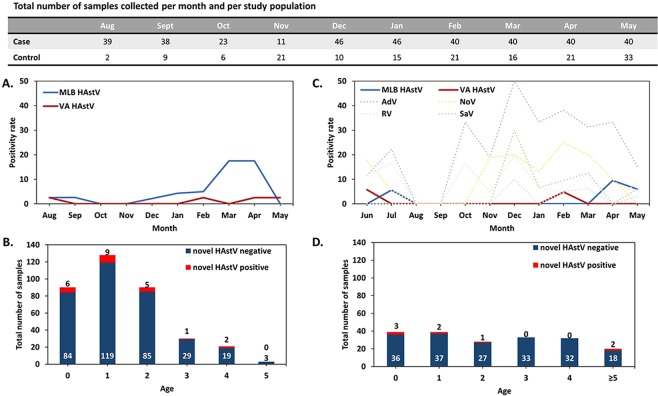
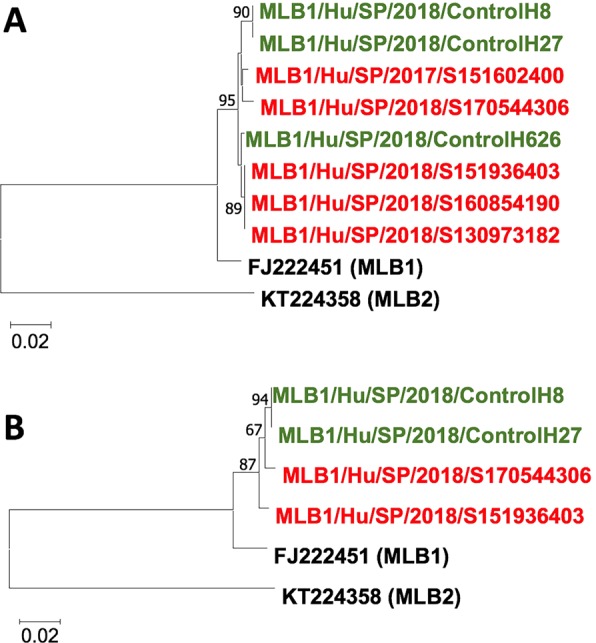
Novel human astroviruses (HAstV) were discovered 10 years ago and have been associated with fatal cases of central nervous system infections. Their role in gastroenteritis is controversial, as they have been identified in symptomatic and asymptomatic subjects. The aim of the study was to investigate novel HAstV in a gastroenteritis case-control study including a pediatric population in Spain over a one-year period. We included stool samples from patients with gastroenteritis and negative results for viruses screened by routine diagnostics, and stool samples of control subjects who sought for a routine medical consultation. All samples were screened by real-time RT-PCR assays for novel HAstV. An additional screening for rotavirus, norovirus GI, GII, sapovirus, classic HAstV and adenovirus was also performed for the control group. Overall, 23/363 stool samples from case patients (6.3%) and 8/199 stool samples from control patients (4%) were positive for ≥1 novel HAstV. MLB1 was predominant (64.5% of positives). Seasonality was observed for the case group (p = 0.015), but not the control group (p = 0.95). No difference was observed in the prevalence of novel HAstV between the case and control groups (OR 1.78, 95% CI 0.68-5.45; p = 0.30). Nevertheless, MLB genome copy numbers/ml of fecal suspension was significantly higher in the control group than in the case group (p = 0.008). In our study, we identified a lack of association between novel HAstV and gastroenteritis in the studied population, which could indicate a potential role of reservoir for children, especially given the higher viral load observed in the asymptomatic group for some of them.
新型人类星状病毒(HAstV)于 10 年前被发现,与致命的中枢神经系统感染有关。它们在胃肠炎中的作用存在争议,因为在有症状和无症状的患者中都发现了它们。本研究的目的是在包括西班牙儿科人群的胃肠炎病例对照研究中调查新型 HAstV。我们纳入了胃肠炎患者的粪便样本,这些患者的病毒检测结果为常规诊断阴性,以及寻求常规医疗咨询的对照患者的粪便样本。所有样本均通过实时 RT-PCR 检测新型 HAstV。对照组还进行了轮状病毒、诺如病毒 GI、GII、肠病毒、经典 HAstV 和腺病毒的额外筛查。总体而言,363 例病例患者的 23/粪便样本(6.3%)和 199 例对照患者的 8/粪便样本(4%)对≥1 种新型 HAstV 呈阳性。MLB1 占优势(阳性标本的 64.5%)。病例组有季节性(p=0.015),但对照组无季节性(p=0.95)。病例组和对照组之间新型 HAstV 的检出率无差异(OR 1.78,95%CI 0.68-5.45;p=0.30)。然而,粪便悬浮液中 MLB 基因组拷贝数/ml 在对照组中显著高于病例组(p=0.008)。在本研究中,我们发现新型 HAstV 与研究人群的胃肠炎之间缺乏关联,这可能表明它们对儿童具有潜在的储库作用,特别是鉴于其中一些无症状组的病毒载量更高。