Nanfang Hospital, Southern Medical University, Guangzhou, China.
Department of Cardiology, The Sencond Affiliated Hospital and Yuying Children's Hospital of Wenzhou Medical University, Wenzhou, China.
Clin Exp Pharmacol Physiol. 2020 Jul;47(7):1182-1192. doi: 10.1111/1440-1681.13271. Epub 2020 Mar 23.
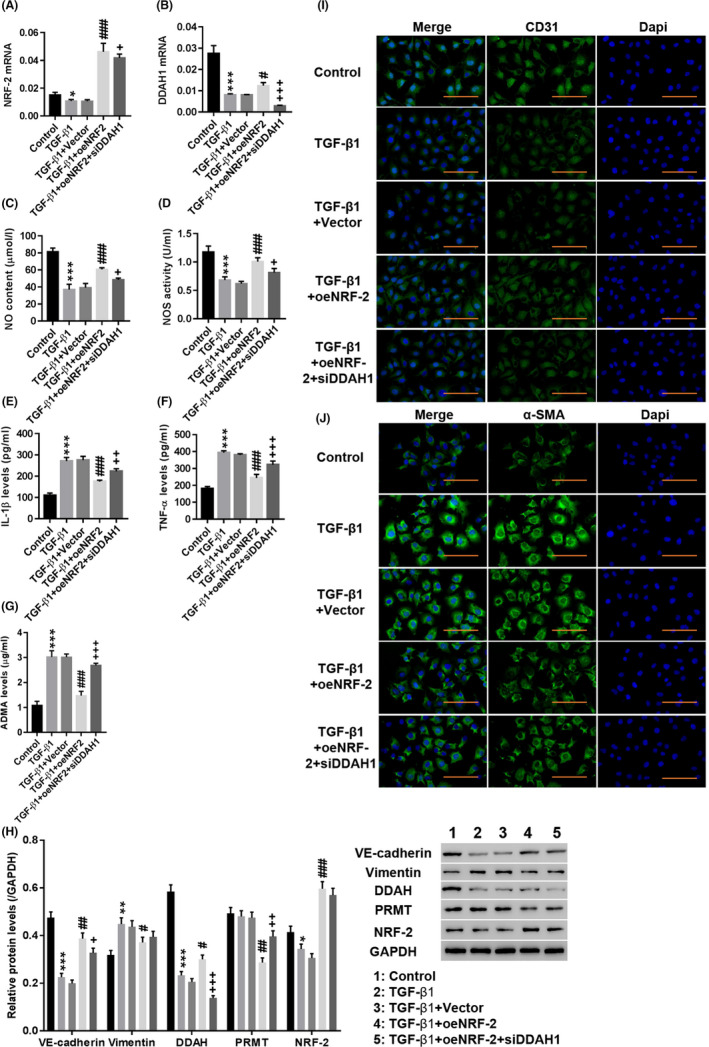
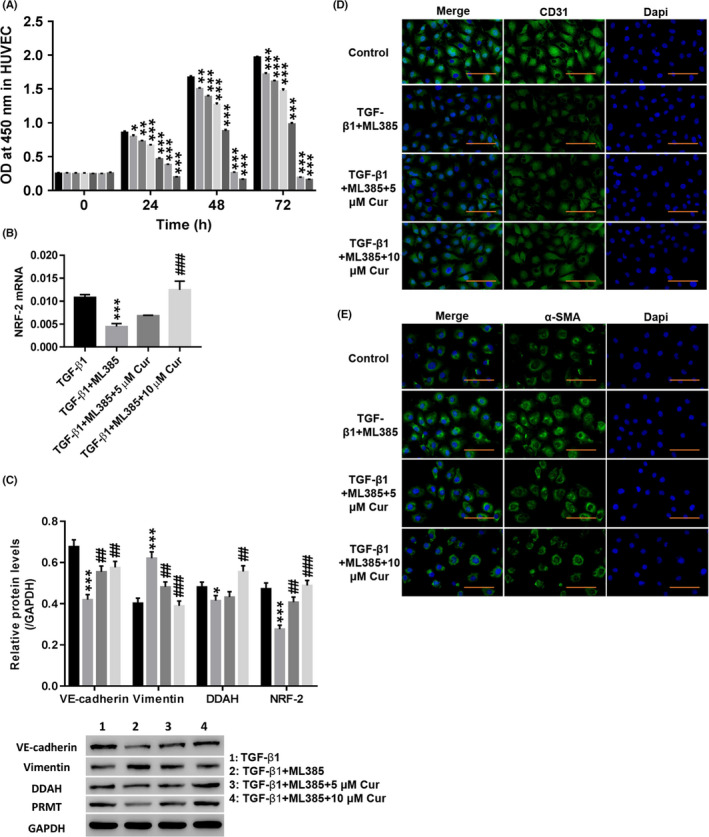
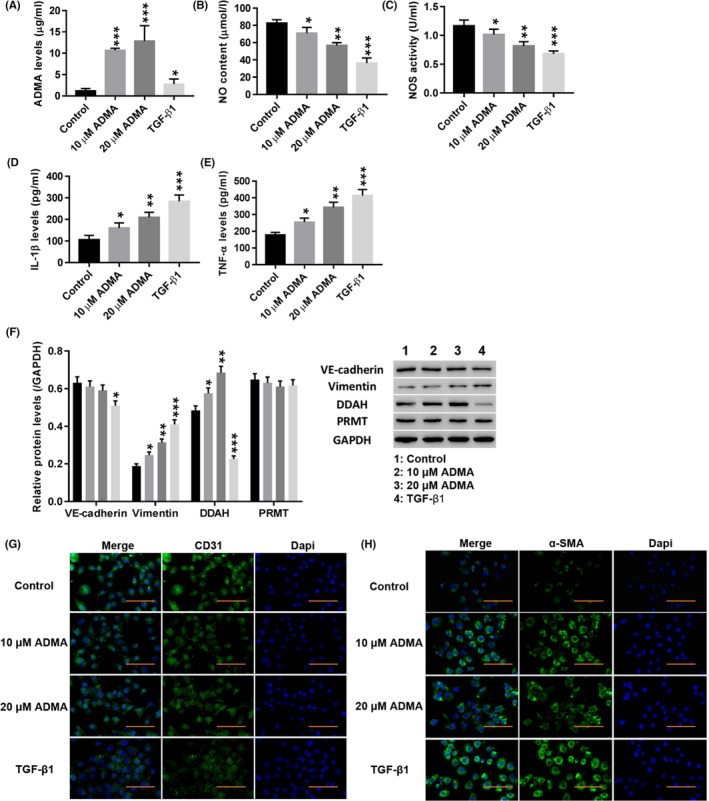
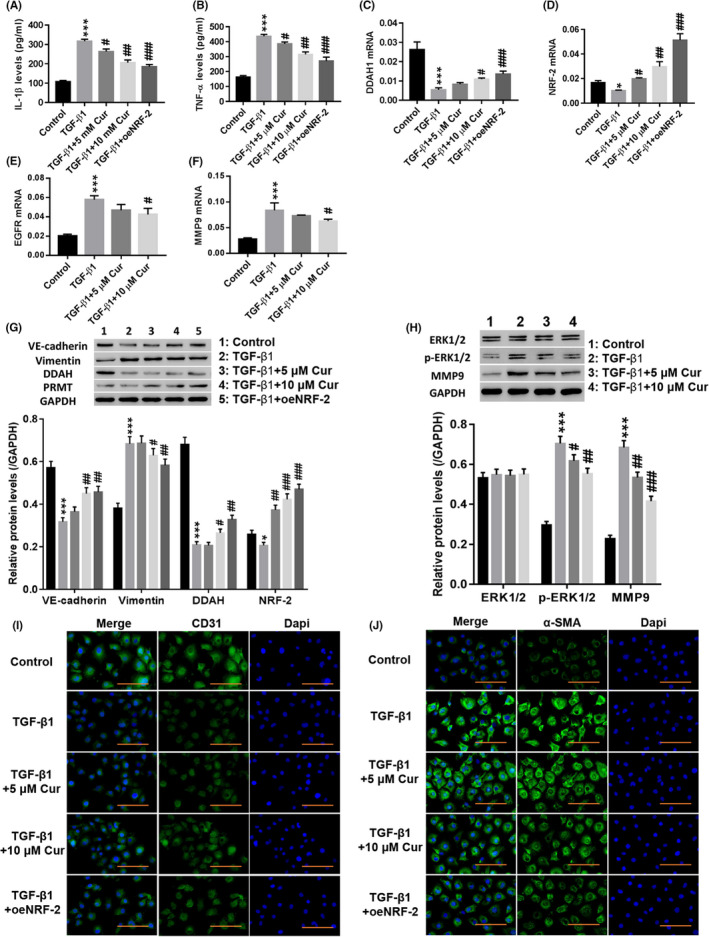
Curcumin (Cur) has various pharmacological activities, including anti-inflammatory, antiapoptotic and anticancer effects. However, there is no report on the effect of Cur on endothelial cell fibrosis. This study was designed to investigate the effect and mechanism of Cur on endothelial cell fibrosis. An endothelial cell fibrosis model was established by using transforming growth factor (TGF) induction. Proliferation assays, qRT-PCR, western blotting and immunostaining were performed to investigate the effects and mechanism of Cur on endothelial cell fibrosis. We found that in human umbilical vein endothelial cells (HUVECs), TGF-β1 treatment significantly decreased the expression of nuclear factor erythroid-2-related factor 2 (NRF-2), dimethylarginine dimethylaminohydrolase-1 (DDAH1), and VE-cadherin, the secretion of cellular nitric oxide (NO) and the activity of nitrous oxide synthase (NOS), while asymmetric dimethylarginine (ADMA) and the release of inflammatory factors were elevated. Immunofluorescence showed decreased CD31 and increased α-smooth muscle actin (α-SMA). Overexpression of NRF-2 significantly attenuated the effects of TGF-β1, while downregulation of DDAH1 potently counteracted the effect of NRF-2. In addition, ADMA treatment resulted in similar results to those of TGF-β1, and Cur significantly attenuated the effect of TGF-β1, accompanied by increased VE-cadherin, DDAH1 and NRF-2 and decreased matrix metalloproteinase-9 (MMP-9) and extracellular regulated protein kinases 1/2 (ERK1/2) phosphorylation. The NRF-2 inhibitor ML385 had the opposite effect as that of Cur. These results demonstrated that Cur inhibits TGF-β1-induced endothelial-to-mesenchymal transition (EndMT) by stimulating DDAH1 expression via the NRF-2 pathway, thus attenuating endothelial cell fibrosis.
姜黄素(Cur)具有多种药理活性,包括抗炎、抗凋亡和抗癌作用。然而,目前尚无关于姜黄素对内皮细胞纤维化影响的报道。本研究旨在探讨姜黄素对内皮细胞纤维化的作用及其机制。通过转化生长因子(TGF)诱导建立内皮细胞纤维化模型,进行增殖实验、qRT-PCR、Western blot 和免疫染色,以研究姜黄素对内皮细胞纤维化的作用和机制。我们发现,在人脐静脉内皮细胞(HUVECs)中,TGF-β1 处理显著降低核因子红细胞 2 相关因子 2(NRF-2)、二甲基精氨酸二甲氨基水解酶 1(DDAH1)和血管内皮钙黏蛋白(VE-cadherin)的表达、细胞一氧化氮(NO)的分泌和一氧化氮合酶(NOS)的活性,同时增加不对称二甲基精氨酸(ADMA)和炎症因子的释放。免疫荧光显示 CD31 减少,α-平滑肌肌动蛋白(α-SMA)增加。NRF-2 的过表达显著减弱了 TGF-β1 的作用,而 DDAH1 的下调则强烈拮抗了 NRF-2 的作用。此外,ADMA 处理的结果与 TGF-β1 相似,姜黄素显著减弱了 TGF-β1 的作用,同时增加了 VE-cadherin、DDAH1 和 NRF-2,减少了基质金属蛋白酶 9(MMP-9)和细胞外调节蛋白激酶 1/2(ERK1/2)磷酸化。NRF-2 抑制剂 ML385 的作用与姜黄素相反。这些结果表明,姜黄素通过刺激 NRF-2 通路增加 DDAH1 的表达,抑制 TGF-β1 诱导的内皮-间充质转化(EndMT),从而减轻内皮细胞纤维化。