Division of Nephrology, Department of Internal Medicine, Gangnam Severance Hospital, Yonsei University College of Medicine, Seoul, Korea.
Department of Internal Medicine, Institute of Kidney Disease Research, Severance Hospital, Yonsei University College of Medicine, Seoul, Korea.
J Cachexia Sarcopenia Muscle. 2020 Jun;11(3):726-734. doi: 10.1002/jcsm.12549. Epub 2020 Feb 5.
Obesity, a known risk factor for chronic kidney disease (CKD), is generally assessed using body mass index (BMI). However, BMI may not effectively reflect body composition, and the impact of muscle-to-fat (MF) mass balance on kidney function has not been elucidated. This study evaluated the association between body muscle and fat mass balance, represented as the MF ratio, and incident CKD development.
Data were retrieved from a prospective community-based cohort study (Korean Genome and Epidemiology Study). Muscle and fat mass were measured using multifrequency bioelectrical impedance analysis. The study endpoint was incident CKD (estimated glomerular filtration rate <60 mL/min/1.73 m in at least two or more consecutive measurements during the follow-up period).
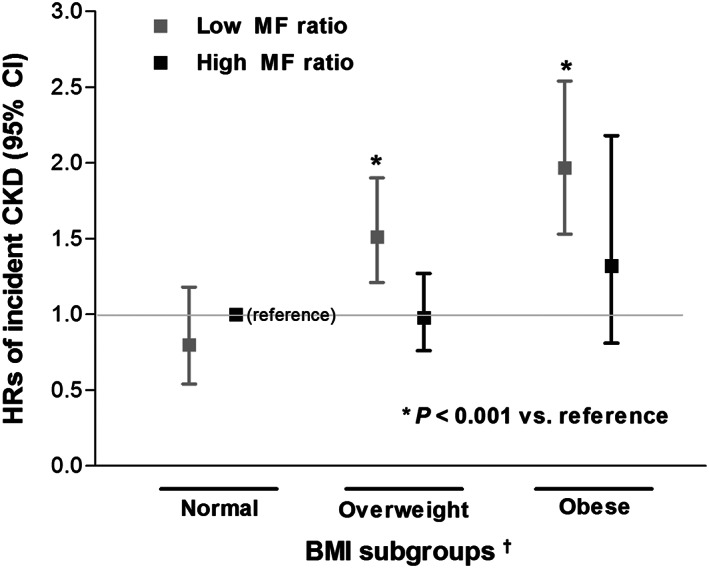
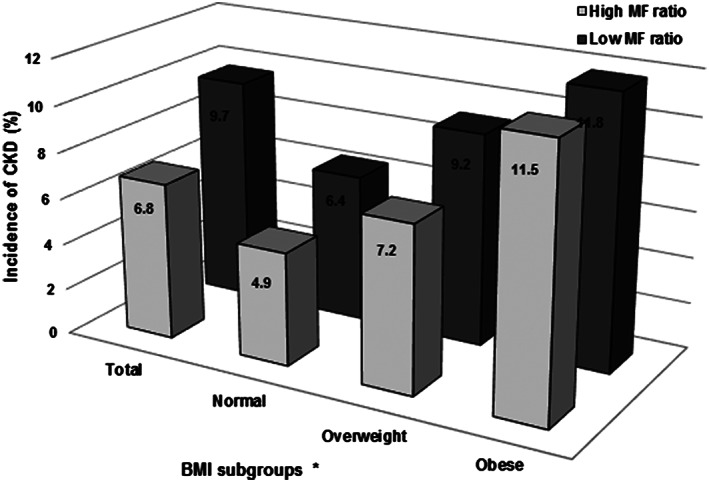
Totally, 7682 participants were evaluated. Their mean age was 51.7 ± 8.7 years, and 48% of the subjects were men. During a median follow-up of 140.0 (70.0-143.0) months, 633 (8.2%) subjects developed incident CKD. When the association between body composition and incident CKD was investigated, multivariable Cox proportional hazard analysis revealed that increase in MF ratio was related with a decreased risk of CKD development [per 1 increase in MF ratio: hazard ratio (HR), 0.86; 95% confidence interval (CI), 0.77-0.96; P = 0.008]. This association was also maintained when MF ratio was dichotomized according to sex-specific median values (high vs. low: HR, 0.83; 95% CI, 0.70-0.98; P = 0.031). Analyses preformed in a propensity score matched group also revealed a similar decreased risk of incident CKD in high MF ratio participants (high vs. low: HR, 0.84; 95% CI, 0.71-0.98; P = 0.037). This relationship between MF ratio and incident CKD risk was consistently significant across subgroups stratified by age, sex, hypertension, estimated glomerular filtration rate categories, and proteinuria. Among different BMI groups (normal, overweight, and obese), the relationship between high MF ratio and lower incident CKD risk was significant only in overweight and obese subjects.
Lower fat mass relative to muscle mass may lower the risk of CKD development in individuals with normal renal function. This relationship seems more prominent in overweight and obese subjects than in normal weight subjects.
肥胖是慢性肾脏病(CKD)的已知危险因素,通常使用体重指数(BMI)进行评估。然而,BMI 可能无法有效地反映身体成分,肌肉与脂肪(MF)质量平衡对肾功能的影响尚未阐明。本研究评估了身体肌肉和脂肪质量平衡,表现为 MF 比值与新发 CKD 发展之间的关系。
数据来自一项前瞻性社区为基础的队列研究(韩国基因组和流行病学研究)。使用多频生物电阻抗分析测量肌肉和脂肪质量。研究终点为新发 CKD(在随访期间至少两次或更多次连续测量中,估计肾小球滤过率 <60 mL/min/1.73 m )。
共评估了 7682 名参与者。他们的平均年龄为 51.7 ± 8.7 岁,48%的受试者为男性。在中位随访 140.0(70.0-143.0)个月期间,633 名(8.2%)受试者发生新发 CKD。当研究身体成分与新发 CKD 的关系时,多变量 Cox 比例风险分析显示,MF 比值增加与 CKD 发展风险降低相关[每增加 1 的 MF 比值:风险比(HR),0.86;95%置信区间(CI),0.77-0.96;P = 0.008]。当根据性别特异性中位数将 MF 比值分为两组时,这种关联仍然存在(高 vs. 低:HR,0.83;95%CI,0.70-0.98;P = 0.031)。在倾向评分匹配组中进行的分析也显示,MF 比值较高的参与者发生新发 CKD 的风险也有类似的降低(高 vs. 低:HR,0.84;95%CI,0.71-0.98;P = 0.037)。MF 比值与新发 CKD 风险之间的关系在按年龄、性别、高血压、估计肾小球滤过率类别和蛋白尿分层的亚组中始终显著。在不同的 BMI 组(正常、超重和肥胖)中,只有在超重和肥胖人群中,高 MF 比值与较低的新发 CKD 风险之间存在显著关系。
与肌肉相比,脂肪质量减少可能会降低肾功能正常人群发生 CKD 的风险。这种关系在超重和肥胖人群中似乎比在正常体重人群中更为明显。