
稳定期慢性阻塞性肺疾病患者股四头肌收缩指数的超声评估:与临床症状、疾病严重程度和膈肌收缩力的关系。
Ultrasound Evaluation of the Quadriceps Muscle Contractile Index in Patients with Stable Chronic Obstructive Pulmonary Disease: Relationships with Clinical Symptoms, Disease Severity and Diaphragm Contractility.
机构信息
Centre Hospitalier de l'Université de Montréal (CHUM), Montreal, Quebec, Canada.
Centre Hospitalier de l'Université de Montréal (CHUM), Department of Medicine, Respiratory Medicine Division, Montreal, Quebec, Canada.
出版信息
Int J Chron Obstruct Pulmon Dis. 2020 Jan 9;15:79-88. doi: 10.2147/COPD.S222945. eCollection 2020.
RATIONALE
Chronic obstructive pulmonary disease (COPD) is associated with changes in the composition and function of peripheral and respiratory muscles, which can negatively impact quality of life. Ultrasonography can provide a non-invasive evaluation of the integrity of both peripheral muscles and diaphragm, but its use in patients with COPD is still being investigated. We aimed at evaluating the relationship between quadriceps size, using ultrasonography and symptoms, lung function and diaphragm contractility in a cohort of patients with COPD.
METHODS
COPD patients were prospectively recruited and ultrasonography of the dominant quadriceps and of the diaphragm was performed. Quadriceps size was evaluated using three measurements: 1) cross-sectional area of the rectus femoris (Qcsa), 2) thickness (Qthick) and 3) contractile index (Qci), defined as the ratio of quadriceps thickness/total anterior thigh thickness. Diaphragm contractility was evaluated using thickening fraction (TFdi). Clinical characteristics and number of moderate-to-severe exacerbations in the previous year were retrieved from medical files. Dyspnea (mMRC scale) and disease impact on health status (COPD Assessment Test (CAT)) were measured at inclusion. Fat-free mass index (FFMI) was assessed using bioelectrical impedance.
RESULTS
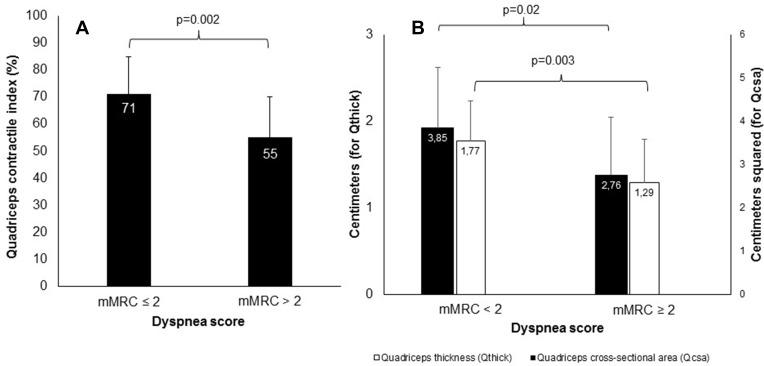
Forty patients were recruited (20 males, mean age and FEV 66±6 years and 49±17%predicted, respectively). Mean Qcsa, Qthick and Qci were 336±145 mm, 1.55±0.53 cm and 64±16%, respectively, and mean TFdi was 91±36%. Qci was significantly correlated with FFMI (rho=0.59, p=0.001), TFdi (rho=0.41, p=0.008), FEV (rho=0.43, p=0.001) but not with age (rho=0.18, p=0.28). Qci was significantly correlated to CAT score (rho=-0.47, p=0.002), even when controlled for FEV, and was lower in patients with an mMRC score ≥2 (55±15 vs 70±14%, p=0.002). Qcsa and Qci were significantly lower in patients with frequent exacerbations. In a multiple linear regression analysis that included age, gender, FFMI, FEV and TFdi, only FFMI and TFdi were found to be significantly related to lower Qci values.
CONCLUSION
In patients with COPD, ultrasound evaluation of the quadriceps contractile index is feasible and related to disease severity, clinical symptoms, exacerbation history and diaphragm contractility. As such, it may provide a novel tool for the evaluation of the severity and burden of the disease in this population. Further studies are required to better delineate its potential role as a prognostic marker in this population.
背景
慢性阻塞性肺疾病(COPD)与外周和呼吸肌的组成和功能变化有关,这会对生活质量产生负面影响。超声检查可提供外周肌肉和横膈膜完整性的非侵入性评估,但在 COPD 患者中的应用仍在研究中。我们旨在评估 COPD 患者中股四头肌大小、超声检查与症状、肺功能和横膈膜收缩力之间的关系。
方法
前瞻性招募 COPD 患者,并对其优势股四头肌和横膈膜进行超声检查。使用三种测量方法评估股四头肌大小:1)股直肌的横截面积(Qcsa),2)厚度(Qthick)和 3)收缩指数(Qci),定义为股四头肌厚度/整个前大腿厚度的比值。使用增厚分数(TFdi)评估横膈膜收缩力。从病历中检索临床特征和前一年中中度至重度加重的次数。在纳入时测量呼吸困难(mMRC 量表)和疾病对健康状况的影响(COPD 评估测试(CAT))。使用生物电阻抗评估无脂肪质量指数(FFMI)。
结果
共纳入 40 名患者(20 名男性,平均年龄和 FEV 分别为 66±6 岁和 49±17%预计值)。平均 Qcsa、Qthick 和 Qci 分别为 336±145mm、1.55±0.53cm 和 64±16%,平均 TFdi 为 91±36%。Qci 与 FFMI(rho=0.59,p=0.001)、TFdi(rho=0.41,p=0.008)和 FEV(rho=0.43,p=0.001)显著相关,但与年龄(rho=0.18,p=0.28)不相关。Qci 与 CAT 评分显著相关(rho=-0.47,p=0.002),即使控制了 FEV 也是如此,且在 mMRC 评分≥2 的患者中较低(55±15%比 70±14%,p=0.002)。在频繁加重的患者中,Qcsa 和 Qci 明显降低。在包括年龄、性别、FFMI、FEV 和 TFdi 的多元线性回归分析中,仅 FFMI 和 TFdi 与较低的 Qci 值显著相关。
结论
在 COPD 患者中,股四头肌收缩指数的超声评估是可行的,与疾病严重程度、临床症状、加重史和横膈膜收缩力有关。因此,它可能为评估该人群疾病的严重程度和负担提供一种新的工具。需要进一步的研究来更好地描绘其作为该人群预后标志物的潜在作用。


 Zotero 插件