Liu Ching-Hsiung, Kung Yen-Ying, Lin Chun-Liang, Yang Jen-Lin, Wu Ta-Peng, Lin Hong-Chun, Chang Yang-Kai, Chang Ching-Mao, Chen Fang-Pey
Department of Neurology, Lotung Poh-Ai Hospital, Ilan, Taiwan, Republic of China.
Institute of Traditional Medicine, School of Medicine, National Yang-Ming University, Taipei, Taiwan, Republic of China.
J Pain Res. 2019 Dec 31;12:3511-3520. doi: 10.2147/JPR.S210672. eCollection 2019.
To investigate the required sample size for and feasibility of a full-scale randomized controlled trial examining the impact of the "dose" effect of acupuncture in treating sciatica.
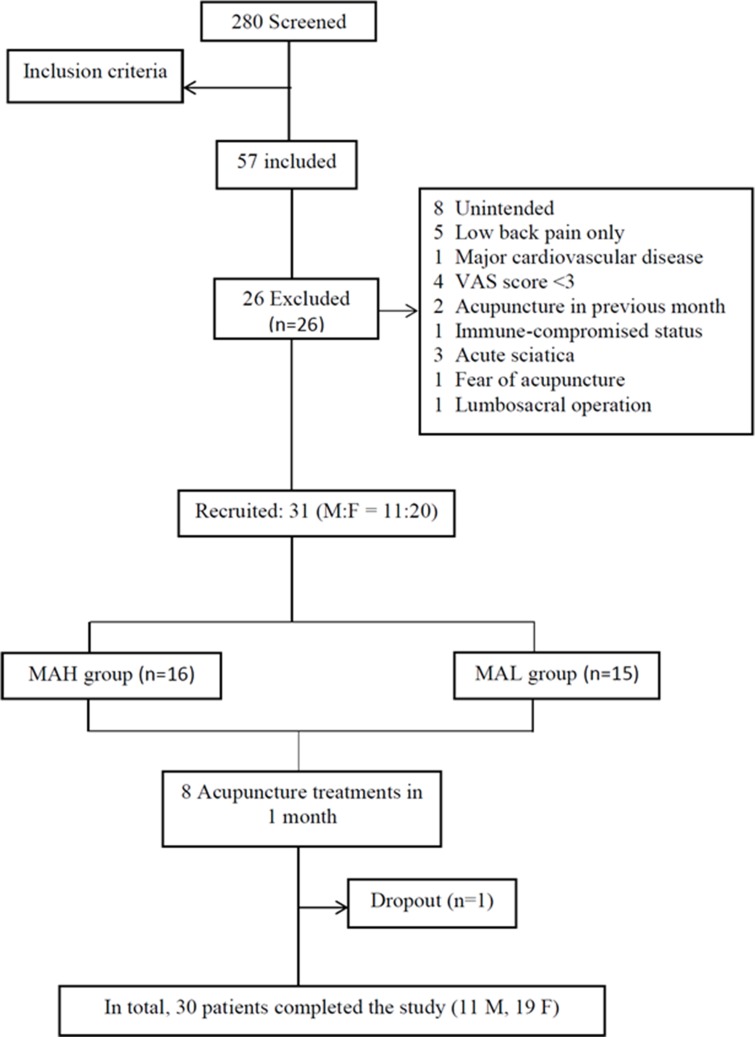
Fifty-seven patients with sciatica, aged 35-70 years, were recruited and screened. Thirty-one participants were randomly assigned to receive "low-dose" manual acupuncture (MAL) (n= 15) or "high-dose" manual acupuncture (MAH) (n=16). The acupuncture treatment was administered twice weekly for 4 weeks. The primary outcome was the visual analog scale (VAS) score at baseline and after 4 weeks of acupuncture treatment. Secondary outcomes included the Roland Disability Questionnaire for Sciatica (RDQS), the Sciatica Bothersomeness Index (SBI), and the World Health Organization Quality of Life in the Brief Edition (WHOQOL-BREF) scores at baseline and after 4 weeks of acupuncture treatment.
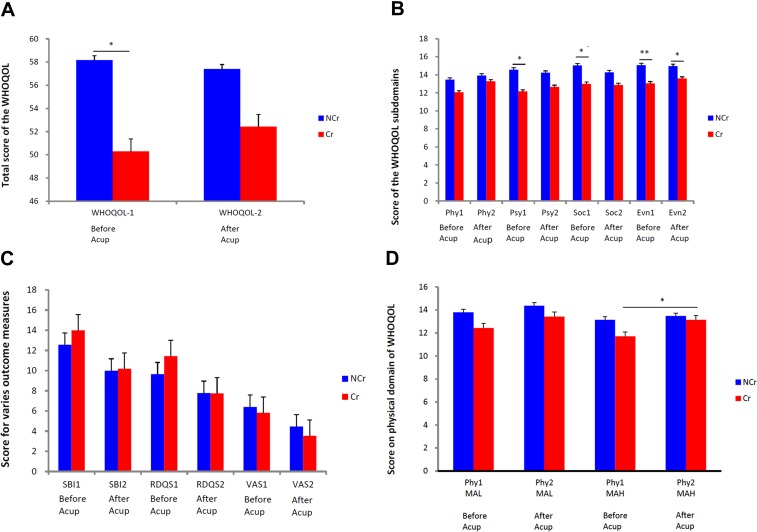
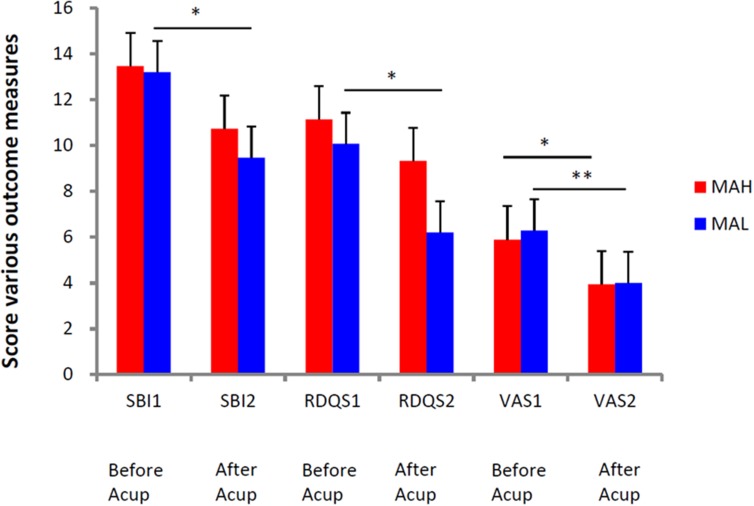
Thirty patients completed the study. For all patients, acupuncture achieved significant improvement in the VAS (5.48±2.0, p<0.001), RDQS (3.18±2.83, p=0.004), and SBI (2.85±3.23, p=0.008) scores, but not in the WHOQOL-BREF scores. In the between-group analysis, the assessed scales showed no significant differences between the MAL and MAH groups. However, based on the level of chronicity, the MAH group demonstrated greater improvement in the outcomes and a significant benefit in the physical subscale of the WHOQOL-BREF (p<0.05).
Results of this pilot study indicate that acupuncture is safe and may effectively relieve symptoms and disability in patients with non-acute sciatica. MAL was as effective as MAH in treating sciatica. A subsequent trial with a larger sample size (estimated at n=96) is required to confirm whether patients with a high level of chronicity would benefit from MAH treatment.
NCT03489681.
探讨一项全面随机对照试验所需的样本量,以及该试验研究针刺“剂量”效应治疗坐骨神经痛的可行性。
招募并筛选了57例年龄在35至70岁之间的坐骨神经痛患者。31名参与者被随机分配接受“低剂量”手法针刺(MAL)(n = 15)或“高剂量”手法针刺(MAH)(n = 16)。针刺治疗每周进行两次,共4周。主要结局指标为基线时及针刺治疗4周后的视觉模拟量表(VAS)评分。次要结局指标包括坐骨神经痛罗兰残疾问卷(RDQS)、坐骨神经痛困扰指数(SBI),以及基线时及针刺治疗4周后的世界卫生组织简版生活质量量表(WHOQOL - BREF)评分。
30例患者完成了研究。对于所有患者,针刺治疗使VAS评分(5.48±2.0,p<0.001)、RDQS评分(3.18±2.83,p = 0.004)和SBI评分(2.85±3.23,p = 0.008)有显著改善,但WHOQOL - BREF评分无改善。在组间分析中,所评估的量表在MAL组和MAH组之间无显著差异。然而,根据慢性程度水平,MAH组在结局方面显示出更大的改善,且在WHOQOL - BREF的身体领域有显著益处(p<0.05)。
这项初步研究的结果表明,针刺是安全的,可能有效缓解非急性坐骨神经痛患者的症状和残疾。MAL在治疗坐骨神经痛方面与MAH效果相当。需要随后进行一项更大样本量(估计n = 96)的试验,以确认慢性程度高的患者是否会从MAH治疗中获益。
NCT03489681。