Department of Physiology and Pharmacology, "Vittorio Erspamer", Sapienza University of Rome, Rome, Italy.
Center for Life Nano Science@Sapienza, Istituto Italiano di Tecnologia (ITT), Rome, Italy.
J Cell Mol Med. 2020 Mar;24(5):3053-3063. doi: 10.1111/jcmm.14943. Epub 2020 Feb 5.
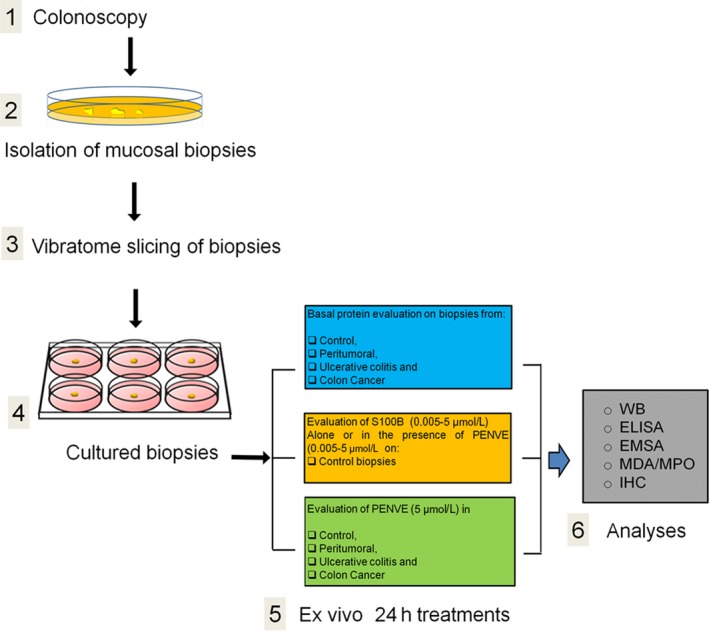
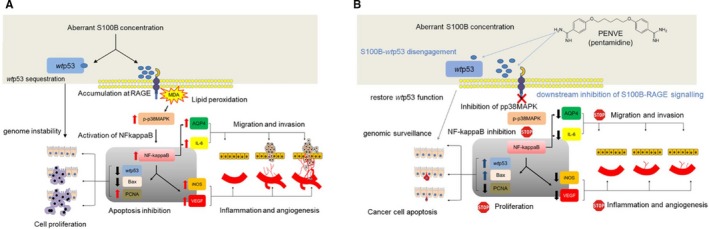
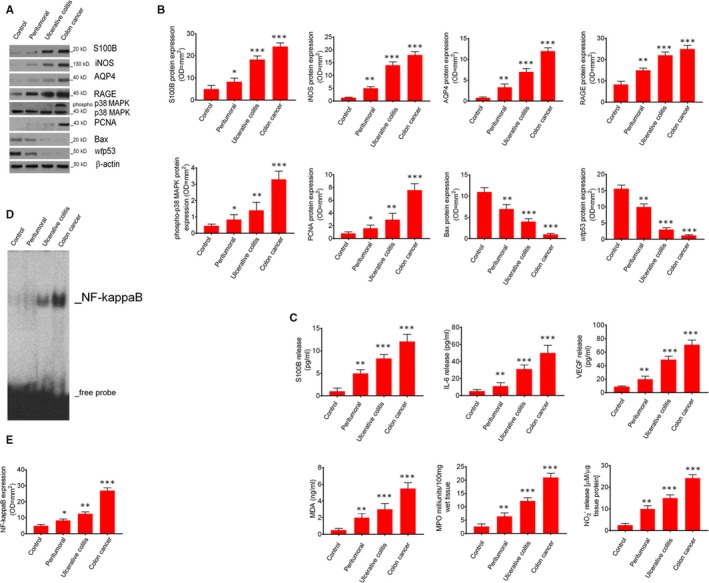
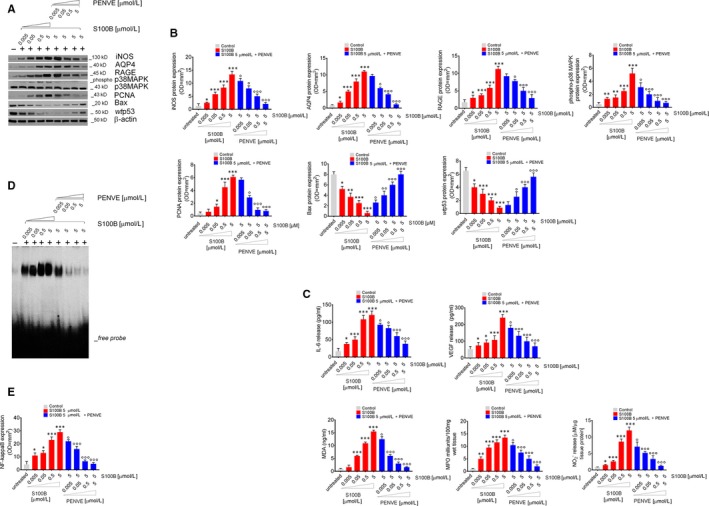
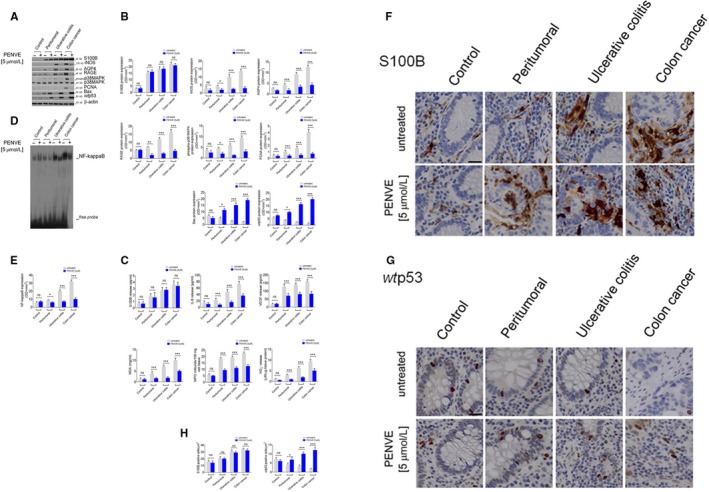
S100B protein bridges chronic mucosal inflammation and colorectal cancer given its ability to activate NF-kappaB transcription via RAGE signalling and sequestrate pro-apoptotic wtp53. Being an S100B inhibitor, pentamidine antagonizes S100B-wtp53 interaction, restoring wtp53-mediated pro-apoptotic control in cancer cells in several types of tumours. The expression of S100B, pro-inflammatory molecules and wtp53 protein was evaluated in human biopsies deriving from controls, ulcerative colitis and colon cancer patients at baseline (a) and (b) following S100B targeting with niosomal PENtamidine VEhiculation (PENVE), to maximize drug permeabilization in the tissue. Cultured biopsies underwent immunoblot, EMSA, ELISA and biochemical assays for S100B and related pro-inflammatory/pro-apoptotic proteins. Exogenous S100B (0.005-5 μmol/L) alone, or in the presence of PENVE (0.005-5 μmol/L), was tested in control biopsies while PENVE (5 μmol/L) was evaluated on control, peritumoral, ulcerative colitis and colon cancer biopsies. Our data show that S100B level progressively increases in control, peritumoral, ulcerative colitis and colon cancer enabling a pro-inflammatory/angiogenic and antiapoptotic environment, featured by iNOS, VEGF and IL-6 up-regulation and wtp53 and Bax inhibition. PENVE inhibited S100B activity, reducing its capability to activate RAGE/phosphor-p38 MAPK/NF-kappaB and favouring its disengagement with wtp53. PENVE blocks S100B activity and rescues wtp53 expression determining pro-apoptotic control in colon cancer, suggesting pentamidine as a potential anticancer drug.
S100B 蛋白通过 RAGE 信号转导激活 NF-κB 转录,并隔离促凋亡的 wt p53,从而促进慢性黏膜炎症和结直肠癌的发生。作为 S100B 的抑制剂,戊二脒通过拮抗 S100B-wt p53 相互作用,恢复 wt p53 在几种类型肿瘤的癌细胞中的促凋亡控制。在基线时(a)和(b),通过用阳离子脂质体 PENtamidine VEhiculation(PENVE)靶向 S100B,最大程度地增加组织中的药物渗透,评估来自对照、溃疡性结肠炎和结肠癌患者的人活检中 S100B、促炎分子和 wt p53 蛋白的表达。培养的活检进行免疫印迹、EMSA、ELISA 和生化测定以检测 S100B 和相关促炎/促凋亡蛋白。单独或在 PENVE(0.005-5 μmol/L)存在的情况下,测试外源性 S100B(0.005-5 μmol/L)在对照活检中,而 PENVE(5 μmol/L)在对照、肿瘤周围、溃疡性结肠炎和结肠癌活检中进行评估。我们的数据表明,S100B 水平在对照、肿瘤周围、溃疡性结肠炎和结肠癌中逐渐升高,从而形成促炎/血管生成和抗凋亡环境,其特征是 iNOS、VEGF 和 IL-6 的上调和 wt p53 和 Bax 的抑制。PENVE 抑制 S100B 活性,降低其激活 RAGE/磷酸化 p38 MAPK/NF-κB 的能力,并促进其与 wt p53 分离。PENVE 阻断 S100B 活性并恢复 wt p53 表达,确定结肠癌中的促凋亡控制,表明戊二脒是一种潜在的抗癌药物。