Center for Cerebral and Cardiovascular Disease Information, National Cerebral and Cardiovascular Center.
Department of Preventive Cardiology, National Cerebral and Cardiovascular Center.
J Atheroscler Thromb. 2020 Nov 1;27(11):1160-1175. doi: 10.5551/jat.48843. Epub 2020 Feb 6.
To construct a risk prediction model for cardiovascular disease (CVD) based on the Suita study, an urban Japanese cohort study, and compare its accuracy against the Framingham CVD risk score (FRS) model.
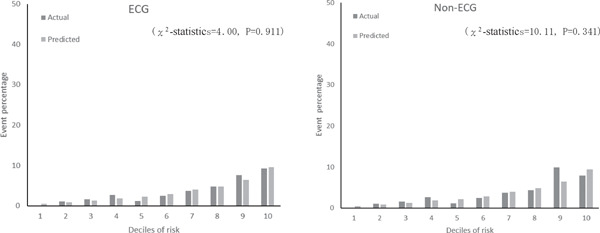
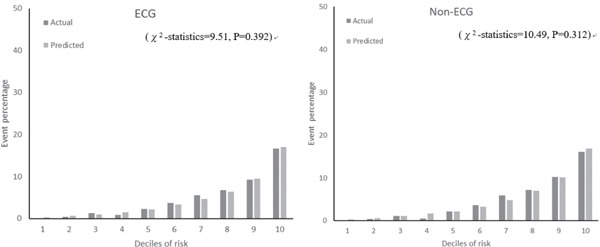
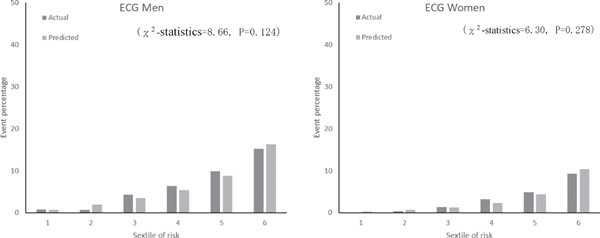
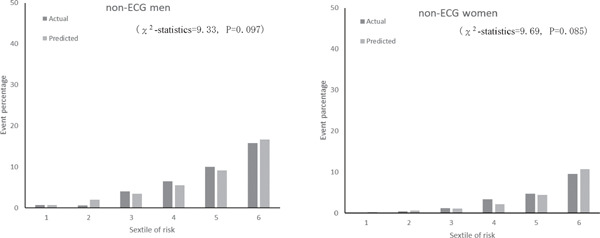
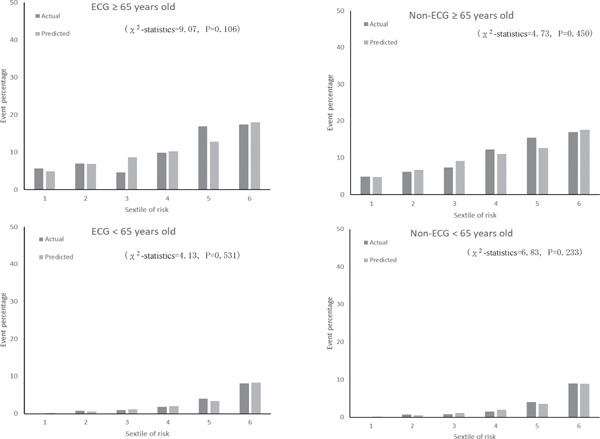
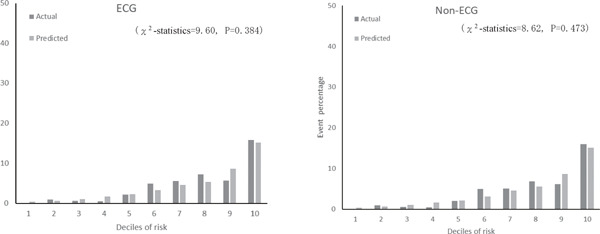
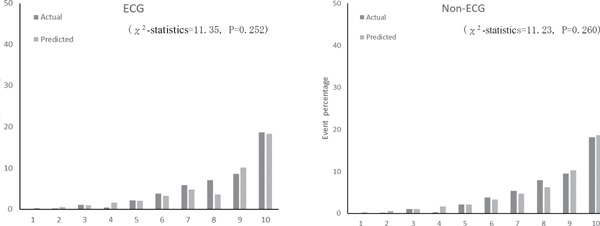
After excluding participants with missing data or those who lost to follow-up, this study consisted of 3,080 men and 3,470 women participants aged 30-79 years without CVD at baseline in 1989-1999. The main outcome of this study was incidence of CVD, defined as the incidence of stroke or coronary heart disease. Multivariable Cox proportional hazards models with stepwise selection were used to develop the prediction model. To assess model performance, concordance statistics (C-statistics) and their 95% confidence intervals (CIs) were calculated using a bootstrap procedure. A calibration test was also conducted.
During a median follow-up period of 16.9 years, 351 men and 241 women developed CVD. We formulated risk models with and without electrocardiogram (ECG) data that included age, sex, systolic blood pressure, diastolic blood pressure, high-density lipoprotein cholesterol, non-high-density lipoprotein cholesterol, low-density lipoprotein cholesterol, diabetes mellitus, smoking, and urinary protein as risk factors. The C-statistics of the Suita CVD risk models with ECG data (0.782; 95% CI, 0.766-0.799) and without ECG data (0.781; 95% CI, 0.765-0.797) were significantly higher than that of the FRS model (0.768; 95% CI, 0.750-0.785).
The Suita CVD risk model is feasible to use and improves predictability of the incidence of CVD relative to the FRS model in Japan.
基于日本城市人群队列研究——Suita 研究,构建心血管疾病(CVD)风险预测模型,并与 Framingham CVD 风险评分(FRS)模型进行比较。
排除有缺失数据或随访丢失的参与者后,本研究共纳入了 1989-1999 年基线时无 CVD 的 3080 名男性和 3470 名女性参与者,年龄 30-79 岁。本研究的主要结局为 CVD 的发生,定义为中风或冠心病的发生。采用逐步选择的多变量 Cox 比例风险模型来建立预测模型。通过 bootstrap 程序计算一致性统计量(C 统计量)及其 95%置信区间(CI)来评估模型性能。同时还进行了校准检验。
在中位随访 16.9 年期间,351 名男性和 241 名女性发生了 CVD。我们构建了包含年龄、性别、收缩压、舒张压、高密度脂蛋白胆固醇、非高密度脂蛋白胆固醇、低密度脂蛋白胆固醇、糖尿病、吸烟和尿蛋白等危险因素的有和无心电图(ECG)数据的风险模型。Suita CVD 风险模型(含 ECG 数据:0.782;95%CI,0.766-0.799;不含 ECG 数据:0.781;95%CI,0.765-0.797)的 C 统计量显著高于 FRS 模型(0.768;95%CI,0.750-0.785)。
Suita CVD 风险模型在日本是可行的,并且相对于 FRS 模型,其对 CVD 发生率的预测能力有所提高。