Department of Mathematics, Aston University, Birmingham B4 7ET, UK.
Department of Computer Science, University of Birmingham, Birmingham B15 2TT, UK.
Sensors (Basel). 2020 Jan 31;20(3):784. doi: 10.3390/s20030784.
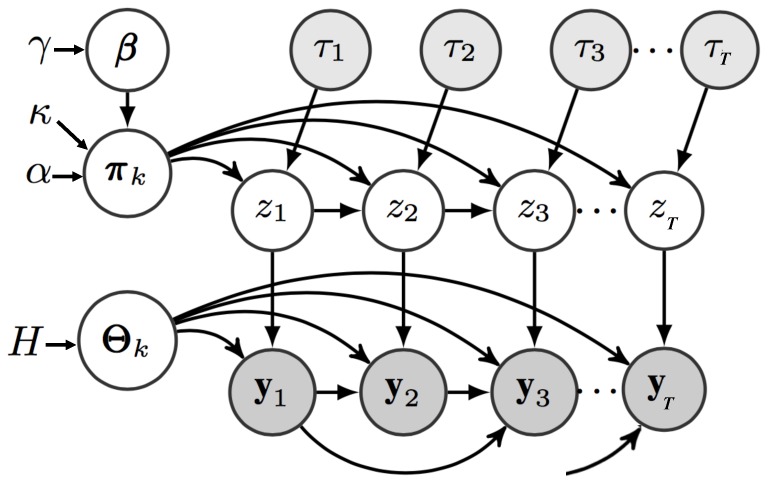
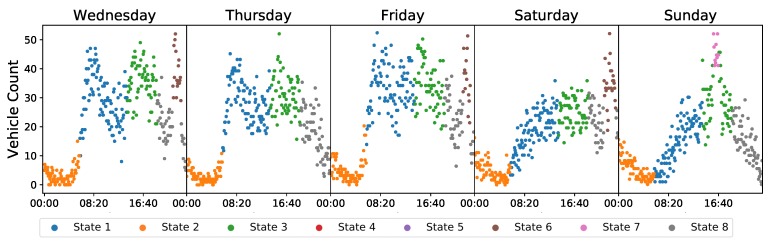
The growth of urban areas in recent years has motivated a large amount of new sensor applications in smart cities. At the centre of many new applications stands the goal of gaining insights into human activity. Scalable monitoring of urban environments can facilitate better informed city planning, efficient security, regular transport and commerce. A large part of monitoring capabilities have already been deployed; however, most rely on expensive motion imagery and privacy invading video cameras. It is possible to use a low-cost sensor alternative, which enables deep understanding of population behaviour such as the Global Positioning System (GPS) data. However, the automated analysis of such low dimensional sensor data, requires new flexible and structured techniques that can describe the generative distribution and time dynamics of the observation data, while accounting for external contextual influences such as time of day or the difference between weekend/weekday trends. In this paper, we propose a novel time series analysis technique that allows for multiple different transition matrices depending on the data's contextual realisations all following shared adaptive observational models that govern the global distribution of the data given a latent sequence. The proposed approach, which we name Adaptive Input Hidden Markov model (AI-HMM) is tested on two datasets from different sensor types: GPS trajectories of taxis and derived vehicle counts in populated areas. We demonstrate that our model can group different categories of behavioural trends and identify time specific anomalies.
近年来,城市地区的发展促使智能城市中出现了大量新的传感器应用。许多新应用的核心目标是深入了解人类活动。对城市环境进行可扩展的监控可以促进更明智的城市规划、高效的安全保障、常规的交通和商业活动。很大一部分监控功能已经部署到位;然而,大多数功能依赖于昂贵的运动图像和侵犯隐私的视频摄像机。使用低成本传感器替代方案是可行的,这可以深入了解人口行为,例如全球定位系统 (GPS) 数据。然而,这种低维传感器数据的自动化分析需要新的灵活和结构化技术,这些技术可以描述观察数据的生成分布和时间动态,同时考虑到外部上下文影响,例如一天中的时间或周末/工作日趋势之间的差异。在本文中,我们提出了一种新颖的时间序列分析技术,该技术允许根据数据的上下文实现情况,根据全局分布数据的共享自适应观测模型,为不同的过渡矩阵建模。我们提出的方法,即自适应输入隐马尔可夫模型 (AI-HMM),在来自不同传感器类型的两个数据集上进行了测试:出租车的 GPS 轨迹和人口稠密地区的车辆计数。我们证明了我们的模型可以对不同类别的行为趋势进行分组,并识别特定时间的异常。