Bae Subeen, Lee Jin, Lee Byoung-Hee
Graduate School of Physical Therapy, Sahmyook University, Seoul 01795, Korea.
Department of Physical Therapy, Sahmyook University, Seoul 01795, Korea.
Healthcare (Basel). 2020 Aug 24;8(3):292. doi: 10.3390/healthcare8030292.
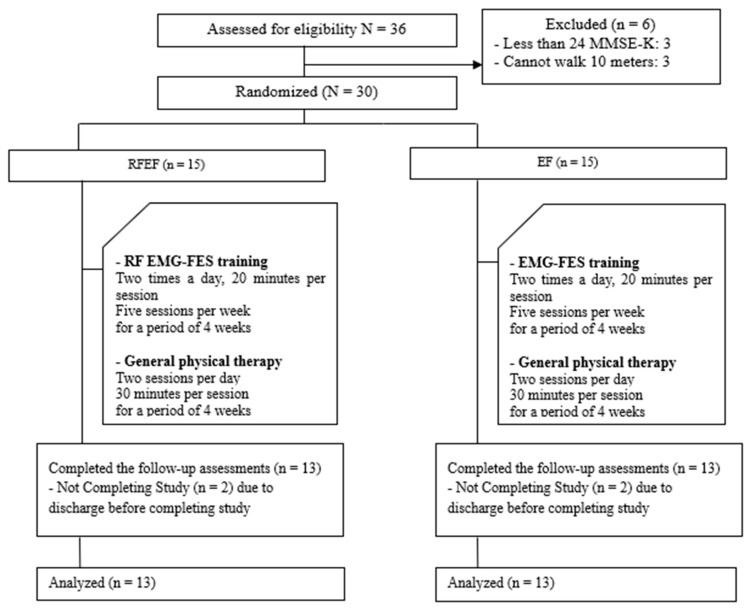
This study evaluated the effects of an electromyography-functional electrical stimulation interface (EMG-FES interface) combined with real-time balance and gait feedback on ankle joint training in patients with stroke hemiplegia. Twenty-six stroke patients participated in this study. All subjects were randomly assigned to either the EMG-FES interface combined with real-time feedback on ankle joint training (RFEF) group ( = 13) or the EMG-FES interface on ankle joint training (EF) group ( = 13). Subjects in both groups were trained for 20 min a day, 5 times a week, for 4 weeks. Similarly, all participants underwent a standard rehabilitation physical therapy for 60 min a day, 5 times a week, for 4 weeks. The RFEF group showed significant increases in weight-bearing lunge test (WBLT), Tardieu Scale (TS), Timed Up and Go Test (TUG), Berg Balance Scale (BBS), velocity, cadence, step length, stride length, stance per, and swing per ( 0.05). Likewise, the EF group showed significant increases in WBLT, TUG, BBS, velocity, and cadence ( < 0.05). Moreover, the RFEF group showed significantly greater improvements than the EF group in terms of WBLT, Tardieu Scale, TUG, BBS, velocity, step length, stride length, stance per, and swing per ( < 0.05). Ankle joint training using an EMG-FES interface combined with real-time feedback improved ankle range of motion (ROM), muscle tone, balance, and gait in stroke patients. These results suggest that an EMG-FES interface combined with real-time feedback is feasible and suitable for ankle joint training in individuals with stroke.
本研究评估了肌电图-功能性电刺激接口(EMG-FES接口)结合实时平衡和步态反馈对中风偏瘫患者踝关节训练的影响。26名中风患者参与了本研究。所有受试者被随机分为肌电图-功能性电刺激接口结合踝关节训练实时反馈(RFEF)组( = 13)或踝关节训练肌电图-功能性电刺激接口(EF)组( = 13)。两组受试者均每天训练20分钟,每周5次,共4周。同样,所有参与者每天接受60分钟的标准康复物理治疗,每周5次,共4周。RFEF组在负重弓步试验(WBLT)、塔迪厄量表(TS)、计时起立行走测试(TUG)、伯格平衡量表(BBS)、速度、步频、步长、步幅、支撑期和摆动期方面均有显著增加( 0.05)。同样,EF组在WBLT、TUG、BBS、速度和步频方面也有显著增加( < 0.05)。此外,RFEF组在WBLT、塔迪厄量表、TUG、BBS、速度、步长、步幅、支撑期和摆动期方面的改善明显优于EF组( < 0.05)。使用肌电图-功能性电刺激接口结合实时反馈进行踝关节训练可改善中风患者的踝关节活动范围(ROM)、肌张力、平衡和步态。这些结果表明,肌电图-功能性电刺激接口结合实时反馈对于中风患者的踝关节训练是可行且合适的。