Université de Strasbourg, UMR7242, ESBS, Bld Sébastien Brant, F-67413 Illkirch, Strasbourg, France; CNRS, UMR7242, ESBS, Bld Sébastien Brant, F-67413 Illkirch, Strasbourg, France.
Laboratoire de Spectrométrie de Masse BioOrganique, Université de Strasbourg, CNRS, IPHC UMR 7178, F-67000 Strasbourg, France.
Mol Cell Proteomics. 2020 Apr;19(4):589-607. doi: 10.1074/mcp.RA119.001829. Epub 2020 Feb 5.
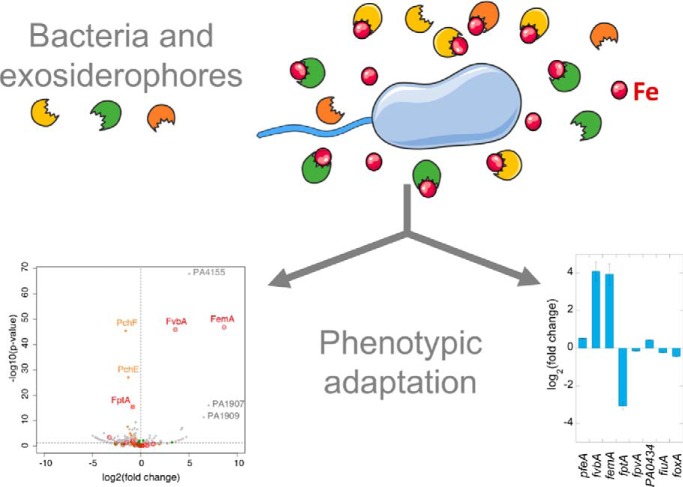
Bacteria secrete siderophores to access iron, a key nutrient poorly bioavailable and the source of strong competition between microorganisms in most biotopes. Many bacteria also use siderophores produced by other microorganisms (exosiderophores) in a piracy strategy. , an opportunistic pathogen, produces two siderophores, pyoverdine and pyochelin, and is also able to use a panel of exosiderophores. We first investigated expression of the various iron-uptake pathways of in three different growth media using proteomic and RT-qPCR approaches and observed three different phenotypic patterns, indicating complex phenotypic plasticity in the expression of the various iron-uptake pathways. We then investigated the phenotypic plasticity of iron-uptake pathway expression in the presence of various exosiderophores (present individually or as a mixture) under planktonic growth conditions, as well as in an epithelial cell infection assay. In all growth conditions tested, catechol-type exosiderophores were clearly more efficient in inducing the expression of their corresponding transporters than the others, showing that bacteria opt for the use of catechol siderophores to access iron when they are present in the environment. In parallel, expression of the proteins of the pyochelin pathway was significantly repressed under most conditions tested, as well as that of proteins of the pyoverdine pathway, but to a lesser extent. There was no effect on the expression of the heme and ferrous uptake pathways. Overall, these data provide precise insights on how adjusts the expression of its various iron-uptake pathways (phenotypic plasticity and switching) to match varying levels of iron and competition.
细菌分泌铁载体来获取铁,这是一种生物利用度差的关键营养物质,也是大多数生物区系中微生物之间强烈竞争的来源。许多细菌还在盗用策略中使用其他微生物产生的铁载体(外铁载体)。作为一种机会性病原体,产生两种铁载体,即绿脓菌素和焦脱镁叶绿酸,并且还能够使用一组外铁载体。我们首先使用蛋白质组学和 RT-qPCR 方法研究了在三种不同生长培养基中 的各种铁摄取途径的表达情况,观察到三种不同的表型模式,表明在各种铁摄取途径的表达中存在复杂的表型可塑性。然后,我们在浮游生长条件下以及上皮细胞感染测定中,研究了各种外铁载体(单独或混合存在)存在时铁摄取途径表达的表型可塑性。在所有测试的生长条件下,儿茶酚型外铁载体显然更有效地诱导其相应转运蛋白的表达,表明当环境中存在时,细菌选择使用儿茶酚铁载体来获取铁。同时,在大多数测试条件下,绿脓菌素途径的蛋白表达以及焦脱镁叶绿酸途径的蛋白表达受到显著抑制,但程度较轻。对血红素和亚铁摄取途径的蛋白表达没有影响。总体而言,这些数据提供了关于 如何调整其各种铁摄取途径(表型可塑性和转换)的表达以适应不同水平的铁和竞争的精确见解。