Kinoshita Junzo, Hasan Nazarul, Bell Brent A, Peachey Neal S
Cole Eye Institute, Cleveland Clinic, Cleveland, OH.
Department of Biochemistry & Molecular Genetics, University of Louisville, Louisville, KY.
Mol Vis. 2019 Dec 31;25:890-901. eCollection 2019.
The mouse carries a missense mutation in the gene (p.Met66Leu), and exhibits a reduced b-wave of the electroretinogram (ERG), abnormal localization of metabotropic glutamate receptor 6 (mGluR6) to the depolarizing bipolar cell (DBC) soma, and a reduced level of mGluR6 at the DBC dendritic tips. Although the underlying mechanism remains unknown, one possible explanation is that DBCs cannot efficiently traffic the mutant mGluR6. In that scenario, reducing the total amount of mutant mGluR6 protein might normalize localization, and thus, improve the ERG phenotype as well. The second purpose of this study was to determine whether the abnormal cellular distribution of mutant mGluR6 in retinas might induce late onset DBC degeneration.
We crossed animals with mice, which carry a null mutation in , to generate compound heterozygotes. We used western blotting to measure the total mGluR6 content, and immunohistochemistry to document mGluR6 localization within DBCs. In addition, we examined outer retinal function with ERG and retinal architecture in vivo with spectral domain optical coherence tomography (SD-OCT).
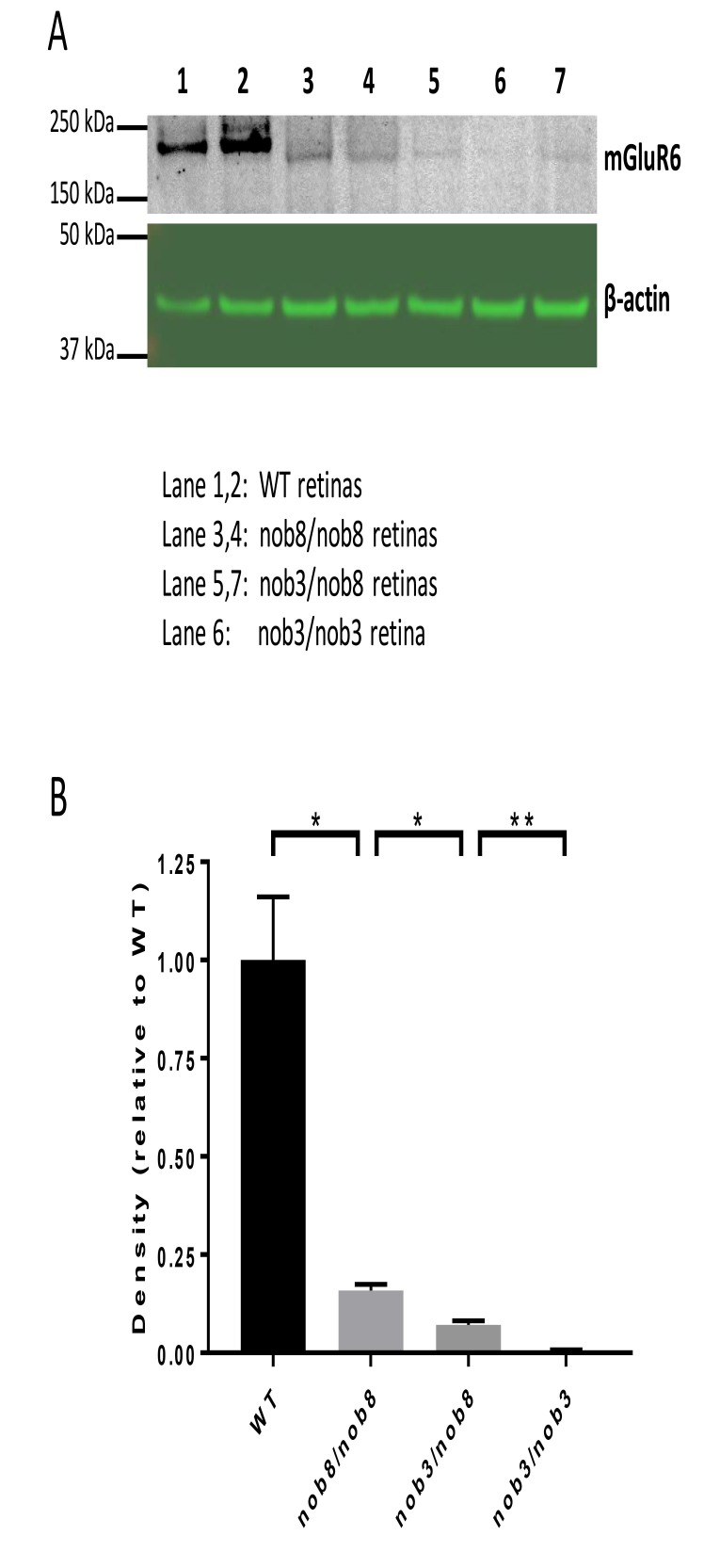
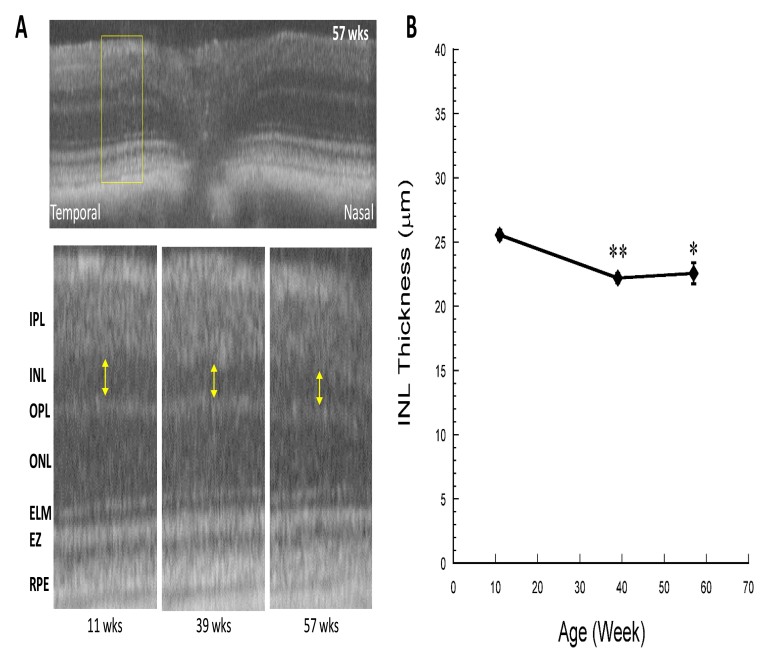
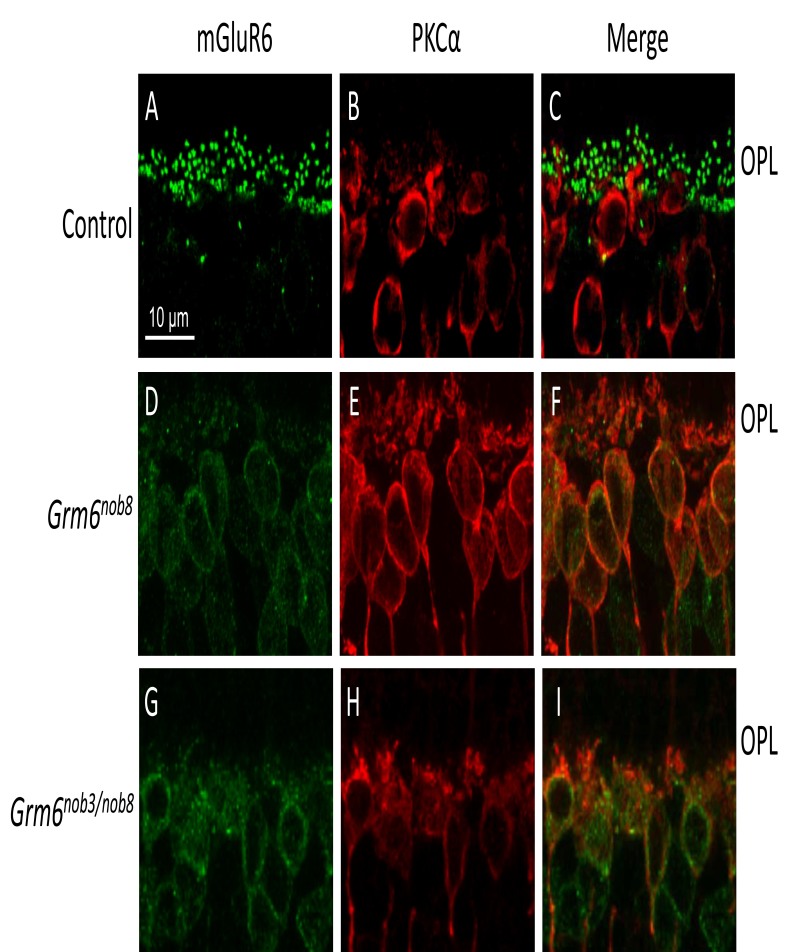
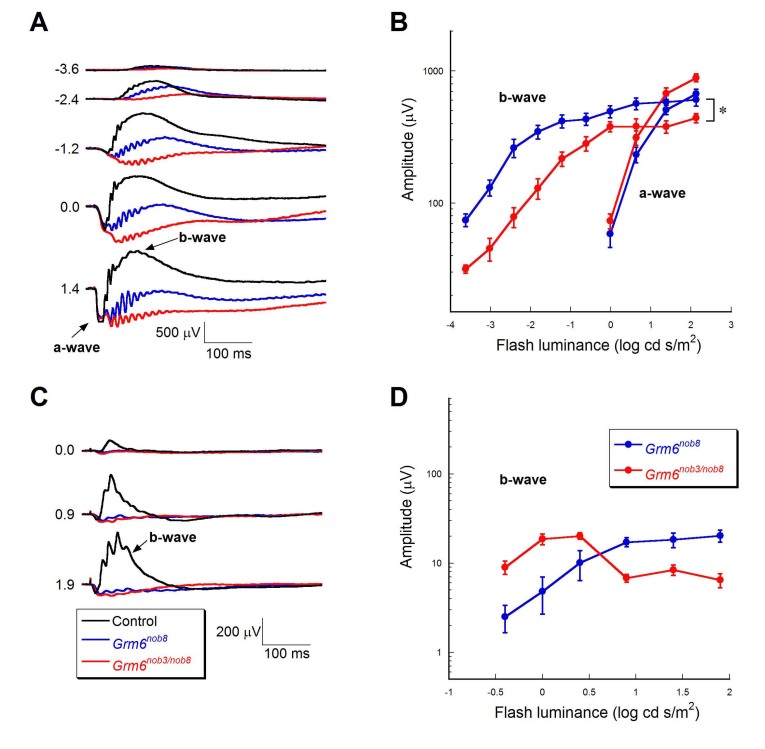
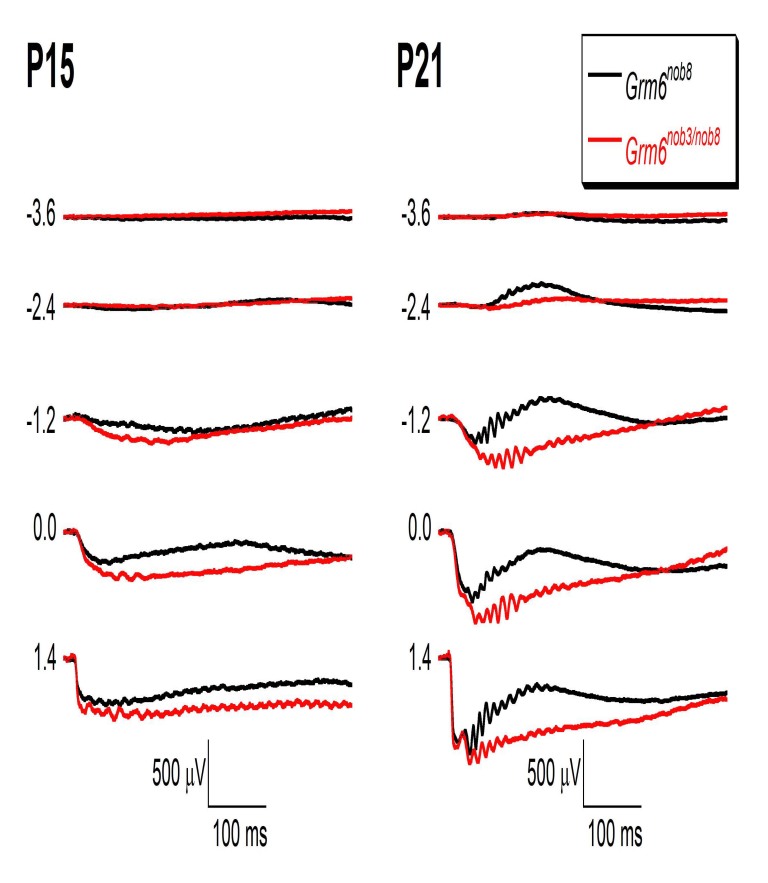
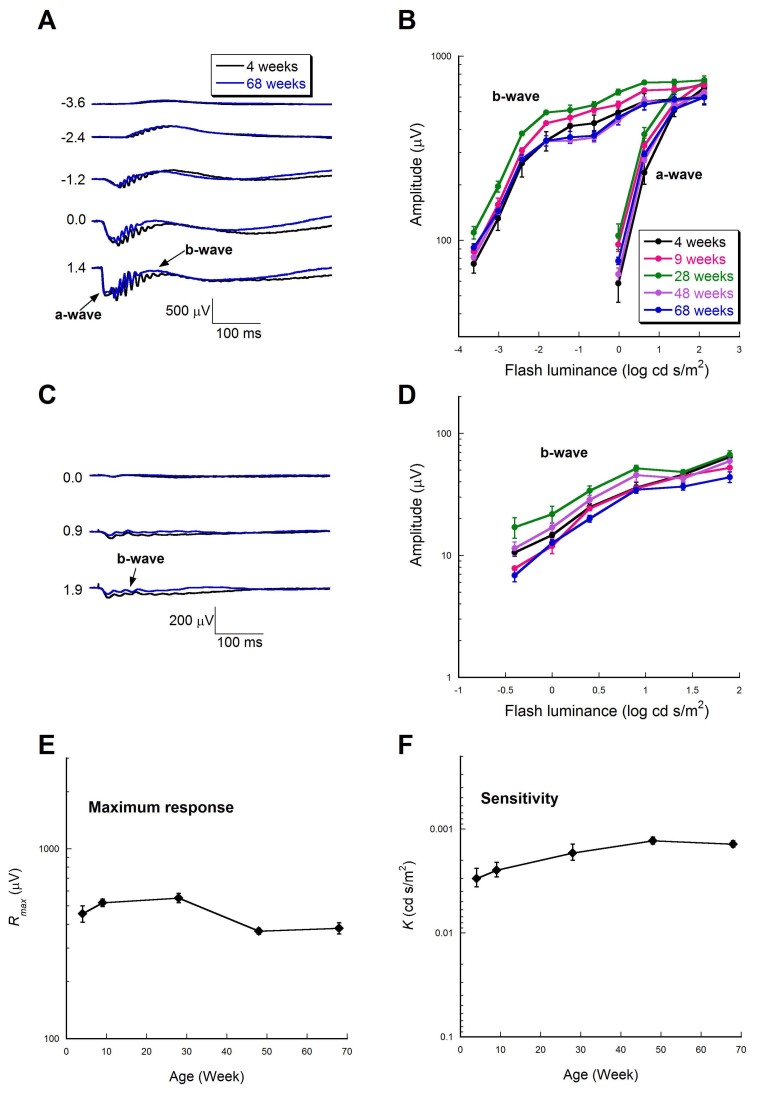
The retinal content of mGluR6 was reduced in the retinas of the compound heterozygotes compared to the homozygotes. The cellular distribution of mGluR6 in the compound heterozygotes matched that of the homozygotes, with extensive expression throughout the DBC cell body and limited expression at the DBC dendritic tips. The dark-adapted ERG b-waves of the mice were reduced in comparison to those of the homozygotes at postnatal day 21 and 28. The overall ERG waveforms obtained from 4- through 68-week old mice were in general agreement for dark- and light-adapted conditions. The maximum response and sensitivity of the dark-adapted ERG b-wave did not change statistically significantly with age. SD-OCT revealed the maintained laminar structure of the retina, including a clear inner nuclear layer (INL) at each age examined (from 11 to 57 weeks old), although the INL in the mice older than 39 weeks of age was somewhat thinner than that seen at 11 weeks.
Mislocalization of mutant mGluR6 is not normalized by reducing the total mGluR6. Mislocalized mutant mGluR6 does not trigger substantial loss of DBCs.
该小鼠的基因存在错义突变(p.Met66Leu),表现为视网膜电图(ERG)的b波降低、代谢型谷氨酸受体6(mGluR6)向去极化双极细胞(DBC)胞体的定位异常以及DBC树突尖端mGluR6水平降低。尽管潜在机制尚不清楚,但一种可能的解释是DBC无法有效地转运突变型mGluR6。在这种情况下,减少突变型mGluR6蛋白的总量可能会使定位正常化,从而也改善ERG表型。本研究的第二个目的是确定视网膜中突变型mGluR6的异常细胞分布是否会诱导迟发性DBC变性。
我们将携带基因无效突变的小鼠与该小鼠杂交,以产生复合杂合子。我们使用蛋白质免疫印迹法测量mGluR6的总含量,并使用免疫组织化学法记录mGluR6在DBC内的定位。此外,我们用ERG检查视网膜外层功能,并用光谱域光学相干断层扫描(SD-OCT)在体内检查视网膜结构。
与纯合子相比,复合杂合子小鼠视网膜中mGluR6的含量降低。复合杂合子中mGluR6的细胞分布与纯合子的分布相匹配,在整个DBC细胞体中广泛表达,而在DBC树突尖端表达有限。与纯合子相比,出生后第21天和28天,该小鼠的暗适应ERG b波降低。从4至68周龄的该小鼠获得的总体ERG波形在暗适应和明适应条件下总体一致。暗适应ERG b波的最大反应和敏感性并未随年龄发生统计学上的显著变化。SD-OCT显示视网膜各层结构保持完整,在所检查的每个年龄(11至57周龄)均有清晰的内核层(INL),尽管39周龄以上小鼠的INL比11周龄时稍薄。
减少mGluR6总量并不能使突变型mGluR6的错误定位正常化。错误定位的突变型mGluR6不会引发DBC的大量丢失。