AlHarthi Fawz S, Qari Alya, Edress Alaa, Abedalthagafi Malak
1Genomics Research Department, Saudi Human Genome Project, King Fahad Medical City and King Abdulaziz City for Science and Technology, Riyadh, Saudi Arabia.
2Genetics Counselling Division, Saudi Diagnostic Laboratory, King Faisal Specialist Hospital International Company, Riyadh, Saudi Arabia.
NPJ Genom Med. 2020 Feb 3;5:3. doi: 10.1038/s41525-019-0110-y. eCollection 2020.
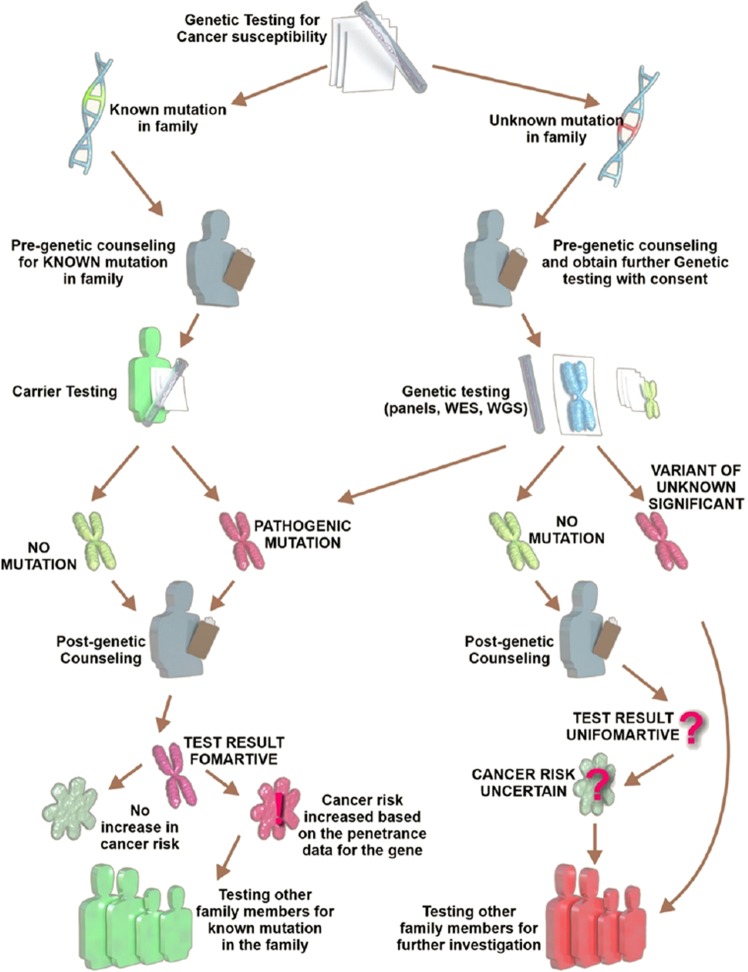
The study of hereditary cancer, which accounts for ~10% of cancer cases worldwide is an important subfield of oncology. Our understanding of hereditary cancers has greatly advanced with recent advances in sequencing technology, but as with any genetic trait, gene frequencies of cancer-associated mutations vary across populations, and most studies that have located hereditary cancer genes have been conducted on European or Asian populations. There is an urgent need to trace hereditary cancer genes across the Arab world. Hereditary disease is particularly prevalent among members of consanguineous populations, and consanguineous marriages are particularly common in the Arab world. There are also cultural and educational idiosyncrasies that differentiate Arab populations from other more thoroughly studied groups with respect to cancer awareness and treatment. Therefore, a review of the literature on hereditary cancers in this understudied population was undertaken. We report that mutations are not as prevalent among Arab breast cancer patients as they are among other ethnic groups, and therefore, other genes may play a more important role. A wide variety of germline inherited mutations that are associated with cancer are discussed, with particular attention to breast, ovarian, colorectal, prostate, and brain cancers. Finally, we describe the state of the profession of familial cancer genetic counselling in the Arab world, and the clinics and societies dedicated to its advances. We describe the complexities of genetic counselling that are specific to the Arab world. Understanding hereditary cancer is heavily dependent on understanding population-specific variations in cancer-associated gene frequencies.
遗传性癌症的研究是肿瘤学的一个重要子领域,全球约10%的癌症病例与之相关。随着测序技术的最新进展,我们对遗传性癌症的理解有了很大进步,但与任何遗传特征一样,癌症相关突变的基因频率在不同人群中存在差异,而且大多数定位遗传性癌症基因的研究都是在欧洲或亚洲人群中进行的。迫切需要在阿拉伯世界追踪遗传性癌症基因。遗传性疾病在近亲结婚人群中尤为普遍,近亲结婚在阿拉伯世界非常常见。在癌症意识和治疗方面,阿拉伯人群在文化和教育上也有一些特质,使其有别于其他研究更充分的群体。因此,我们对这个研究较少的人群中关于遗传性癌症的文献进行了综述。我们报告称,突变在阿拉伯乳腺癌患者中不如在其他种族群体中普遍,因此,其他基因可能发挥更重要的作用。本文讨论了与癌症相关的多种种系遗传突变,尤其关注乳腺癌、卵巢癌、结直肠癌、前列腺癌和脑癌。最后,我们描述了阿拉伯世界家族性癌症遗传咨询行业的状况,以及致力于推动该领域发展的诊所和协会。我们描述了阿拉伯世界特有的遗传咨询的复杂性。对遗传性癌症的理解在很大程度上依赖于对癌症相关基因频率的人群特异性差异的理解。