Kuppusamy Maheshkumar, Kamaldeen Dilara, Pitani Ravishankar, Amaldas Julius, Ramasamy Padmavathi, Shanmugam Poonguzhali, Vijayakumar Venugopal
Government Yoga and Naturopathy Medical College and Hospital, Chennai, India.
Department of Physiology, Sri Ramachandra Medical College and Research Institute, Chennai, India.
Integr Med Res. 2020 Mar;9(1):28-32. doi: 10.1016/j.imr.2020.01.006. Epub 2020 Jan 20.
This study was conducted among healthy adolescents to assess the effects of a yoga breathing practice (Bhramari pranayama, Bhr.P) towards cardiac autonomic function using heart rate variability (HRV) parameters.
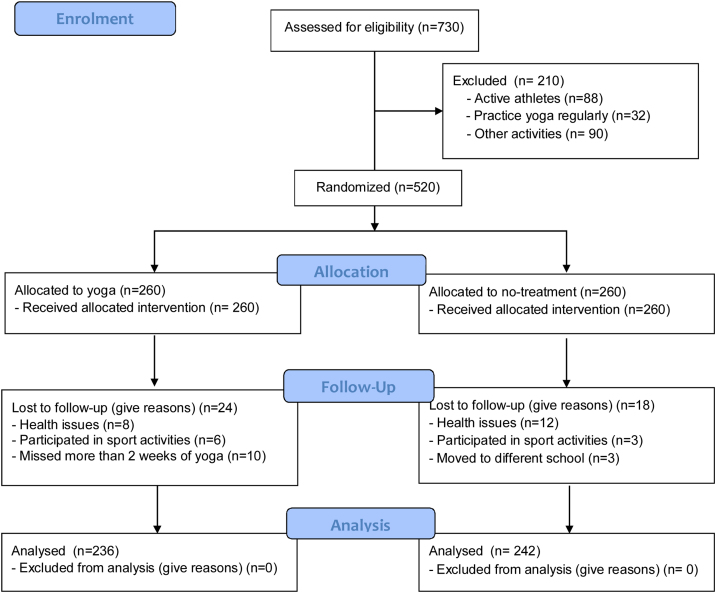
Of the 730 eligible subjects screened, 520 healthy adolescents who met the inclusion and exclusion criteria were randomly assigned to either yoga breathing group (n = 260) or control group (n = 260). The yoga breathing group practiced Bhr.P. five days a week for a duration of six months while the control group continued with their daily routine without any intervention. Outcome measures were time and frequency domain of HRV in both groups which were assessed before and after the intervention using Lead II ECG. Linear models were used in the analysis of short term HRV.
After 6 months of yoga breathing, the time domain parameters of short term HRV showed significant (P < 0.05) improvement towards the parasympathetic domain. Frequency domain parameters also showed the same direction of changes. In contrast, control group subjects showed a trend towards a sympathetic domain.
The present study showed a positive shift in cardiac autonomic modulation towards parasympathetic predominance after 6 months of yoga breathing practice among apparently healthy adolescents.
本研究在健康青少年中进行,以使用心率变异性(HRV)参数评估瑜伽呼吸练习(蜂鸣式呼吸法,Bhr.P)对心脏自主神经功能的影响。
在筛选出的730名符合条件的受试者中,520名符合纳入和排除标准的健康青少年被随机分为瑜伽呼吸组(n = 260)或对照组(n = 260)。瑜伽呼吸组每周五天练习Bhr.P,持续六个月,而对照组继续其日常活动,不进行任何干预。结局指标是两组HRV的时域和频域,在干预前后使用II导联心电图进行评估。线性模型用于短期HRV的分析。
经过6个月的瑜伽呼吸练习后,短期HRV的时域参数显示出对副交感神经领域有显著(P < 0.05)改善。频域参数也显示出相同的变化方向。相比之下,对照组受试者显示出向交感神经领域变化的趋势。
本研究表明,在明显健康的青少年中进行6个月的瑜伽呼吸练习后,心脏自主神经调节向副交感神经占优势发生了积极转变。