Lee Gwenyth O, Paz-Soldan Valerie A, Riley-Powell Amy R, Gómez Andrea, Tarazona-Meza Carla, Villaizan Paliza Katerine, Ambikapathi Ramya, Ortiz Katherine, Comina German, Hernandez Gustavo, Naik Nehal, Oberhelman Richard, Ugarte-Gil Cesar
Department of Global Community Health and Behavioral Sciences, Tulane University School of Public Health and Tropical Medicine, New Orleans, LA, USA.
University of Michigan School of Public Health, Ann Arbor, MI, USA.
Curr Dev Nutr. 2020 Jan 3;4(2):nzaa001. doi: 10.1093/cdn/nzaa001. eCollection 2020 Feb.
In Peru, tuberculosis (TB) is perceived as a nutritional disease. This perception, alongside factors including household food insecurity, may drive the food choices of people with TB and influence treatment outcomes.
The objective of this qualitative study was to explore drivers of food choice among adults recently diagnosed with TB.
The study was conducted between April and December 2016 in the Huaycán district of Lima, Peru. Structured questionnaires were administered to 39 adults with TB at the time of diagnosis and after 1 mo of treatment to characterize food security and socioeconomic status. At 1 mo of treatment, 24-h dietary recalls, enhanced by recipes obtained from local street vendors, were administered to examine patterns of food consumption and determine mean daily intake of macro- and micronutrients. Among a subset of 9 participants, in-depth interviews were used to explore dietary beliefs and food choices associated with TB.
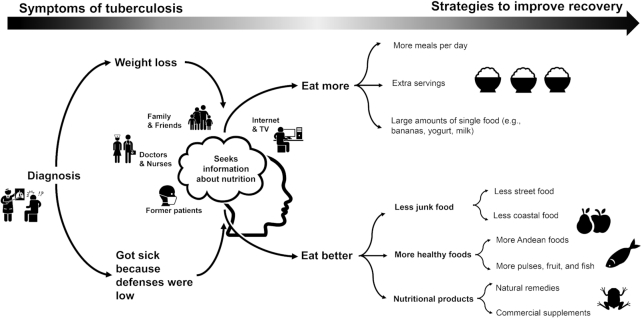
Overall, 13.2% of participants were underweight at baseline, and 10.5% were overweight. At 1 mo of treatment, the mean caloric intake was 600 kcal/d over what was needed to maintain their current weight. Most of these additional kilocalories came from carbohydrates. Patients made active efforts to improve their diets during treatment, and were both receptive to, and actively sought out, nutritional advice. However, many patients reported significant unnecessary spending on questionable commercial products, such as expensive natural remedies and nutritional supplements.
The perceived connection between TB and diet creates both opportunities and challenges for treatment providers. Nutritional counseling provided through the national TB program should promote dietary quality through foods that are locally available, inexpensive, and aligned with cultural perceptions of health and wellness.
在秘鲁,结核病被视为一种营养性疾病。这种认知,连同家庭粮食不安全等因素,可能会影响结核病患者的食物选择并影响治疗效果。
这项定性研究的目的是探讨近期被诊断患有结核病的成年人食物选择的驱动因素。
该研究于2016年4月至12月在秘鲁利马的瓦伊坎区进行。在诊断时和治疗1个月后,对39名结核病成年人进行了结构化问卷调查,以描述其粮食安全和社会经济状况。在治疗1个月时,采用24小时膳食回顾法,并结合从当地街头小贩处获得的食谱,以检查食物消费模式并确定宏量营养素和微量营养素的每日平均摄入量。在9名参与者的子集中,采用深入访谈法探讨与结核病相关的饮食观念和食物选择。
总体而言,13.2%的参与者在基线时体重过轻,10.5%的参与者超重。在治疗1个月时,平均热量摄入量比维持当前体重所需的热量多600千卡/天。这些额外的千卡大部分来自碳水化合物。患者在治疗期间积极努力改善饮食,并乐于接受并积极寻求营养建议。然而,许多患者报告称,在可疑的商业产品上花费了大量不必要的费用,如昂贵的天然药物和营养补充剂。
结核病与饮食之间的认知联系给治疗提供者带来了机遇和挑战。通过国家结核病项目提供的营养咨询应通过当地可得、价格低廉且符合健康文化观念的食物来提高饮食质量。