Ambikapathi Ramya, Boncyk Morgan, Gunaratna Nilupa S, Fawzi Wafaie, Leyna Germana, Kadiyala Suneetha, Patil Crystal L
Department of Global Development, Cornell University, USA.
Department of Public Health, Purdue University, USA.
Glob Food Sec. 2024 Sep;42:100788. doi: 10.1016/j.gfs.2024.100788.
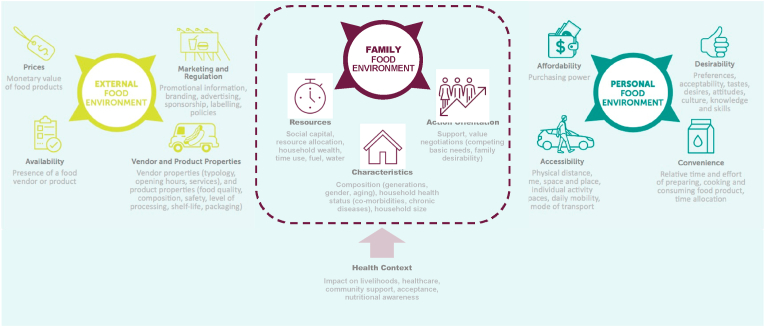
Food environment changes in low- and middle-income countries are increasing diet-related noncommunicable diseases (NCDs). This paper synthesizes the qualitative evidence about how family dynamics shape food choices within the context of HIV (Prospero: CRD42021226283). Guided by structuration theory and food environment framework, we used best-fit framework analysis to develop the Family Dynamics Food Environment Framework (FDF) comprising three interacting dimensions (resources, characteristics, and action orientation). Findings show how the three food environment domains (personal, family, external) interact to affect food choices within families affected by HIV. Given the growing prevalence of noncommunicable and chronic diseases, the FDF can be applied beyond the context of HIV to guide effective and optimal nutritional policies for the whole family.
低收入和中等收入国家的食物环境变化正在增加与饮食相关的非传染性疾病(NCDs)。本文综合了关于家庭动态如何在艾滋病毒背景下影响食物选择的定性证据(国际系统评价注册库:CRD42021226283)。在结构化理论和食物环境框架的指导下,我们采用最佳拟合框架分析法,构建了家庭动态食物环境框架(FDF),该框架由三个相互作用的维度(资源、特征和行动取向)组成。研究结果表明,在受艾滋病毒影响的家庭中,三个食物环境领域(个人、家庭、外部)如何相互作用以影响食物选择。鉴于非传染性和慢性疾病的患病率不断上升,家庭动态食物环境框架可应用于艾滋病毒背景之外,以指导针对整个家庭的有效和最佳营养政策。