Shim Kyu-Chan, Kim Sun Ha, Lee Hyun-Sook, Adeva Cheryl, Jeon Yun-A, Luong Ngoc Ha, Kim Woo-Jin, Akhtamov Mirjalol, Park Yong-Jin, Ahn Sang-Nag
Department of Agronomy, Chungnam National University, Daejeon, 34134, South Korea.
Department of Plant Resources, College of Industrial Science, Kongju National University, Yesan, 32439, South Korea.
Rice (N Y). 2020 Feb 5;13(1):10. doi: 10.1186/s12284-020-0370-2.
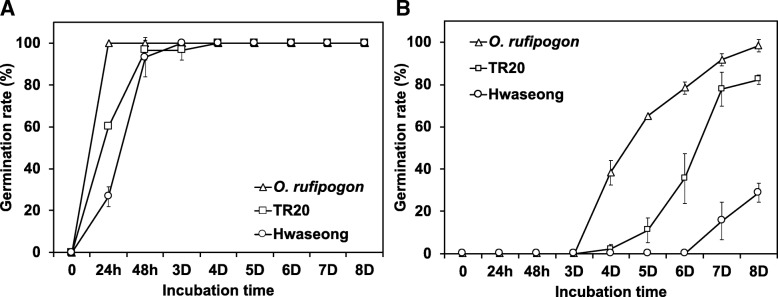
Rice (Oryza sativa L.) is generally sensitive to low temperatures, and in production systems that use direct-seeding, low-temperature germinability (LTG) is a desired trait. Previously, the QTLs, qLTG1 and qLTG3, that control LTG, were mapped using the BCF population, which is a cross of Korean elite cultivar Hwaseong and O. rufipogon (IRGC 105491). We have characterized and analyzed the interaction between the two QTLs, by crossing TR20 that has O. rufipogon alleles at qLTG1 and qLTG3 in a Hwaseong background, with Hwaseong, to develop an F population.
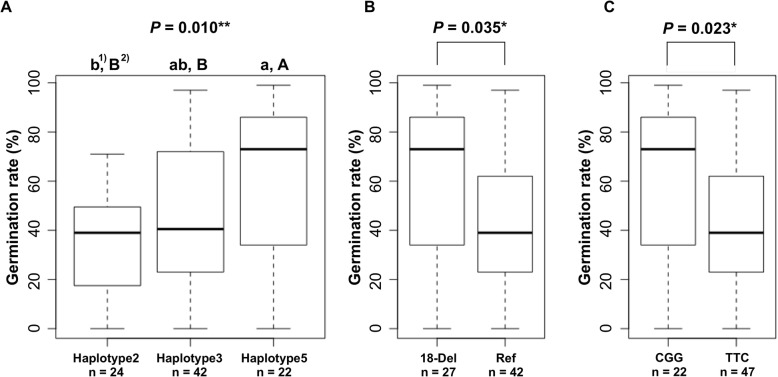
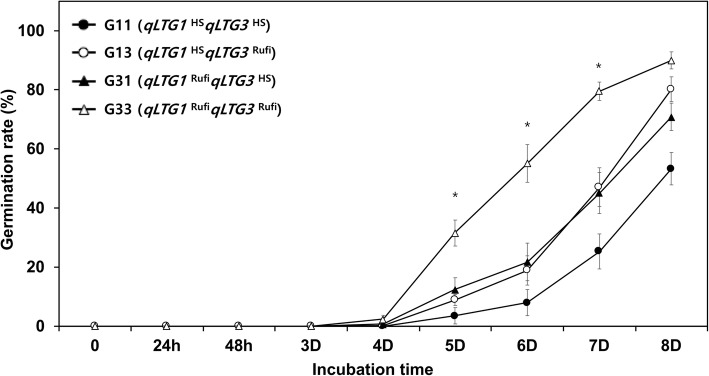
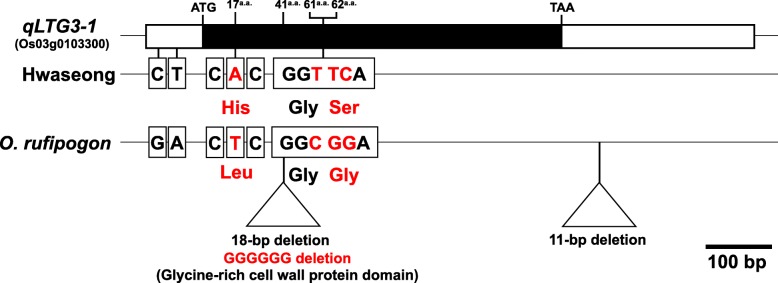
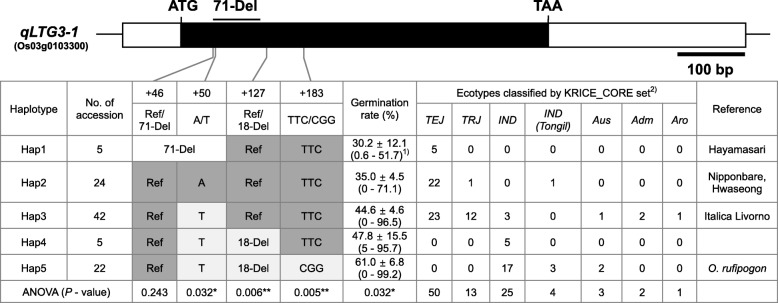
The F plants with both qLTG1 and qLTG3 alleles from O. rufipogon showed higher LTG scores, than the plants with only qLTG1 or qLTG3. No significant interaction between the qLTG1 and qLTG3 was observed, indicating that they may regulate LTG via different pathways. Based on its location, qLTG3 appears to be allelic with qLTG3-1, a major QTL known to control LTG. To investigate the genetic differences between the two parents, that were controlling LTG, we compared their qLTG3-1 sequences. In the coding region, three sequence variations leading to amino acid changes were identified between the Hwaseong and O. rufipogon. Of these, a non-synonymous substitution at the 62nd amino acid site, had not previously been reported. To understand the cause of the LTG variations between the parents, we genotyped three sequence variations of qLTG3-1, that were identified in 98 Asian cultivated rice accessions (Oryza sativa L.). The 98 accessions were classified into 5 haplotypes, based on three variations and a 71-bp deletion. Mean low-temperature germination rates were compared among the haplotypes, and haplotype 5 (O. rufipogon-type) showed a significantly higher germination rate than haplotype 2 (Nipponbare-type), and haplotype 3 (Italica Livorno-type).
The O. rufipogon qLTG3-1 allele can be utilized for the improvement of LTG in rice breeding programs. Nearly isogenic lines harboring both qLTG1 and qLTG3-1 alleles from O. rufipogon, showed higher LTG scores than the NILs with qLTG1 or qLTG3-1 alone, and the two QTLs regulate LTG via different pathways. To our knowledge, this is the first report to detect a new qLTG3-1 allele and analyze the interaction of the two LTG QTLs in a nearly isogenic background.
水稻(Oryza sativa L.)通常对低温敏感,在采用直播的生产系统中,低温发芽能力(LTG)是一个理想性状。此前,利用BCF群体(韩国优良品种华城与野生稻O. rufipogon(IRGC 105491)的杂交后代)定位了控制LTG的数量性状位点qLTG1和qLTG3。我们通过将在华城背景下qLTG1和qLTG3具有野生稻等位基因的TR20与华城杂交,构建了一个F群体,对这两个数量性状位点之间的相互作用进行了表征和分析。
来自野生稻的同时具有qLTG1和qLTG3等位基因的F植株,其LTG评分高于仅具有qLTG1或qLTG3的植株。未观察到qLTG1和qLTG3之间存在显著相互作用,表明它们可能通过不同途径调控LTG。基于其位置,qLTG3似乎与已知控制LTG的主要数量性状位点qLTG3 - 1等位。为了研究控制LTG的两个亲本之间的遗传差异,我们比较了它们的qLTG3 - 1序列。在编码区,在华城和野生稻之间鉴定出三个导致氨基酸变化的序列变异。其中,第62个氨基酸位点的非同义替换此前未见报道。为了解亲本之间LTG变异的原因,我们对在98份亚洲栽培稻种质(Oryza sativa L.)中鉴定出的qLTG3 - 1的三个序列变异进行了基因分型。基于这三个变异和一个71 bp的缺失,将这98份种质分为5个单倍型。比较了各单倍型的平均低温发芽率,单倍型5(野生稻型)的发芽率显著高于单倍型2(日本晴型)和单倍型3(意大利利沃诺型)。
野生稻qLTG3 - 1等位基因可用于水稻育种计划中改善LTG。同时含有来自野生稻qLTG1和qLTG3 - 1等位基因的近等基因系,其LTG评分高于仅含有qLTG1或qLTG3 - 1的近等基因系,且这两个数量性状位点通过不同途径调控LTG。据我们所知,这是首次在近等基因背景下检测到新的qLTG3 - 1等位基因并分析两个LTG数量性状位点相互作用的报道。