Morgado Fabiane F R, Meireles Juliana F F, Neves Clara M, Amaral Ana C S, Ferreira Maria E C
Institute of Education, Universidade Federal Rural do Rio de Janeiro, BR-465, km 7, Seropédica, Rio de Janeiro, 23890-000, Brazil.
Faculty of Psychology, Universidade Federal de Juiz de Fora, Rua José Lourenço Kelmer, s/n-Campus Universitário Bairro São Pedro, Juiz de Fora, Minas Gerais, 36036-900, Brazil.
Psicol Reflex Crit. 2017 Jan 25;30(1):3. doi: 10.1186/s41155-016-0057-1.
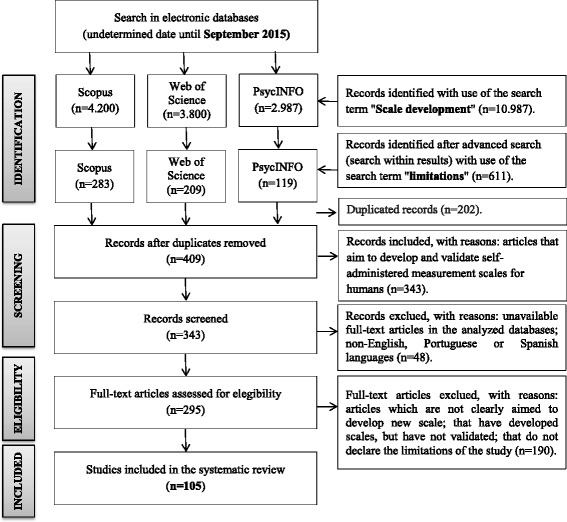
The scale development process is critical to building knowledge in human and social sciences. The present paper aimed (a) to provide a systematic review of the published literature regarding current practices of the scale development process, (b) to assess the main limitations reported by the authors in these processes, and (c) to provide a set of recommendations for best practices in future scale development research. Papers were selected in September 2015, with the search terms "scale development" and "limitations" from three databases: Scopus, PsycINFO, and Web of Science, with no time restriction. We evaluated 105 studies published between 1976 and 2015. The analysis considered the three basic steps in scale development: item generation, theoretical analysis, and psychometric analysis. The study identified ten main types of limitation in these practices reported in the literature: sample characteristic limitations, methodological limitations, psychometric limitations, qualitative research limitations, missing data, social desirability bias, item limitations, brevity of the scale, difficulty controlling all variables, and lack of manual instructions. Considering these results, various studies analyzed in this review clearly identified methodological weaknesses in the scale development process (e.g., smaller sample sizes in psychometric analysis), but only a few researchers recognized and recorded these limitations. We hope that a systematic knowledge of the difficulties usually reported in scale development will help future researchers to recognize their own limitations and especially to make the most appropriate choices among different conceptions and methodological strategies.
量表编制过程对于构建人文社会科学知识至关重要。本文旨在:(a)对已发表的关于量表编制过程当前实践的文献进行系统综述;(b)评估作者在这些过程中报告的主要局限性;(c)为未来量表编制研究的最佳实践提供一套建议。2015年9月选取论文,检索词为“量表编制”和“局限性”,来自三个数据库:Scopus、PsycINFO和Web of Science,无时间限制。我们评估了1976年至2015年间发表的105项研究。分析考虑了量表编制的三个基本步骤:项目生成、理论分析和心理测量分析。该研究确定了文献中报告的这些实践中的十种主要局限性类型:样本特征局限性、方法学局限性、心理测量局限性、定性研究局限性、数据缺失、社会期望偏差、项目局限性、量表简短性、难以控制所有变量以及缺乏操作指南。考虑到这些结果,本综述中分析的各种研究明确指出了量表编制过程中的方法学弱点(例如,心理测量分析中的样本量较小),但只有少数研究人员认识到并记录了这些局限性。我们希望,对量表编制中通常报告的困难有系统的了解,将有助于未来的研究人员认识到自己的局限性,特别是在不同概念和方法策略中做出最合适的选择。