Department of Gynecologic Oncology, Women's Hospital, School of Medicine Zhejiang University, Hangzhou, China.
Center for Uterine Cancer Diagnosis & Therapy Research of Zhejiang Province, Hangzhou, China.
J Gynecol Oncol. 2020 Jul;31(4):e36. doi: 10.3802/jgo.2020.31.e36. Epub 2020 Jan 7.
To assess the outcomes and toxic effects of 5-day actinomycin D (Act-D) salvage therapy and to explore the predictors of Act-D resistance in patients with low-risk gestational trophoblastic neoplasia (GTN)who failed 5-day methotrexate (MTX) chemotherapy.
This retrospective study analyzed patients with low-risk GTN administered Act-D salvage therapy after failing MTX chemotherapy at Women's Hospital, School of Medicine Zhejiang University between January 2000 and December 2015. The clinical parameters of these patients were collected and analyzed.
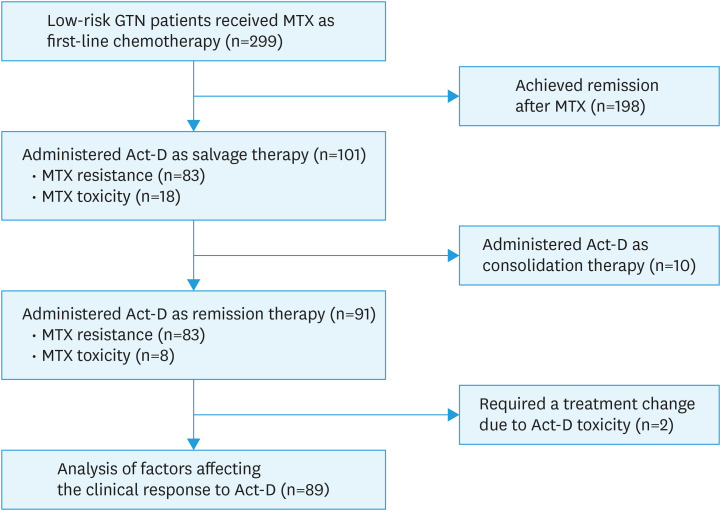
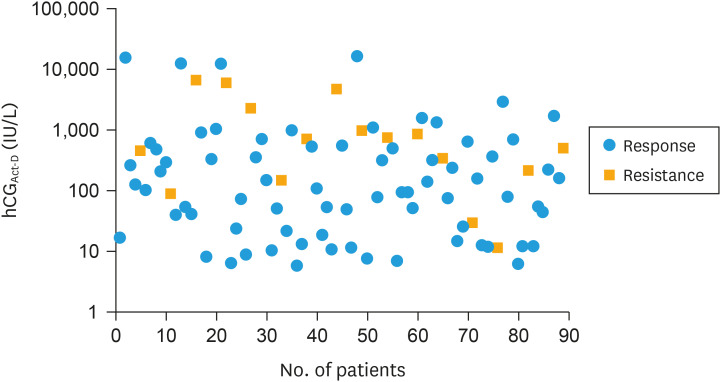
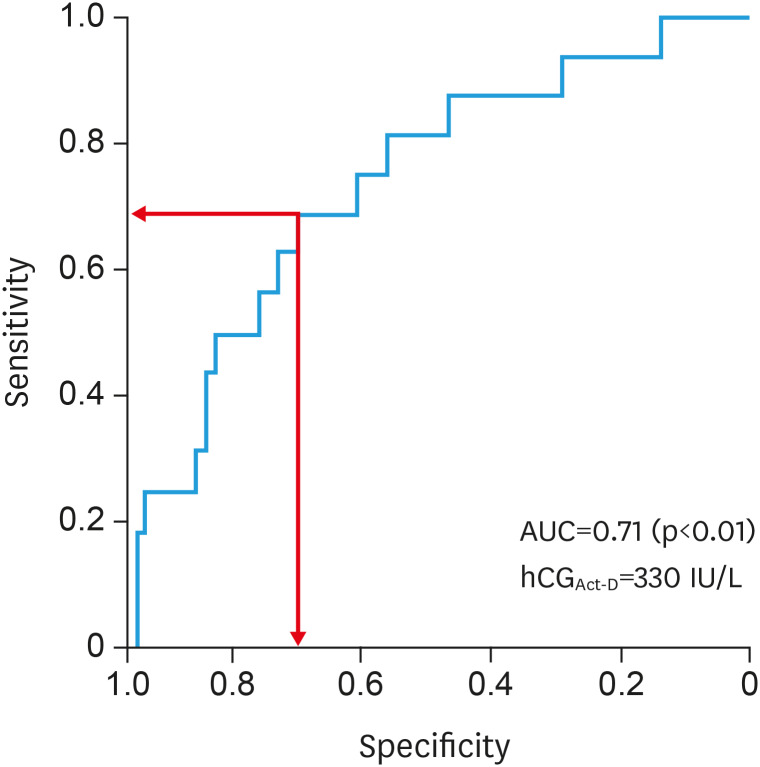
The final analysis included 89 cases. Of these, 73 cases (82.02%) responded to salvage Act-D. The remaining 16 resistant cases were switched to etoposide, MTX, Act-D/cyclophosphamide, and vincristine chemotherapy and achieved complete remission. Serum human chorionic gonadotrophin levels before Act-D salvage therapy (hCG)in the Act-D-resistant cases were significantly higher than those in the Act-D responders (median 605 vs. 103 IU/L, p=0.009). However, the range of hCG values in Act-D responders was wider than that in Act-D-resistant cases (5.76-16,664 IU/L vs. 11.43-6,732 IU/L). Thus, assigning a general cut-off value was difficult considering the individual setting. Except for 2 cases requiring other salvage regimens due to Act-D toxicity, 97.80% of cases (89/91) tolerated the toxicity. During at least 1-year follow-up, the survival rate was 100.00% and no case developed recurrence.
Based on the good therapeutic effect and tolerable toxicity, we recommend Act-D salvage therapy for all patients with low-risk GTN who fail primary MTX chemotherapy. The higher serum hCG levels before Act-D salvage therapy may be associated with resistance to this treatment.
评估低危妊娠滋养细胞肿瘤(GTN)患者在接受甲氨蝶呤(MTX)化疗失败后,采用 5 天放线菌素 D(Act-D)挽救治疗的结局和毒副作用,并探索 Act-D 耐药的预测因素。
本回顾性研究分析了 2000 年 1 月至 2015 年 12 月在浙江大学医学院附属妇产科医院接受 Act-D 挽救治疗的低危 GTN 患者。收集并分析这些患者的临床参数。
最终分析纳入 89 例患者。其中,73 例(82.02%)对挽救性 Act-D 治疗有反应。其余 16 例耐药患者被换用依托泊苷、MTX、Act-D/环磷酰胺和长春新碱化疗,并获得完全缓解。Act-D 耐药患者的 Act-D 挽救治疗前血清人绒毛膜促性腺激素(hCG)水平显著高于 Act-D 应答者(中位数 605 vs. 103 IU/L,p=0.009)。然而,Act-D 应答者的 hCG 值范围比 Act-D 耐药者更宽(5.76-16664 IU/L vs. 11.43-6732 IU/L)。因此,考虑到个体差异,很难设定一个通用的截断值。除了 2 例因 Act-D 毒性需要其他挽救方案外,97.80%的病例(89/91)能够耐受毒性。在至少 1 年的随访期间,生存率为 100.00%,无病例复发。
基于良好的治疗效果和可耐受的毒性,我们建议所有接受初次 MTX 化疗失败的低危 GTN 患者采用 Act-D 挽救治疗。Act-D 挽救治疗前血清 hCG 水平较高可能与该治疗的耐药性相关。