Department of Neuroscience, The Scripps Research Institute, La Jolla, CA, USA.
Department of Genetics and Neurology, University of North Carolina, Chapel Hill, NC, USA.
Addict Biol. 2021 Jan;26(1):e12877. doi: 10.1111/adb.12877. Epub 2020 Feb 6.
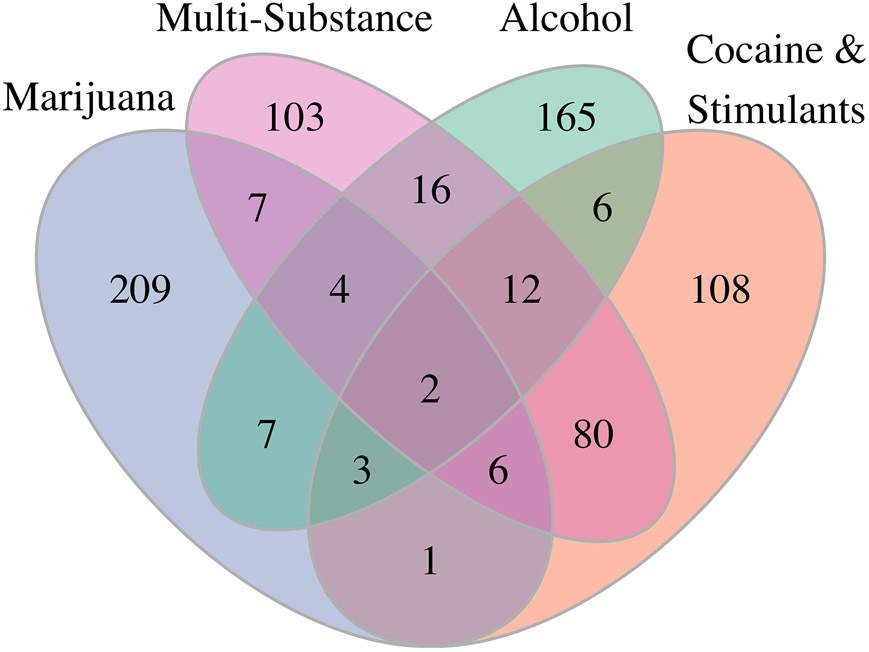
Alcohol and other substance use disorders (AUD and SUD) are complex diseases that are postulated to have a polygenic inheritance and are often comorbid with other disorders. The comorbidities may arise partially through genetic pleiotropy. Identification of specific gene variants accounting for large parts of the variance in these disorders has yet to be accomplished. We describe a flexible strategy that takes a variant-trait association database and determines if a subset of disease/straits are potentially pleiotropic with the disorder under study. We demonstrate its usage in a study of use disorders in two independent cohorts: alcohol, stimulants, cannabis (CUD), and multi-substance use disorders (MSUD) in American Indians (AI) and AUD and CUD in Mexican Americans (MA). Using a machine learning method with variants in GWAS catalog, we identified 229 to 246 pleiotropic variants for AI and 153 to 160 for MA for each SUD. Inflammation was the most enriched for MSUD and AUD in AIs. Neurological disorder was the most significantly enriched for CUD in both cohorts, and for AUD and stimulants in AIs. Of the select pleiotropic genes shared among substances-cohorts, multiple biological pathways implicated in SUD and other psychiatric disorders were enriched, including neurotrophic factors, immune responses, extracellular matrix, and circadian regulation. Shared pleiotropic genes were significantly up-regulated in brain regions playing important roles in SUD, down-regulated in esophagus mucosa, and differentially regulated in adrenal gland. This study fills a gap for pleiotropy detection in understudied admixed populations and identifies pleiotropic variants that may be potential targets of interest for SUD.
酒精和其他物质使用障碍(AUD 和 SUD)是复杂的疾病,据推测具有多基因遗传,并且常常与其他疾病共病。这些共病可能部分通过遗传多效性产生。尚未确定特定基因变异体可解释这些疾病中大部分变异的情况。我们描述了一种灵活的策略,该策略采用变体-特征关联数据库,并确定疾病/特征子集是否与正在研究的疾病潜在存在多效性。我们在两个独立队列中使用该策略对使用障碍进行了研究:美国印第安人(AI)的酒精、兴奋剂、大麻(CUD)和多物质使用障碍(MSUD)以及墨西哥裔美国人(MA)的 AUD 和 CUD。使用基于 GWAS 目录的变体的机器学习方法,我们确定了 229 到 246 个与 AI 中的每种 SUD 潜在多效的变体,以及 153 到 160 个与 MA 中的每种 SUD 潜在多效的变体。在 AI 中,炎症在 MSUD 和 AUD 中最为丰富。在两个队列中,神经系统疾病在 CUD 中最为显著,在 AI 中在 AUD 和兴奋剂中也最为显著。在物质-队列共有的选择多效性基因中,包括神经营养因子、免疫反应、细胞外基质和昼夜节律调节在内的多种与 SUD 和其他精神障碍相关的生物学途径都被富集。共享的多效性基因在 SUD 中起重要作用的大脑区域中显著上调,在食道粘膜中下调,在肾上腺中差异调节。这项研究填补了在研究不足的混合人群中检测多效性的空白,并确定了可能是 SUD 潜在感兴趣的多效性变异体。