Melanoma Immunology and Oncology Group, The Centenary Institute, Royal Prince Alfred Hospital, University of Sydney, Camperdown, New South Wales, Australia.
Melanoma Institute Australia, The University of Sydney, Sydney, New South Wales, Australia.
Pigment Cell Melanoma Res. 2020 Sep;33(5):660-670. doi: 10.1111/pcmr.12870. Epub 2020 Feb 20.
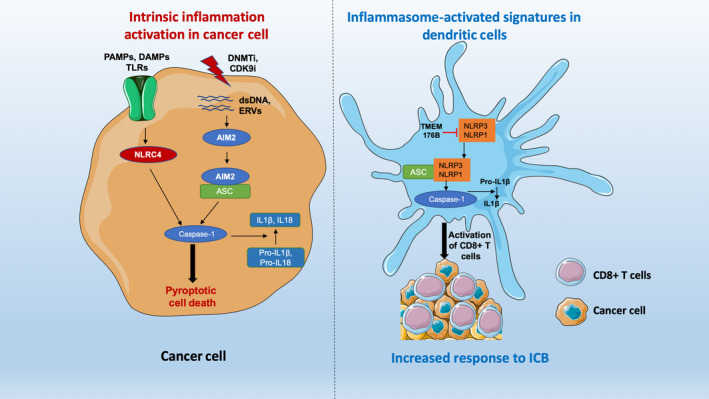
Melanoma, as for many other cancers, undergoes a selection process during progression that limits many innate and adaptive tumor control mechanisms. Immunotherapy with immune checkpoint blockade overcomes one of the escape mechanisms but if the tumor is not eliminated other escape mechanisms evolve that require new approaches for tumor control. Some of the innate mechanisms that have evolved against infections with microorganisms and viruses are proving to be active against cancer cells but require better understanding of how they are activated and what inhibitory mechanisms may need to be targeted. This is particularly so for inflammasomes which have evolved against many different organisms and which recruit a number of cytotoxic mechanisms that remain poorly understood. Equally important is understanding of where these mechanisms will fit into existing treatment strategies and whether existing strategies already involve the innate killing mechanisms.
黑色素瘤与许多其他癌症一样,在进展过程中经历选择过程,限制了许多先天和适应性的肿瘤控制机制。免疫检查点阻断的免疫疗法克服了其中一种逃逸机制,但如果肿瘤未被消除,其他逃逸机制会随之演变,这需要新的肿瘤控制方法。一些针对微生物和病毒感染而进化的先天机制已被证明对癌细胞有效,但需要更好地了解它们是如何被激活的,以及哪些抑制机制可能需要靶向。对于炎性小体来说尤其如此,它们是针对许多不同的生物体进化而来的,并且招募了许多仍不为人知的细胞毒性机制。同样重要的是要了解这些机制将如何融入现有的治疗策略,以及现有的策略是否已经涉及先天杀伤机制。