Infectious and Tropical Diseases Research Center, Health Research Institute, Ahvaz Jundishapur University of Medical Sciences, Ahvaz, Khuzestan, Iran.
Department of Parasitology, School of Medicine, Ahvaz Jundishapur University of Medical Sciences, Ahvaz, Khuzestan, Iran.
PLoS One. 2020 Feb 6;15(2):e0228317. doi: 10.1371/journal.pone.0228317. eCollection 2020.
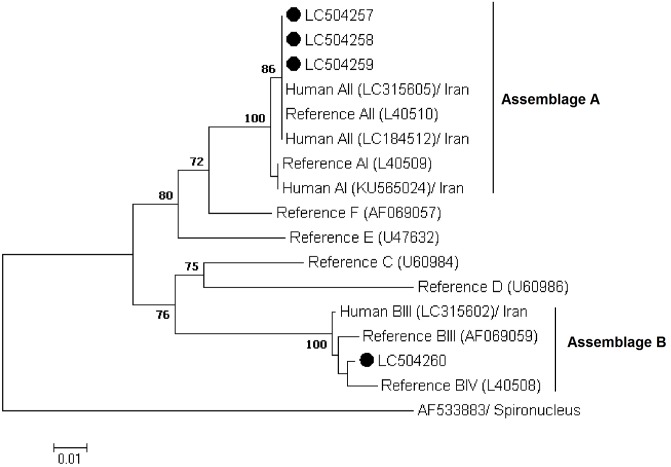
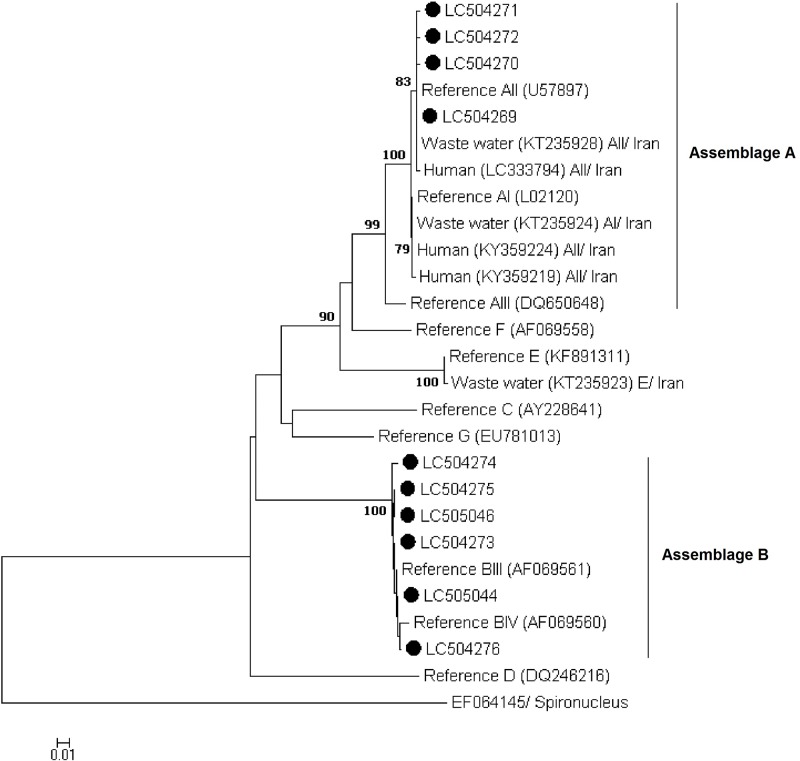
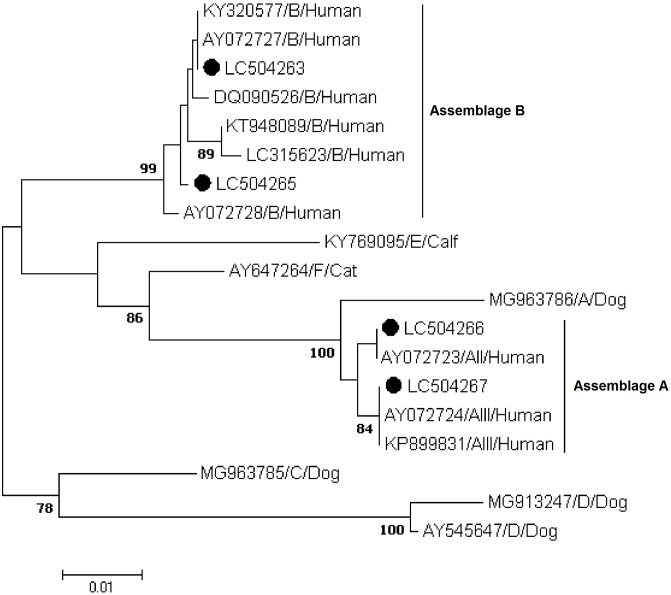
Giardia duodenalis is one of the main enteric pathogens associated with diarrheal disease. In developing countries, giardiasis is a major public health concern, particularly in children under five years of age. This study aimed to evaluate the occurrence and genetic diversity of G. duodenalis causing human infections in Shushtar County, Southwestern Iran. Individual faecal specimens were collected from 1,163 individuals (male/female ratio: 0.9; age range 2-75 years) with (n = 258) and without (n = 905) gastrointestinal symptoms living in rural and urban settings during the period 2017-2018. Conventional (sucrose flotation and microscopy) methods were used for the initial detection of G. duodenalis cysts in faecal specimens. Microscopy-positive samples were confirmed by PCR amplification and sequencing of the small subunit rRNA (ssu rRNA) gene of the parasite. A multilocus genotyping (MLG) scheme targeting the triose phosphate isomerase (tpi), the glutamate dehydrogenase (gdh), and the beta-giardin (bg) genes was used for genotyping purposes. Giardia duodenalis cysts were detected in 7.7% (90/1,163) of samples by microscopy, of which 82 were confirmed by ssu-PCR. Successful amplification and sequencing results were obtained for 23.2% (19/82), 9.8% (8/82), and 8.5% (7/82) of the confirmed samples at the tpi, gdh, and bg loci, respectively. MLG data for the three loci were available for two samples only. Out of the 24 samples genotyped at any loci, 50% (12/24) were identified as assemblage A and the remaining half as assemblage B. Overall, AII was the most prevalent sub-assemblage detected (41.7%, 10/24), followed by BIII (25.0%, 6/24), discordant BIII/BIV (5/24) or AII/AIII (2/24) sequences, and BIV (1/24). No significant correlation was demonstrated between a given assemblage/sub-assemblage and the occurrence of clinical symptoms. No genotypes adapted to animal hosts other than humans (e.g. assemblages C-F) were found circulating in the investigated human population, suggesting that transmission of human giardiasis in this Iranian region is primarily of anthroponotic nature. Further molecular-based studies are needed to confirm and expand these results, and to ascertain the presence and public health relevance of the parasite in environmental (e.g. drinking water) samples.
十二指肠贾第鞭毛虫是与腹泻病相关的主要肠道病原体之一。在发展中国家,贾第虫病是一个主要的公共卫生关注点,特别是在五岁以下儿童中。本研究旨在评估伊朗西南部舒什塔尔县引起人类感染的贾第鞭毛虫的发生和遗传多样性。在 2017 年至 2018 年期间,从农村和城市地区的 1163 名个体(男/女比例:0.9;年龄范围 2-75 岁)中采集了个体粪便标本,其中 258 名有(n=258)和没有(n=905)胃肠道症状。使用常规(蔗糖漂浮和显微镜)方法初步检测粪便标本中的十二指肠贾第鞭毛虫包囊。显微镜阳性样本通过寄生虫小亚单位 rRNA(ssu rRNA)基因的 PCR 扩增和测序进行确认。针对三磷酸甘油醛异构酶(tpi)、谷氨酸脱氢酶(gdh)和β-微管蛋白(bg)基因的多位点基因分型(MLG)方案用于基因分型目的。通过显微镜检测到 7.7%(90/1163)的样本中存在十二指肠贾第鞭毛虫包囊,其中 82 个通过 ssu-PCR 确认。在确认的样本中,23.2%(19/82)、9.8%(8/82)和 8.5%(7/82)成功扩增和测序结果分别获得了 tpi、gdh 和 bg 基因。在任何基因座进行基因分型的 24 个样本中,只有两个样本获得了三个基因座的 MLG 数据。在进行基因分型的 24 个样本中,有 50%(12/24)鉴定为 A 群,其余一半为 B 群。总体而言,检测到的最常见亚群为 AII(41.7%,10/24),其次是 BIII(25.0%,6/24)、不相符的 BIII/BIV(5/24)或 AII/AIII(2/24)序列和 BIV(1/24)。未发现特定组合/亚组合与临床症状的发生之间存在显著相关性。在所研究的人群中未发现除人类以外的动物宿主适应性基因型(例如组合 C-F),这表明该地区的人类贾第虫病传播主要是人际传播。需要进一步的基于分子的研究来证实和扩展这些结果,并确定寄生虫在环境(例如饮用水)样本中的存在和公共卫生相关性。