Foisy Hélène, Pioche Mathieu, Chabrun Edouard, Ponchon Thierry, Zerbib Frank, Rivory Jérôme, Mion François, Roman Sabine
Université de Lyon, Hospices Civils de Lyon, Gastroenterology, Hopital E Herriot, Lyon, France.
Université de Lyon, Lyon I University, Digestive Physiology, Lyon, France.
J Neurogastroenterol Motil. 2020 Apr 30;26(2):204-214. doi: 10.5056/jnm19135.
BACKGROUND/AIMS: Peroral endoscopy myotomy (POEM) is effective to treat achalasia. We aim to determine POEM effect on esophageal function and search for predictive factors of response to POEM and co-occurrence of gastroesophageal reflux disease (GERD).
A total of 64 untreated achalasia patients who underwent high-resolution manometry (HRM) before and 3 months after POEM were retrospectively included. Response to treatment was defined as an Eckardt score < 3. Reflux symptoms and patient's satisfaction were evaluated. Data were compared using paired t test, Chi-square test or log rank test.
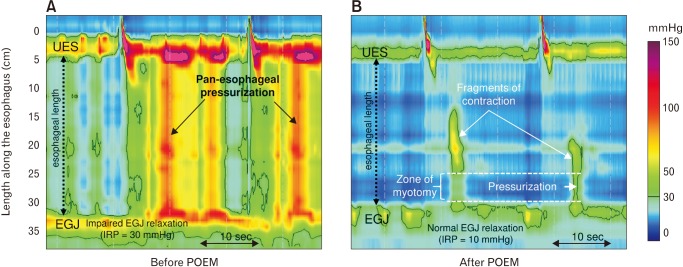
The 2-year success rate in response to POEM was 90%. All responders reported being satisfied while only 33% of non-responders did ( < 0.001) and 64% of patients with reflux symptoms were satisfied versus 96% of those without ( = 0.009). On HRM, the integrated relaxation pressure and the contractile pattern changed significantly after POEM but were not predictive of response. Between pre and post POEM HRM, a decrease in maximal esophageal pressurization during rapid drink challenge (RDC) was associated with a better response rate than an increase of pressurization (91% vs 50%, = 0.004). As evidenced by pH monitoring performed after POEM, GERD was pathological or borderline in 50% of patients (18/36) while only 19% (11/59) reported clinically significant reflux symptoms. On post POEM HRM, maximal esophageal pressurization during RDC was lower in patients with pathological or borderline GERD compared to those without ( = 0.054).
Esophageal HRM parameters changed significantly after POEM. Maximal esophageal pressurization during RDC may be useful to predict outcome.
背景/目的:经口内镜下肌切开术(POEM)治疗贲门失弛缓症有效。我们旨在确定POEM对食管功能的影响,并寻找POEM反应的预测因素以及胃食管反流病(GERD)的共病情况。
回顾性纳入64例未经治疗的贲门失弛缓症患者,这些患者在POEM术前和术后3个月接受了高分辨率测压(HRM)。治疗反应定义为埃卡德特评分<3。评估反流症状和患者满意度。使用配对t检验、卡方检验或对数秩检验比较数据。
POEM治疗的2年成功率为90%。所有有反应者均表示满意,而无反应者中只有33%满意(<0.001),有反流症状的患者中64%满意,无反流症状的患者中96%满意(=0.009)。在HRM上,POEM术后综合松弛压和收缩模式有显著变化,但不能预测反应。在POEM术前和术后HRM之间,快速饮水试验(RDC)期间最大食管增压降低的患者反应率优于增压增加的患者(91%对50%,=0.004)。POEM术后pH监测显示,50%的患者(18/36)存在病理性或临界性GERD,而只有19%(11/59)报告有临床显著的反流症状。在POEM术后HRM上,病理性或临界性GERD患者在RDC期间的最大食管增压低于无GERD患者(=0.054)。
POEM术后食管HRM参数有显著变化。RDC期间的最大食管增压可能有助于预测结果。