Department of Nutrition Science, Purdue University, West Lafayette, Indiana; the Office of Dietary Supplements, National Institutes of Health, Bethesda, Maryland; the Department of Nutrition and Integrative Physiology, University of Utah, Salt Lake City, Utah; and the Department of Pediatrics, School of Medicine, University of Colorado, Aurora, Colorado.
Obstet Gynecol. 2020 Mar;135(3):623-633. doi: 10.1097/AOG.0000000000003657.
To estimate the prevalence of use and the micronutrient contribution of dietary supplements among pregnant, lactating, and nonpregnant and nonlactating women in the United States.
Cross-sectional data from 1,314 pregnant, 297 lactating, and 8,096 nonpregnant and nonlactating women (aged 20-44 years) in the 1999-2014 National Health and Nutrition Examination Survey were combined to produce statistically reliable, nationally representative estimates. Information about dietary supplements used in the past 30 days was collected through an interviewer-administered questionnaire and in-home inventory. The prevalence of nutrient-specific supplement use, mean daily nutrient intakes from supplements among users, and motivations for supplement use were assessed. Differences by age, income, and trimester within pregnant women were also tested.
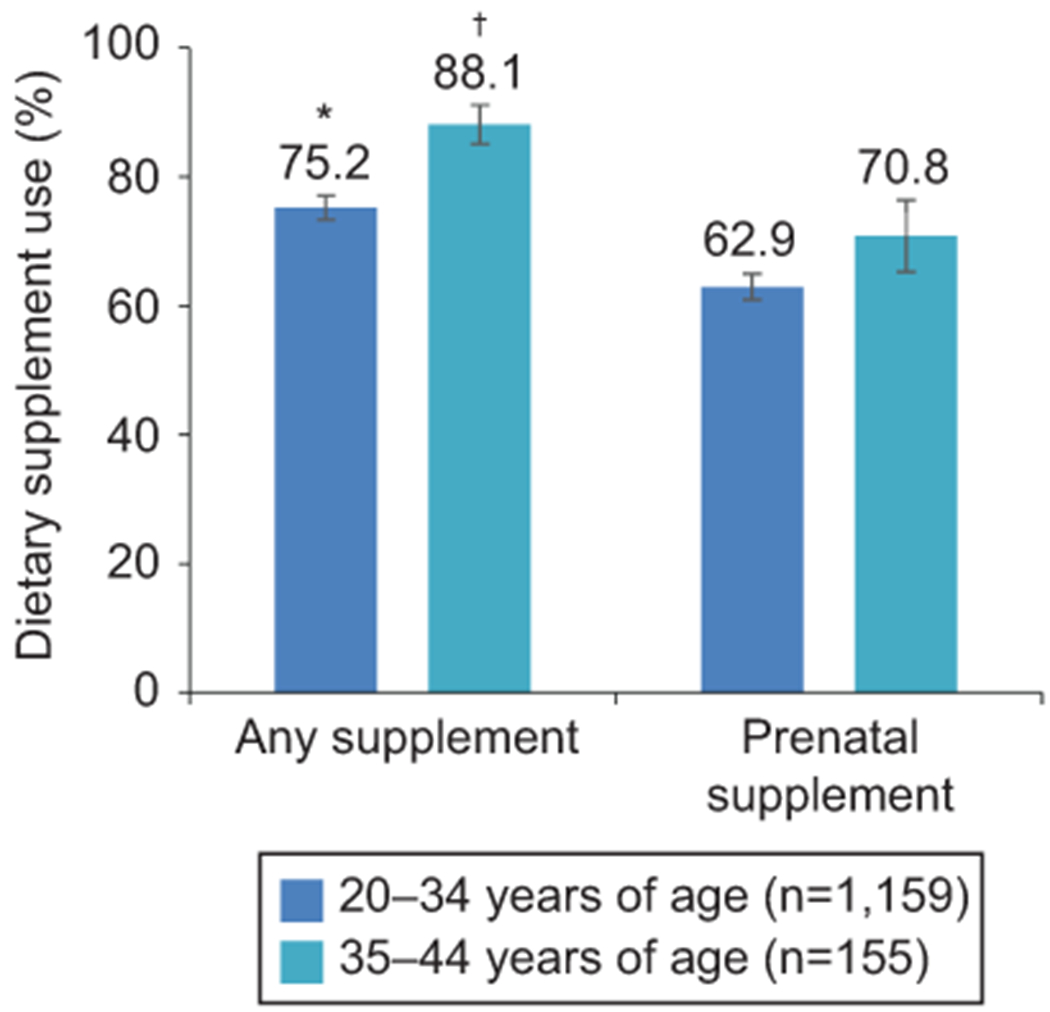
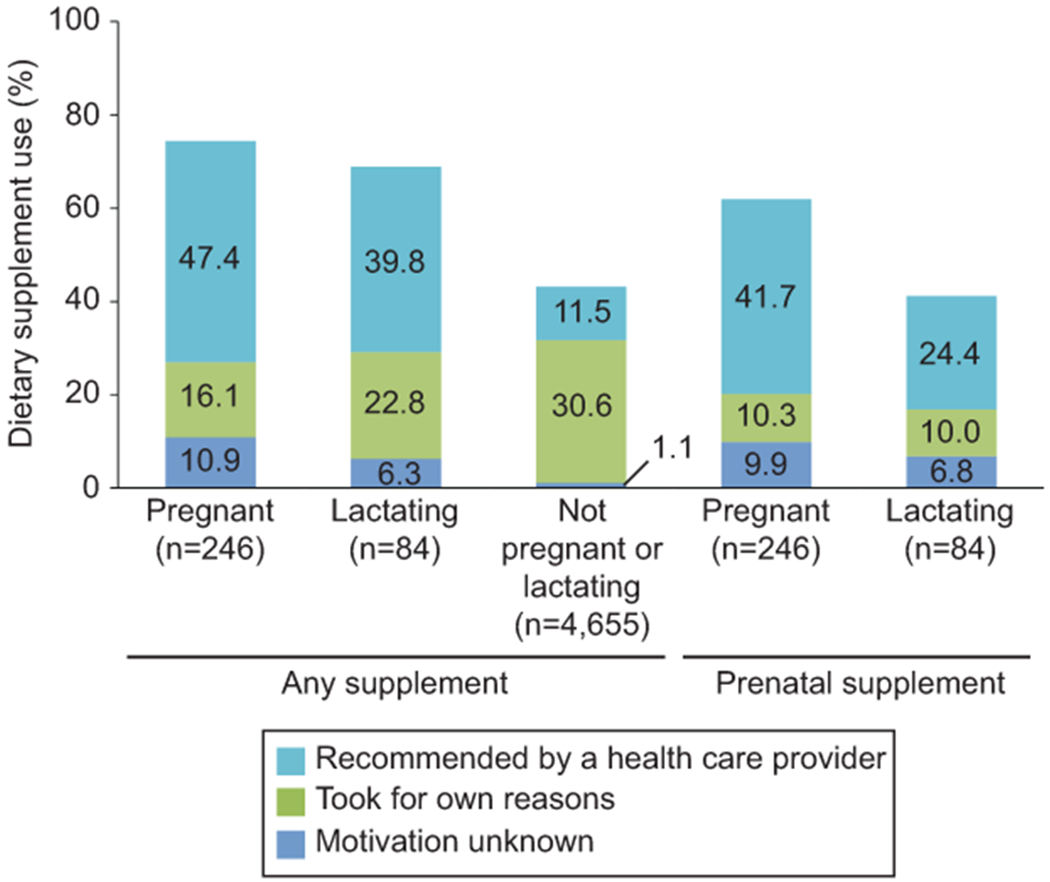
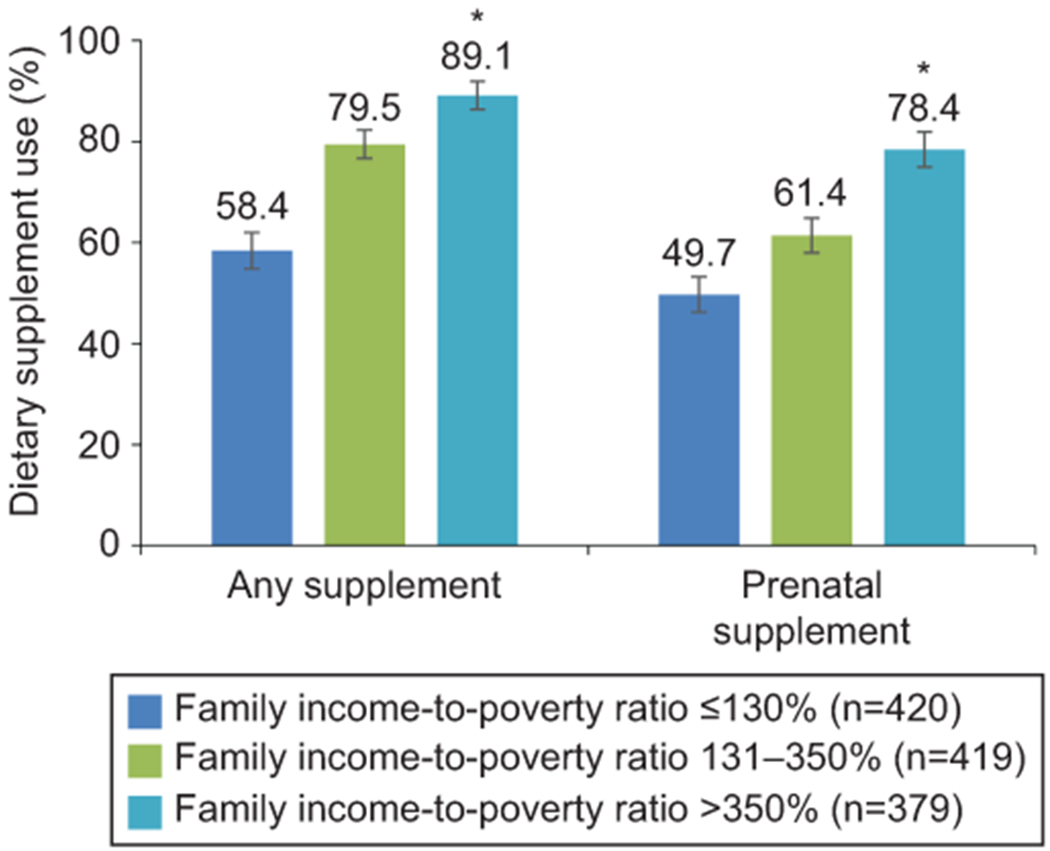
Seventy-seven percent of pregnant women and 70% of lactating women used one or more dietary supplements, whereas 45% of nonpregnant and nonlactating women used supplements. In particular, 64% of pregnant and 54% of lactating women used prenatal supplements. Mean intakes of thiamin, riboflavin, niacin, folic acid, vitamins B6, B12, and C, iron, and zinc from supplements alone were at or above their respective recommended dietary allowances (RDAs) among pregnant and lactating supplement users. About half of pregnant and 40% of lactating women took supplements based on the recommendation of a health care provider. Among pregnant women, those in their first trimester, aged 20-34 years, or in a lower-income family were less likely to use supplements compared with their counterparts.
The majority of pregnant and lactating women used dietary supplements, which contributed many nutrients in doses above the RDAs. Although inadequate Intakes of folate and iron are of concern among pregnant women who are not using supplements, supplement users often consumed high doses, suggesting a potential need of health care providers to discuss dietary supplement use and the recommended doses of nutrients during pregnancy and lactation.
估计美国孕妇、哺乳期妇女和非孕妇、非哺乳期妇女使用膳食补充剂的流行率及其微量营养素的摄入量。
将 1999-2014 年全国健康和营养调查中 1314 名孕妇、297 名哺乳期妇女和 8096 名非孕妇、非哺乳期妇女(年龄 20-44 岁)的横断面数据进行合并,以产生具有统计学可靠性的全国代表性估计值。通过访谈者管理的问卷和家庭库存收集过去 30 天内使用膳食补充剂的信息。评估了特定营养素补充剂的使用流行率、使用者中补充剂的每日营养素摄入量以及补充剂使用的动机。还测试了孕妇中不同年龄、收入和孕期的差异。
77%的孕妇和 70%的哺乳期妇女使用了一种或多种膳食补充剂,而 45%的非孕妇和非哺乳期妇女使用了补充剂。特别是,64%的孕妇和 54%的哺乳期妇女使用了产前补充剂。仅从补充剂中获得的硫胺素、核黄素、烟酸、叶酸、维生素 B6、B12 和 C、铁和锌的平均摄入量在孕妇和哺乳期补充剂使用者中达到或超过了其相应的推荐膳食允许量(RDA)。大约一半的孕妇和 40%的哺乳期妇女根据医疗保健提供者的建议服用补充剂。与对照组相比,处于孕早期、年龄在 20-34 岁之间或家庭收入较低的孕妇更不可能使用补充剂。
大多数孕妇和哺乳期妇女使用膳食补充剂,这些补充剂以剂量高于 RDA 的形式提供了许多营养素。虽然不使用补充剂的孕妇中叶酸和铁的摄入量不足令人担忧,但补充剂使用者通常摄入高剂量,这表明医疗保健提供者在妊娠和哺乳期期间需要讨论膳食补充剂的使用和建议的营养素剂量。