Center for Cooperative Research in Biomaterials (CIC biomaGUNE), Basque Research and Technology Alliance (BRTA), Paseo de Miramon 182, 20014 Donostia San Sebastián, Spain.
Instituto Biofisika UPV/EHU, CSIC, Barrio Sarriena s/n, Leioa, E-48940 Bizkaia, Spain.
Int J Mol Sci. 2020 Feb 3;21(3):1007. doi: 10.3390/ijms21031007.
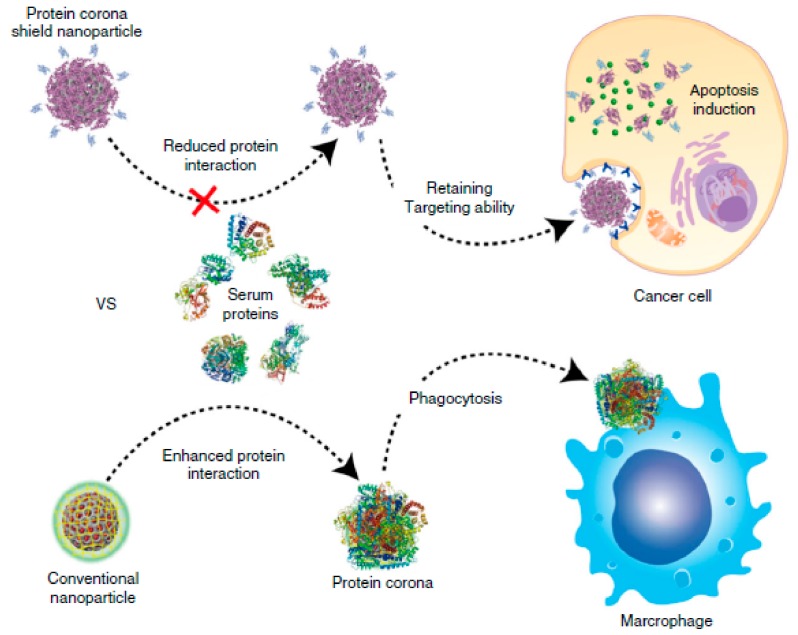
Biofouling is a major issue in the field of nanomedicine and consists of the spontaneous and unwanted adsorption of biomolecules on engineered surfaces. In a biological context and referring to nanoparticles (NPs) acting as nanomedicines, the adsorption of biomolecules found in blood (mostly proteins) is known as protein corona. On the one hand, the protein corona, as it covers the NPs' surface, can be considered the biological identity of engineered NPs, because the corona is what cells will "see" instead of the underlying NPs. As such, the protein corona will influence the fate, integrity, and performance of NPs in vivo. On the other hand, the physicochemical properties of the engineered NPs, such as their size, shape, charge, or hydrophobicity, will influence the identity of the proteins attracted to their surface. In this context, the design of coatings for NPs and surfaces that avoid biofouling is an active field of research. The gold standard in the field is the use of polyethylene glycol (PEG) molecules, although zwitterions have also proved to be efficient in preventing protein adhesion and fluorinated molecules are emerging as coatings with interesting properties. Hence, in this review, we will focus on recent examples of anti-biofouling coatings in three main areas, that is, PEGylated, zwitterionic, and fluorinated coatings.
生物污染是纳米医学领域的一个主要问题,它是指生物分子在工程表面上自发且不受欢迎的吸附。在生物学背景下,针对作为纳米药物的纳米粒子 (NPs),血液中发现的生物分子(主要是蛋白质)的吸附被称为蛋白冠。一方面,由于蛋白冠覆盖了 NPs 的表面,因此可以将其视为工程化 NPs 的生物学特征,因为细胞将看到的是覆盖在 NPs 表面的蛋白冠,而不是底层的 NPs。因此,蛋白冠将影响 NPs 在体内的命运、完整性和性能。另一方面,工程化 NPs 的物理化学性质,如大小、形状、电荷或疏水性,将影响吸引到其表面的蛋白质的特性。在这种情况下,设计可避免生物污染的 NPs 和表面涂层是一个活跃的研究领域。该领域的金标准是使用聚乙二醇 (PEG) 分子,尽管两性离子也已被证明能有效防止蛋白质黏附,氟化分子作为具有有趣特性的涂层也崭露头角。因此,在这篇综述中,我们将重点关注三个主要领域中最近的抗生物污染涂层的例子,即 PEG 化、两性离子和氟化涂层。