Zhao Qing, Luan Xin, Zheng Min, Tian Xin-Hui, Zhao Jing, Zhang Wei-Dong, Ma Bing-Liang
Department of Pharmacology, School of Pharmacy, Shanghai University of Traditional Chinese Medicine, Shanghai 201203, China.
Institute of Interdisciplinary Integrative Medicine Research, Shanghai University of Traditional Chinese Medicine, Shanghai 201203, China.
Pharmaceutics. 2020 Feb 3;12(2):128. doi: 10.3390/pharmaceutics12020128.
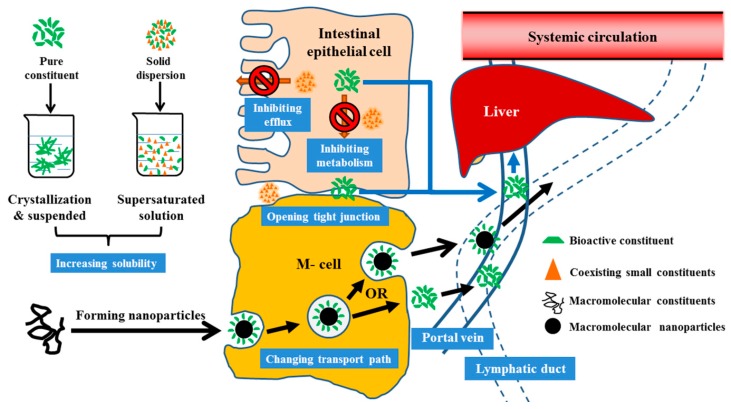
The systematic separation strategy has long and widely been applied in the research and development of herbal medicines. However, the pharmacological effects of many bioactive constituents are much weaker than those of the corresponding herbal extracts. Thus, there is a consensus that purer herbal extracts are sometimes less effective. Pharmacological loss of purified constituents is closely associated with their significantly reduced intestinal absorption after oral administration. In this review, pharmacokinetic synergies among constituents in herbal extracts during intestinal absorption were systematically summarized to broaden the general understanding of the pharmaceutical nature of herbal medicines. Briefly, some coexisting constituents including plant-produced primary and secondary metabolites, promote the intestinal absorption of active constituents by improving solubility, inhibiting first-pass elimination mediated by drug-metabolizing enzymes or drug transporters, increasing the membrane permeability of enterocytes, and reversibly opening the paracellular tight junction between enterocytes. Moreover, some coexisting constituents change the forms of bioactive constituents via mechanisms including the formation of natural nanoparticles. This review will focus on explaining this new synergistic mechanism. Thus, herbal extracts can be considered mixtures of bioactive compounds and pharmacokinetic synergists. This review may provide ideas and strategies for further research and development of herbal medicines.
系统分离策略长期以来一直在草药研发中得到广泛应用。然而,许多生物活性成分的药理作用远弱于相应的草药提取物。因此,人们普遍认为,纯度更高的草药提取物有时效果反而更差。纯化成分的药理活性丧失与其口服后肠道吸收显著降低密切相关。在本综述中,系统总结了草药提取物成分在肠道吸收过程中的药代动力学协同作用,以拓宽对草药药物性质的普遍认识。简而言之,一些共存成分,包括植物产生的初级和次级代谢产物,通过改善溶解度、抑制药物代谢酶或药物转运体介导的首过消除、增加肠上皮细胞的膜通透性以及可逆地打开肠上皮细胞间的细胞旁紧密连接,促进活性成分的肠道吸收。此外,一些共存成分通过包括形成天然纳米颗粒在内的机制改变生物活性成分的形式。本综述将重点解释这种新的协同机制。因此,草药提取物可被视为生物活性化合物和药代动力学增效剂的混合物。本综述可能为草药的进一步研发提供思路和策略。