Health and Rehabilitation Sciences Program, Faculty of Health Sciences, University of Western Ontario, London, Ontario, Canada.
School of Health Studies, Faculty of Health Sciences, University of Western Ontario, London, Ontario, Canada.
Int J Behav Nutr Phys Act. 2020 Feb 7;17(1):14. doi: 10.1186/s12966-020-0912-4.
Early experiences in physical activity (PA) are important to shape healthy movement behaviours long-term; as such, it is critical that PA is promoted from infancy, and that detrimental behaviours (e.g., prolonged sedentary time [ST]) are minimized. The purpose of this systematic review and meta-analysis was to examine infants' and toddlers' movement behaviours across daytime hours.
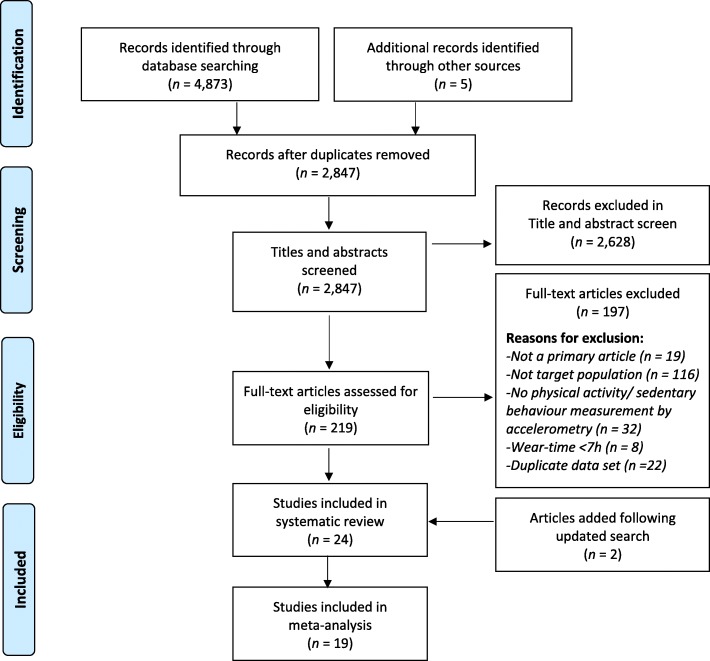
Seven online databases were searched for terms related to infants (< 12 months), toddlers (12-35.9 months), PA, ST, and accelerometry. Two independent reviewers examined 4873 articles for peer-reviewed original research, published in English, that assessed infants' (counts/min) and/or toddlers' PA or ST (min/day) using accelerometry across daytime hours. Infants' mean PA level (counts/min) was averaged across studies, and ranges were produced. Estimates of toddlers' movement behaviours were aggregated meta-analytically to produce average daily rates, and accelerometer placement, cut-point validity, device type, and epoch length were tested as a moderating variables.
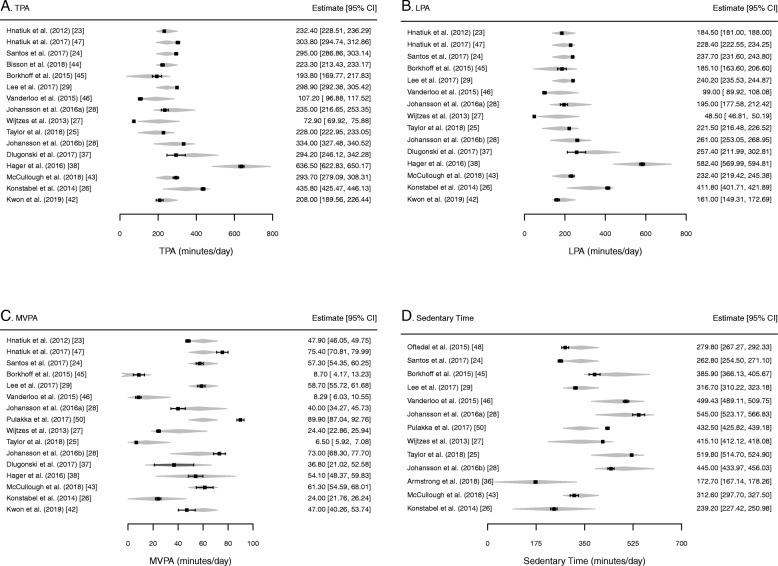
Twenty-four studies from 16 countries (published 2011-2019), representing 3699 participants, were included in the systematic review. Five studies reported on infants' PA, which ranged from 78.2 to 2580.5 cpm. Across 20 studies, toddlers' total PA, light PA, moderate-to vigorous-intensity PA, and ST ranged from 72.9 to 636.5, 48.5 to 582.4, 6.5 to 89.9, and 172.7 to 545.0 min/day, respectively. After taking into account accelerometer placement, cut-point validity, device type, and epoch length, we found that toddlers engaged in 246.19 min/day (SE = 28.50; 95% CI: 190.34, 302.04) of total PA, 194.10 min/day (SE = 28.76; 95% CI: 137.73, 250.47) of light PA, and 60.16 min/day (SE = 5.88; 95% CI: 48.64, 71.69) of moderate-to vigorous-intensity PA. Toddlers engaged in 337.04 min/day (SE = 32.67; 95% CI: 273.01, 401.07) of ST.
With limited studies conducted in infants (n = 5), PA estimates are inconclusive and largely heterogeneous. Overall, toddlers tend to exceed the total PA recommendation of 180 min/day; however, very little of this time is spent at higher movement intensities. Even with high PA rates, toddlers still engage in substantial ST. More consistent and valid measurement protocols are needed to improve comparability across studies.
早期的身体活动(PA)经历对于长期塑造健康的运动行为很重要;因此,从婴儿期开始促进 PA 并尽量减少有害行为(例如,长时间久坐)至关重要。本系统评价和荟萃分析的目的是检查婴儿和幼儿在白天的活动情况。
为了查找与婴儿(<12 个月)、幼儿(12-35.9 个月)、PA、久坐时间(ST)和加速度计相关的术语,在七个在线数据库中搜索了相关文章。两名独立的评审员检查了 4873 篇同行评审的原始研究文章,这些文章发表于英语期刊,使用加速度计评估了婴儿(每分钟计数)和/或幼儿的 PA 或 ST(每天分钟)。婴儿的平均 PA 水平(每分钟计数)在研究中进行平均,生成范围。幼儿活动行为的估计值通过荟萃分析进行汇总,以产生平均每日率,并测试加速度计放置、切点有效性、设备类型和时段长度作为调节变量。
来自 16 个国家的 24 项研究(发表于 2011-2019 年),涉及 3699 名参与者,被纳入系统评价。五项研究报告了婴儿的 PA,范围从 78.2 到 2580.5 cpm。在 20 项研究中,幼儿的总 PA、低强度 PA、中等到剧烈强度 PA 和 ST 分别为 72.9 到 636.5、48.5 到 582.4、6.5 到 89.9 和 172.7 到 545.0 分钟/天。在考虑加速度计放置、切点有效性、设备类型和时段长度后,我们发现幼儿每天进行 246.19 分钟(SE=28.50;95%CI:190.34,302.04)的总 PA、194.10 分钟(SE=28.76;95%CI:137.73,250.47)的低强度 PA 和 60.16 分钟(SE=5.88;95%CI:48.64,71.69)的中等到剧烈强度 PA。幼儿每天进行 337.04 分钟(SE=32.67;95%CI:273.01,401.07)的 ST。
由于对婴儿(n=5)的研究有限,PA 估计结果不确定且差异较大。总体而言,幼儿往往超过每天 180 分钟的总 PA 推荐量;然而,这段时间只有很少一部分是在更高的运动强度下度过的。即使有很高的 PA 率,幼儿仍然会进行大量的 ST。需要更一致和有效的测量方案来提高研究之间的可比性。