Hager Erin R, Gormley Candice E, Latta Laura W, Treuth Margarita S, Caulfield Laura E, Black Maureen M
Department of Pediatrics, University of Maryland School of Medicine, Baltimore, MD, USA.
Department of Epidemiology and Public Health, University of Maryland School of Medicine, Baltimore, MD, USA.
BMC Public Health. 2016 Sep 6;16(1):936. doi: 10.1186/s12889-016-3569-9.
Toddlerhood is an important age for physical activity (PA) promotion to prevent obesity and support a physically active lifestyle throughout childhood. Accurate assessment of PA is needed to determine trends/correlates of PA, time spent in sedentary, light, or moderate-vigorous PA (MVPA), and the effectiveness of PA promotion programs. Due to the limited availability of objective measures that have been validated and evaluated for feasibility in community studies, it is unclear which subgroups of toddlers are at the highest risk for inactivity. Using Actical ankle accelerometry, the objectives of this study are to develop valid thresholds, examine feasibility, and examine demographic/ anthropometric PA correlates of MVPA among toddlers from low-income families.
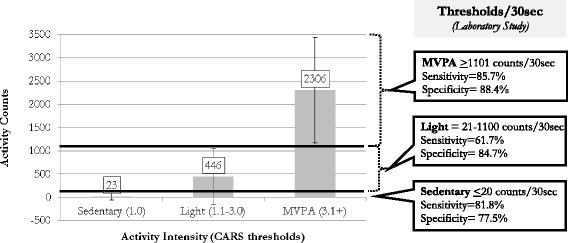
Two studies were conducted with toddlers (12-36 months). Laboratory Study (n = 24)- Two Actical accelerometers were placed on the ankle. PA was observed using the Child Activity Rating Scale (CARS, prescribed activities). Analyses included device equivalence reliability (correlation: activity counts of two Acticals), criterion-related validity (correlation: activity counts and CARS ratings), and sensitivity/specificity for thresholds. Community Study (n = 277, low-income mother-toddler dyads recruited)- An Actical was worn on the ankle for > 7 days (goal >5, 24-h days). Height/weight was measured. Mothers reported demographics. Analyses included frequencies (feasibility) and stepwise multiple linear regression (sMLR).
Laboratory Study- Acticals demonstrated reliability (r = 0.980) and validity (r = 0.75). Thresholds demonstrated sensitivity (86 %) and specificity (88 %). Community Study- 86 % wore accelerometer, 69 % had valid data (mean = 5.2 days). Primary reasons for missing/invalid data: refusal (14 %) and wear-time ≤2 days (11 %). The MVPA threshold (>2200 cpm) yielded 54 min/day. In sMLR, MVPA was associated with age (older > younger, β = 32.8, p < 0.001), gender (boys > girls, β = -11.21, p = 0.032), maternal MVPA (β = 0.44, p = 0.002) and recruitment location (suburban > urban, β = 19.6, p < 0.001), or race (non-Black > Black, β = 18.5, p = 0.001). No association with toddler weight status.
Ankle accelerometry is a valid, reliable, and feasible method of assessing PA in community studies of toddlers from low-income families. Sub-populations of toddlers may be at increased risk for inactivity, including toddlers that are younger, female, Black, those with less active mothers, and those living in an urban location.
幼儿期是促进身体活动(PA)以预防肥胖并支持整个儿童期积极生活方式的重要阶段。需要准确评估PA,以确定PA的趋势/相关因素、久坐、轻度或中度至剧烈PA(MVPA)所花费的时间,以及PA促进项目的效果。由于在社区研究中经过验证和可行性评估的客观测量方法有限,尚不清楚哪些幼儿亚组不活动的风险最高。本研究使用Actical脚踝加速度计,旨在为低收入家庭的幼儿制定有效的阈值,检验可行性,并研究MVPA的人口统计学/人体测量学PA相关因素。
对幼儿(12 - 36个月)进行了两项研究。实验室研究(n = 24)——在脚踝上放置两个Actical加速度计。使用儿童活动评级量表(CARS,规定活动)观察PA。分析包括设备等效可靠性(相关性:两个Actical的活动计数)、标准相关效度(相关性:活动计数和CARS评级)以及阈值的敏感性/特异性。社区研究(n = 277,招募低收入母婴二元组)——在脚踝上佩戴Actical超过7天(目标>5个24小时日)。测量身高/体重。母亲报告人口统计学信息。分析包括频率(可行性)和逐步多元线性回归(sMLR)。
实验室研究——Actical加速度计显示出可靠性(r = 0.980)和效度(r = 0.75)。阈值显示出敏感性(86%)和特异性(88%)。社区研究——86%的人佩戴了加速度计,69%有有效数据(平均 = 5.2天)。缺失/无效数据的主要原因:拒绝(14%)和佩戴时间≤2天(11%)。MVPA阈值(>2200次/分钟)产生的时间为每天54分钟。在sMLR中,MVPA与年龄(年龄较大>年龄较小,β = 32.8,p < 0.001)、性别(男孩>女孩,β = -11.21,p = 0.032)、母亲的MVPA(β = 0.44,p = 0.002)以及招募地点(郊区>城市,β = 19.6,p < 0.001)或种族(非黑人>黑人,β = 18.5,p = 0.001)相关。与幼儿体重状况无关。
脚踝加速度计是评估低收入家庭幼儿社区研究中PA的有效、可靠且可行的方法。幼儿亚群体不活动的风险可能增加,包括年龄较小、女性、黑人、母亲活动较少以及居住在城市地区的幼儿。