Bartols Andreas, Bormann Carsten, Werner Luisa, Schienle Melanie, Walther Winfried, Dörfer Christof E
Dental Academy for Continuing Professional Development Karlsruhe, Karlsruhe, Germany.
Clinic for Conservative Dentistry and Periodontology, School for Dental Medicine, Christian-Albrechts-University, Kiel, Germany.
PeerJ. 2020 Jan 30;8:e8495. doi: 10.7717/peerj.8495. eCollection 2020.
The aim of this study was to assess the clinical impact of non-surgical root canal treatments (NSRCT) performed with different treatment protocols on the probability of tooth survival without untoward events and to identify predictors influencing the outcome.
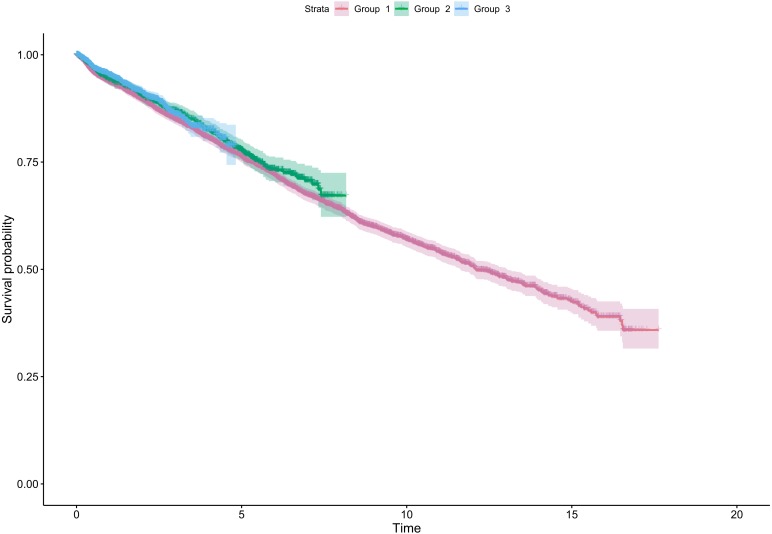
During the period from July 1999 to October 2016, 5,858 patients were identified in which 9,967 NSRCTs were performed. The treatments were followed up and divided into three groups. In Group 1 root canal treatment was performed with hand instruments, in Group 2 with multiple file rotary instruments and passive ultrasonic irrigation (PUI), and Group 3 was treated with Reciproc instruments and PUI. Untoward events were defined as orthograde retreatment, apicoectomy or extraction of the tooth after initial treatment. Weibull regression was used to analyse the data.
A total of 9,938 cases could be included into the analyses. The results showed 5-years predicted survival rates without untoward events of 73.9% (95% CI [71.7%-76.1%]), 75.1% (95% CI [71.7%-78.0%]) and 78.4% (95% CI [75.1%-81.4%]) for study group 1 ( = 5,580), 2 ( = 1,700) and 3 ( = 2,658), respectively. The differences between Group 1 and 3 were statistically significant ( < 0.006). Higher age of the patient (per year increase) and number of earlier NSRCTs (per unit increase) reduce the survival without untoward events statistically significant (both < 0.02), while treatment of premolars had a statistically significant lower hazard ratio [0.89 (95% CI [0.79-0.99]; = 0.030)] compared to treatment of molars and anterior teeth. A higher number of supportive periodontal treatments (per unit increase) improved tooth survival without untoward events highly significant ( < 0.0001).
More recent endodontic treatment protocols involving reciprocating instruments and PUI appear to be associated with higher tooth survival rates without untoward events compared to hand instruments.
本研究的目的是评估采用不同治疗方案进行的非手术根管治疗(NSRCT)对牙齿无不良事件存活概率的临床影响,并确定影响治疗结果的预测因素。
在1999年7月至2016年10月期间,共确定了5858例患者,对其进行了9967次非手术根管治疗。对这些治疗进行随访并分为三组。第1组使用手动器械进行根管治疗,第2组使用多锉旋转器械和被动超声冲洗(PUI),第3组使用Reciproc器械和PUI。不良事件定义为初次治疗后进行的正向再治疗、根尖切除术或拔牙。采用威布尔回归分析数据。
共有9938例病例纳入分析。结果显示,研究组1(n = 5580)、2(n = 1700)和3(n = 2658)在5年时无不良事件的预测生存率分别为73.9%(95%CI[71.7%-76.1%])、75.1%(95%CI[71.7%-78.0%])和78.4%(95%CI[75.1%-81.4%])。第1组和第3组之间的差异具有统计学意义(P < 0.006)。患者年龄越大(每年增加)和先前非手术根管治疗次数越多(每增加一个单位),无不良事件的生存率在统计学上显著降低(均P < 0.02),而与磨牙和前牙治疗相比,前磨牙治疗的风险比在统计学上显著降低[0.89(95%CI[0.79-0.99];P = 0.030)]。更多的支持性牙周治疗(每增加一个单位)显著提高了无不良事件的牙齿生存率(P < 0.0001)。
与手动器械相比,涉及往复式器械和PUI的最新牙髓治疗方案似乎与更高的无不良事件牙齿生存率相关。