Department of Biomedical Sciences, Ohio University Heritage College of Osteopathic Medicine, Warrensville Heights, Ohio, United States of America.
Department of Biologic & Materials Sciences & Prosthodontics, University of Michigan School of Dentistry, Ann Arbor, Michigan, United States of America.
PLoS One. 2020 Feb 7;15(2):e0228619. doi: 10.1371/journal.pone.0228619. eCollection 2020.
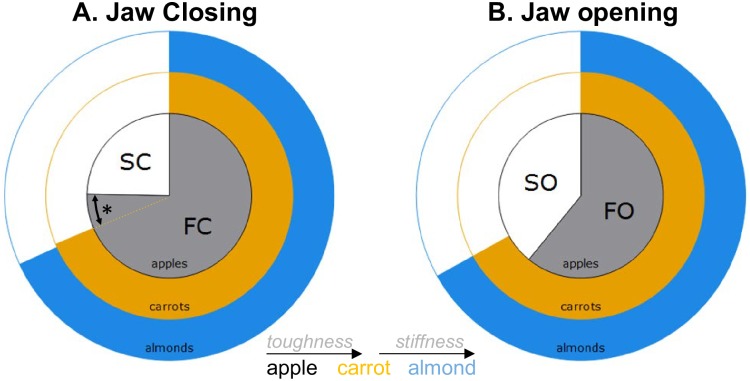
Chewing is a rhythmic oral behavior that requires constant modifications of jaw movements in response to changes in food properties. The food-specific kinematic response is dependent on the potential for kinematic flexibility allowed by morphology and modulation of motor control. This study investigates the effects of food toughness and stiffness on the amplitude and variability of jaw movements during chewing in a typical omnivorous mammalian model (pigs). Jaw movements were reconstructed using X-ray Reconstruction Of Moving Morphology (XROMM) and kinematic data associated with the amplitude of jaw pitch (opening-closing) and jaw yaw (mediolateral rotation) were extracted for each cycle. Between-food differences were tested for the amplitude of jaw movements during each phase of the gape cycle, as well as in their respective within-food variability, or stereotypy, as indicated by coefficients of variation. With increasing toughness, jaw pitch amplitude is decreased during fast close, larger and more stereotyped during slow close, smaller but more variable during slow open, and more variable during fast open. In addition, when chewing on tougher foods, the amplitude of jaw yaw during slow close only increases in a subset of individuals, but all become less variable (i.e., more stereotyped). In contrast, increasing food stiffness has no effect on the amplitude or the variability of jaw pitch, whereas jaw yaw increases significantly in the majority of individuals studied. Our data demonstrate that food stiffness and toughness both play a role in modulating gape cycle dynamics by altering the trajectory of jaw movements, especially during the slow-close phase and tooth-food-tooth contact, albeit differently. This highlights how a generalist oral morphology such as that of pigs (e.g., bunodont teeth lacking precise occlusion, permissive temporomandibular joint allowing extensive condylar displacements in 3 dimensions) enables organisms to not only adjust chewing movements in their amplitude, but also in their variability.
咀嚼是一种有节奏的口腔行为,需要不断调整下颌运动以适应食物特性的变化。食物特有的运动学反应取决于形态学允许的运动学灵活性以及运动控制的调节。本研究以典型的杂食性哺乳动物模型(猪)为研究对象,研究了食物韧性和硬度对咀嚼过程中下颌运动幅度和变异性的影响。使用 X 射线重建运动形态学(XROMM)重建下颌运动,提取每个周期与下颌俯仰(开合)幅度相关的运动学数据。对张口周期各阶段咀嚼时下颌运动幅度的食物间差异进行了检验,以及食物内变异性或刻板性的差异,用变异系数表示。随着韧性的增加,快速闭合时的下颌俯仰幅度减小,慢速闭合时的幅度增大且更刻板,慢速张开时的幅度减小但变异性增加,快速张开时的变异性增加。此外,当咀嚼更坚韧的食物时,慢速闭合时的下颌偏航幅度只有一部分个体增加,但所有个体的变异性(即更刻板)都减小。相反,食物硬度的增加对下颌俯仰幅度或变异性没有影响,而下颌偏航幅度在大多数研究的个体中显著增加。我们的数据表明,食物韧性和硬度都通过改变下颌运动轨迹来调节张口周期动力学,特别是在慢速闭合阶段和牙齿-食物-牙齿接触时,尽管方式不同。这突出表明,猪等具有一般性口腔形态的动物(例如,无精确咬合的圆钝齿,允许髁突在 3 个维度上进行广泛位移的颞下颌关节)不仅能够调整咀嚼运动的幅度,还能调整其变异性。