Wallace H. Coulter Department of Biomedical Engineering, Georgia Institute of Technology, Atlanta, GA 30332, USA.
Parker H. Petit Institute for Bioengineering and Bioscience, Georgia Institute of Technology, Atlanta, GA 30332, USA.
Cells. 2020 Feb 5;9(2):364. doi: 10.3390/cells9020364.
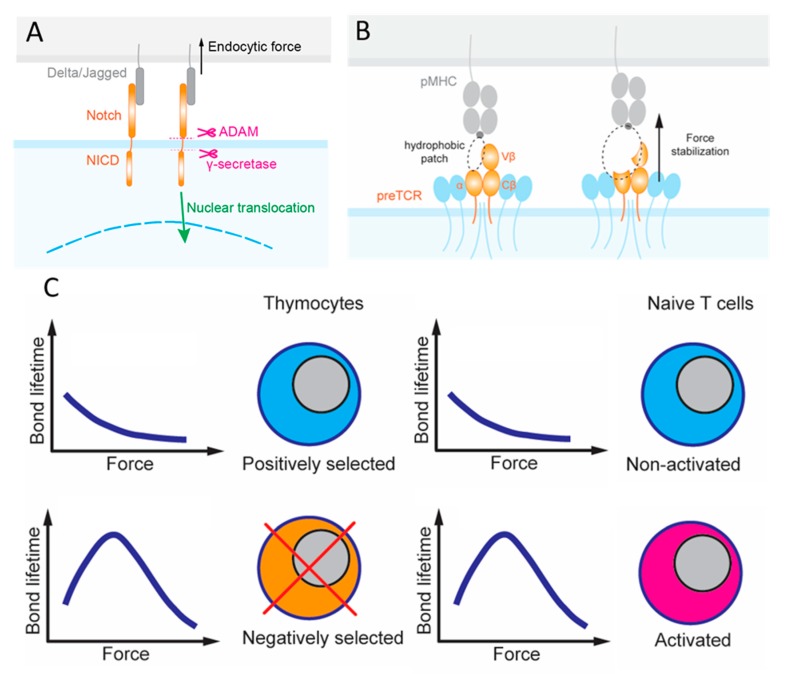
Cells in the body are actively engaging with their environments that include both biochemical and biophysical aspects. The process by which cells convert mechanical stimuli from their environment to intracellular biochemical signals is known as mechanotransduction. Exemplifying the reliance on mechanotransduction for their development, differentiation and function are T cells, which are central to adaptive immune responses. T cell mechanoimmunology is an emerging field that studies how T cells sense, respond and adapt to the mechanical cues that they encounter throughout their life cycle. Here we review different stages of the T cell's life cycle where existing studies have shown important effects of mechanical force or matrix stiffness on a T cell as sensed through its surface molecules, including modulating receptor-ligand interactions, inducing protein conformational changes, triggering signal transduction, amplifying antigen discrimination and ensuring directed targeted cell killing. We suggest that including mechanical considerations in the immunological studies of T cells would inform a more holistic understanding of their development, differentiation and function.
细胞积极与其环境相互作用,其中包括生化和生物物理方面。细胞将环境中的机械刺激转化为细胞内生化信号的过程称为机械转导。T 细胞就是依赖机械转导来发育、分化和发挥功能的范例,T 细胞是适应性免疫反应的核心。T 细胞力学免疫学是一个新兴领域,研究 T 细胞如何感知、响应和适应它们在整个生命周期中遇到的机械线索。在这里,我们回顾了 T 细胞生命周期的不同阶段,现有研究表明,机械力或基质硬度通过其表面分子对 T 细胞产生重要影响,包括调节受体-配体相互作用、诱导蛋白质构象变化、触发信号转导、放大抗原识别和确保靶向细胞杀伤。我们认为,在 T 细胞的免疫学研究中纳入机械因素将有助于更全面地了解它们的发育、分化和功能。