
小核仁 RNA 宿主基因 1(SNHG1)和 2 号染色体开放阅读框 48(C2orf48)通过构建调控网络作为肝癌潜在的预后标志物。
Small Nucleolar RNA Host Gene 1 (SNHG1) and Chromosome 2 Open Reading Frame 48 (C2orf48) as Potential Prognostic Signatures for Liver Cancer by Constructing Regulatory Networks.
机构信息
Department of Hepatopancreatobiliary Surgical Oncology, Fujian Cancer Hospital and Fujian Medical University Cancer Hospital, Fuzhou, Fujian, China (mainland).
Department of Gastrointestinal Tumor Surgery, Fujian Cancer Hospital and Fujian Medical University Cancer Hospital, Fuzhou, Fujian, China (mainland).
出版信息
Med Sci Monit. 2020 Feb 9;26:e920482. doi: 10.12659/MSM.920482.
BACKGROUND Liver cancer is a common malignant tumor with poor prognosis. The present study sought to identify potential signatures that can predict the prognosis of patients with liver cancer. MATERIAL AND METHODS The RNA sequencing (RNA-seq) and clinical information of liver cancer patients were obtained from the Cancer Genome Atlas (TCGA) database. Differentially expressed long noncoding RNAs (lncRNAs), microRNAs (miRNAs), and messenger RNAs (mRNAs) were identified between liver cancer and adjacent normal tissues. After predicting lncRNA-miRNA and miRNA-mRNA pairs using online databases, the competing endogenous RNA (ceRNA) networks were constructed. Furthermore, the prognostic value of these differentially expressed genes was evaluated using univariate and multivariate Cox regression analyses. RESULTS After constructing the ceRNA network, 2 lncRNAs small nucleolar RNA host gene 1 (SNHG1) and chromosome 2 open reading frame 48 (C2orf48) with the most nodes were identified. Correlation analysis revealed that SNHG1 was correlated with miR-195 and C2orf48 was correlated with miR-195 and miR-93. High expression of SNHG1, C2orf48, and miR-93 can contribute to poorer clinical outcomes compared to low expression. Furthermore, low miR-195 expression was correlated with shorter survival time than was high expression. SNHG1 and C2orf48 were closely associated with histology grade. Univariate and multivariate Cox regression analyses confirmed that SNHG1 and C2orf48 are risk factors for liver cancer. CONCLUSIONS Our findings revealed that SNHG1 and C2orf48 possess potential prognostic value and should be considered as possible biomarkers for predicting clinical outcomes for patients with liver cancer.
背景
肝癌是一种预后不良的常见恶性肿瘤。本研究旨在寻找能够预测肝癌患者预后的潜在标志物。
材料与方法
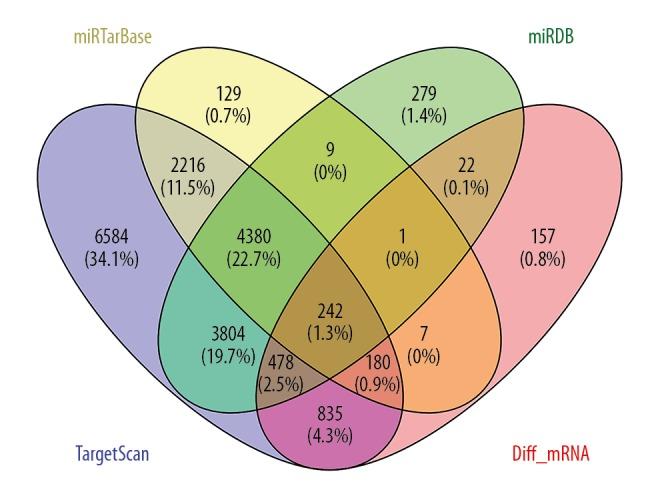
从癌症基因组图谱(TCGA)数据库中获取肝癌患者的 RNA 测序(RNA-seq)和临床信息。在肝癌和相邻正常组织之间鉴定差异表达的长非编码 RNA(lncRNA)、微小 RNA(miRNA)和信使 RNA(mRNA)。使用在线数据库预测 lncRNA-miRNA 和 miRNA-mRNA 对后,构建竞争内源性 RNA(ceRNA)网络。此外,使用单因素和多因素 Cox 回归分析评估这些差异表达基因的预后价值。
结果
构建 ceRNA 网络后,鉴定出具有最多节点的 2 个 lncRNA 核仁小分子 RNA 宿主基因 1(SNHG1)和染色体 2 开放阅读框 48(C2orf48)。相关性分析显示,SNHG1 与 miR-195 相关,C2orf48 与 miR-195 和 miR-93 相关。与低表达相比,SNHG1、C2orf48 和 miR-93 的高表达可能导致更差的临床结局。此外,miR-195 的低表达与较短的生存时间相关,而高表达则与之相反。SNHG1 和 C2orf48 与组织学分级密切相关。单因素和多因素 Cox 回归分析证实 SNHG1 和 C2orf48 是肝癌的危险因素。
结论
我们的研究结果表明,SNHG1 和 C2orf48 具有潜在的预后价值,可作为预测肝癌患者临床结局的潜在生物标志物。





 Zotero 插件