Chennakrishnaiah Shilpa, Tsering Thupten, Aprikian Saro, Rak Janusz
Montreal Children's Hospital, RI MUHC, McGill University, Montreal, QC, Canada.
Front Pharmacol. 2020 Jan 24;10:1608. doi: 10.3389/fphar.2019.01608. eCollection 2019.
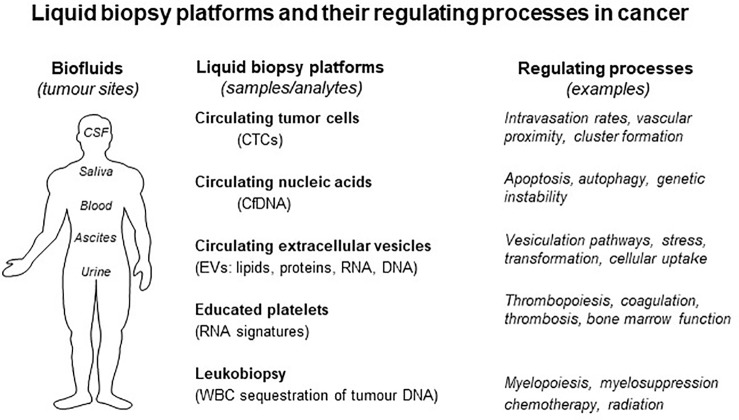
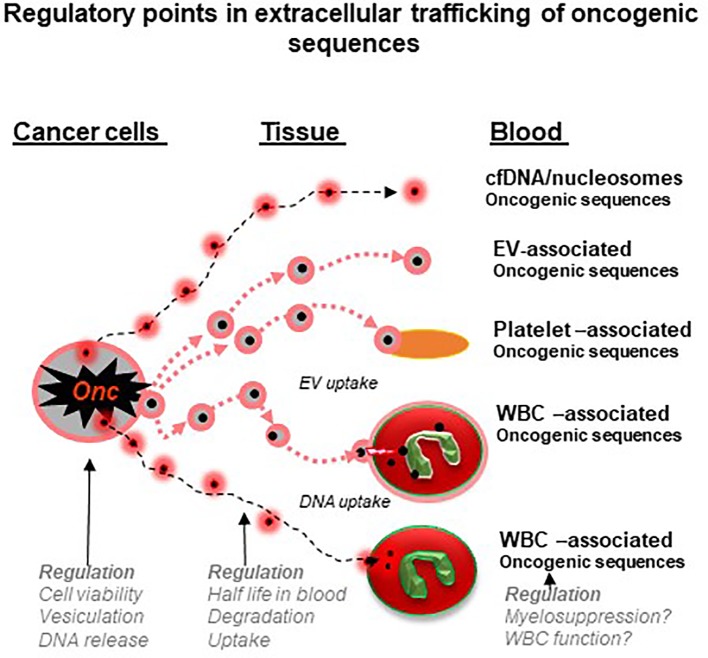
Detection of unique oncogenic alterations encoded by the sequence or biochemical modification in cancer-associated transforming macromolecules has revolutionized diagnosis, classification and management of human cancers. While these signatures were traditionally regarded as largely intracellular and confined to the tumor mass, oncogenic mutations and actionable cancer-related molecular alterations can also be accessed remotely through their recovery from biofluids of either rare circulating tumor cells (CTCs), or of more abundant non-cellular carriers, such as extracellular vesicles (EVs), protein complexes, or cell-free tumor DNA (ctDNA). Tumor-related macromolecules may also accumulate in circulating platelets. Collectively, these approaches are known as liquid biopsy and hold promise as non-invasive, real-time opportunities to access to the evolving molecular landscape of human malignancies. More recently, a possibility of recovering cancer-specific DNA sequences from circulating leukocytes has also been postulated using experimental models. While it is often assumed that these and other liquid biopsy approaches rely on material passively shed from the tumor mass or its debris, recent evidence suggests that several regulated processes contribute to the abundance, nature, half-life, and turnover of different circulating cancer-related molecular signals. Moreover, many of these signals possess biological activity and may elicit local and systemic regulatory responses. Thus, a better understanding of the biology of liquid biopsy platforms and analytes may enable achieving improved performance of this promising and emerging diagnostic strategy in cancer.
对癌症相关转化大分子中由序列或生化修饰编码的独特致癌改变的检测,彻底改变了人类癌症的诊断、分类和管理。虽然这些特征传统上在很大程度上被认为是细胞内的,且局限于肿瘤块,但致癌突变和可操作的癌症相关分子改变也可以通过从罕见的循环肿瘤细胞(CTC)或更丰富的非细胞载体(如细胞外囊泡(EV)、蛋白质复合物或游离肿瘤DNA(ctDNA))的生物流体中回收来远程获取。肿瘤相关大分子也可能在循环血小板中积累。总体而言,这些方法被称为液体活检,并有望成为获取人类恶性肿瘤不断演变的分子格局的非侵入性实时机会。最近,也有人利用实验模型推测了从循环白细胞中回收癌症特异性DNA序列的可能性。虽然通常认为这些以及其他液体活检方法依赖于从肿瘤块或其碎片中被动脱落的物质,但最近的证据表明,一些调节过程对不同循环癌症相关分子信号的丰度、性质、半衰期和周转率有影响。此外,许多这些信号具有生物活性,可能引发局部和全身调节反应。因此,更好地理解液体活检平台和分析物的生物学特性,可能有助于提高这种有前景的新兴癌症诊断策略的性能。