Pessuti Carmen Luz, Costa Deise Fialho, Ribeiro Kleber S, Abdouh Mohamed, Tsering Thupten, Nascimento Heloisa, Commodaro Alessandra G, Marcos Allexya Affonso Antunes, Torrecilhas Ana Claudia, Belfort Rubens N, Belfort Rubens, Burnier Julia Valdemarin
Department of Ophthalmology, Federal University of São Paulo, Vision Institute, IPEPO, São Paulo - Brazil.
Cancer Research Program, McGill University Health Centre Research Institute, Montreal, Quebec - Canada.
J Circ Biomark. 2022 Jun 27;11:36-47. doi: 10.33393/jcb.2022.2370. eCollection 2022 Jan-Dec.
: Uveal melanoma (UM) is the most common intraocular malignant tumor in adults. Extracellular vesicles (EVs) have been extensively studied as a biomarker to monitor disease in patients. The study of new biomarkers in melanoma patients could prevent metastasis by earlier diagnosis. In this study, we determined the proteomic profile of EVs isolated from aqueous humor (AH), vitreous humor (VH), and plasma from UM patients in comparison with cancer-free control patients.
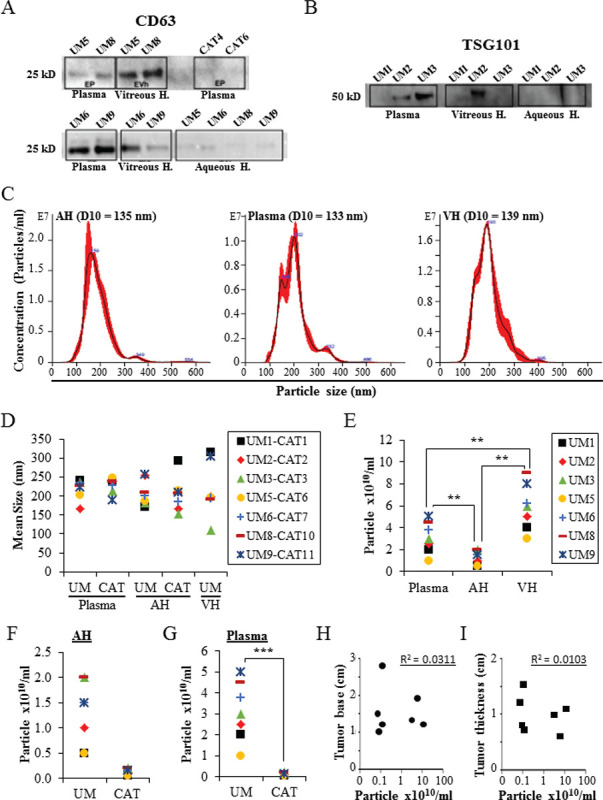
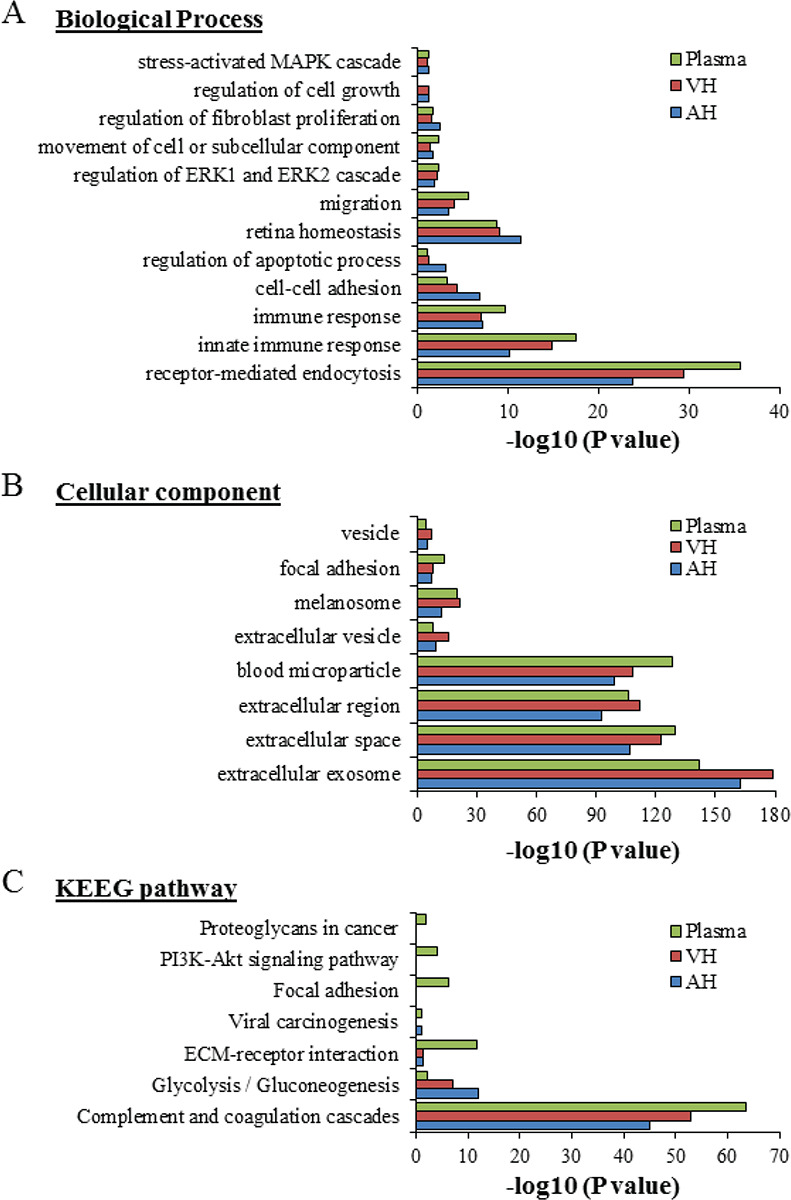
: AH, VH and plasma were collected from seven patients with UM after enucleation; AH and plasma were collected from seven cancer-free patients with cataract (CAT; control group). EVs were isolated using the membrane-based affinity binding column method. Nanoparticle tracking analysis (NTA) was performed to determine the size and concentration of EVs. EV markers, CD63 and TSG101, were assessed by immunoblotting, and the EV proteome was characterized by mass spectrometry.
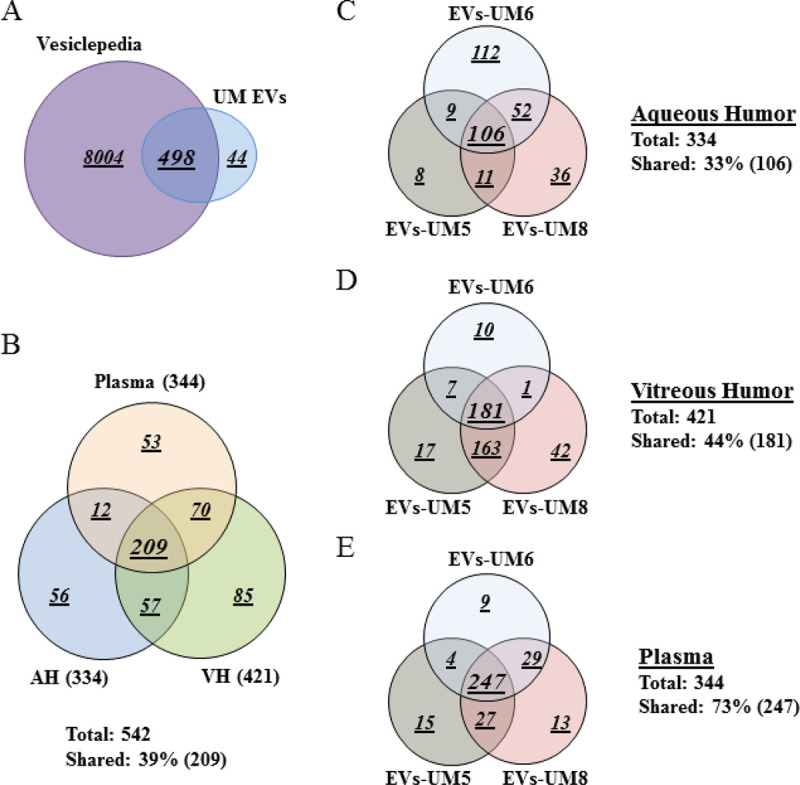
: Mean EV concentration was higher in all analytes of UM patients compared to those in the CAT group. In the UM cohort, the mean concentration of EVs was significantly lower in AH and plasma than in VH. In contrast, the mean size and size distribution of EVs was invariably identical in all analyzed analytes and in both studied groups (UM vs. CAT). Mass spectrometry analyses from the different analytes from UM patients showed the presence of EV markers.
: EVs isolated from AH, VH, and plasma from patients with UM showed consistent profiles and support the use of blood to monitor UM patients as a noninvasive liquid biopsy.
葡萄膜黑色素瘤(UM)是成人中最常见的眼内恶性肿瘤。细胞外囊泡(EVs)作为监测患者疾病的生物标志物已得到广泛研究。研究黑色素瘤患者的新生物标志物有助于通过早期诊断预防转移。在本研究中,我们确定了从UM患者的房水(AH)、玻璃体(VH)和血浆中分离出的EVs的蛋白质组学特征,并与无癌对照患者进行了比较。
从7例UM患者眼球摘除术后收集AH、VH和血浆;从7例无癌白内障患者(CAT;对照组)收集AH和血浆。使用基于膜的亲和结合柱法分离EVs。进行纳米颗粒跟踪分析(NTA)以确定EVs的大小和浓度。通过免疫印迹评估EV标志物CD63和TSG101,并通过质谱对EV蛋白质组进行表征。
与CAT组相比,UM患者所有分析物中的平均EV浓度更高。在UM队列中,AH和血浆中EVs的平均浓度显著低于VH。相反,在所有分析物以及两个研究组(UM与CAT)中,EVs的平均大小和大小分布始终相同。对UM患者不同分析物的质谱分析显示存在EV标志物。
从UM患者的AH、VH和血浆中分离出的EVs显示出一致的特征,并支持将血液作为一种非侵入性液体活检用于监测UM患者。