Reichenberger Jonas, Pfaller Michael, Mühlberger Andreas
Department of Clinical Psychology and Psychotherapy, Institute of Psychology, University of Regensburg, Regensburg, Germany.
Front Psychol. 2020 Jan 23;11:35. doi: 10.3389/fpsyg.2020.00035. eCollection 2020.
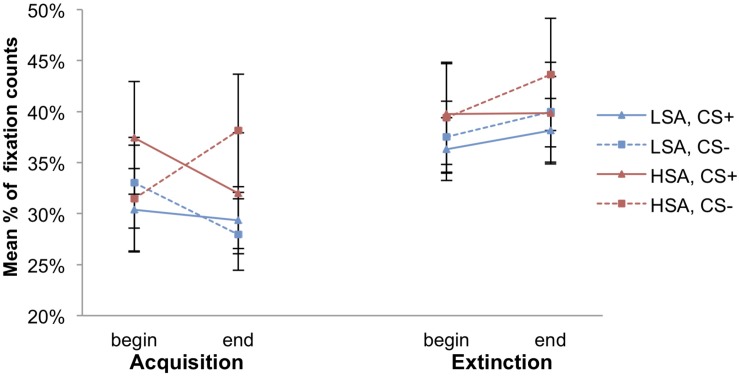
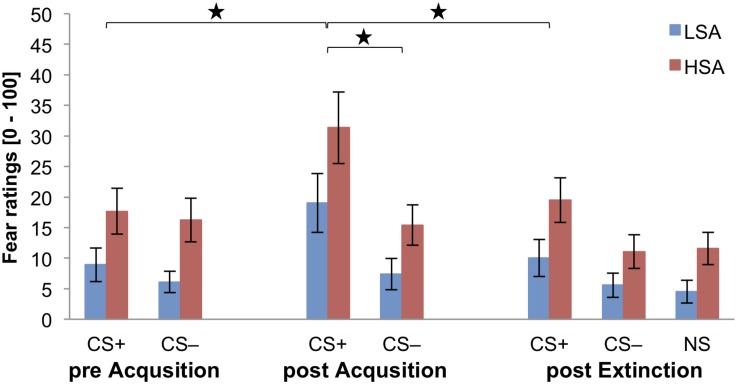
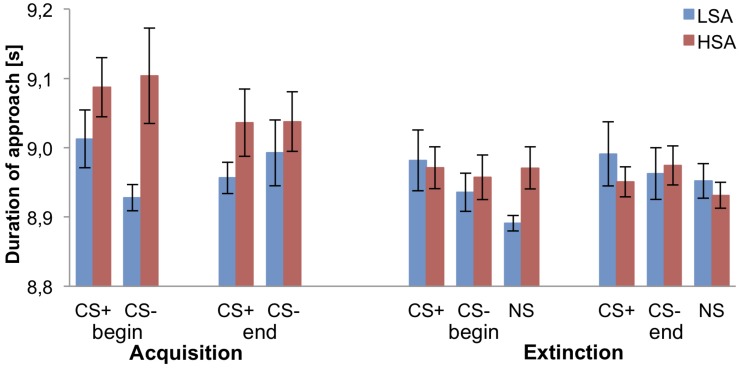
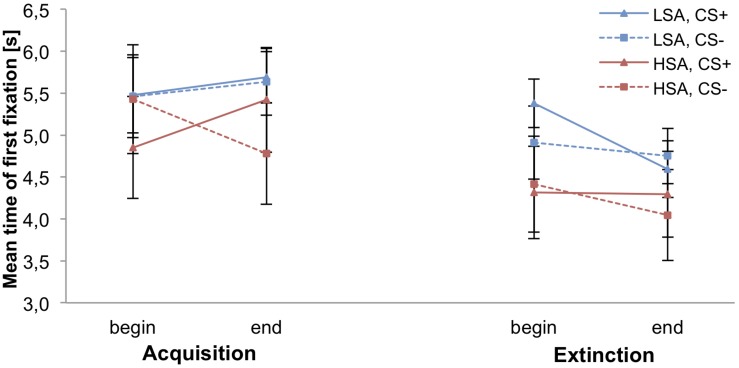
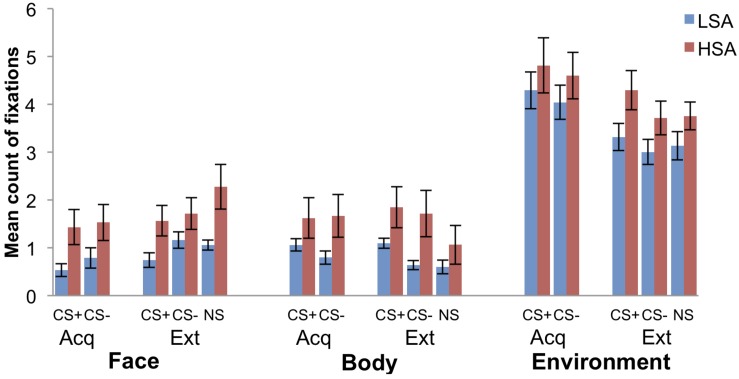
The vigilance-avoidance hypothesis of selective attention assumes that socially anxious persons initially direct their attention toward fear-related stimuli and subsequently avoid these social stimuli to reduce emotional distress. New technical developments provide tools to implicit measure overt attention on fear-related stimuli via eye-tracking in ecological valid virtual environments presented via a head-mounted display. We examined in 27 low (LSA) and 26 high socially anxious (HSA) individuals fear ratings, physical behavior (duration of approach), hypervigilance (time to first fixation), and attentional avoidance (count of fixations) toward virtual female and male agents (CS) during social fear conditioning (SFC) and extinction in virtual reality (VR). As hypothesized, generally SFC was successfully induced and extinguished concerning the fear ratings. Our findings partly support the vigilance-avoidance hypothesis as HSA directed especially at the first half of the fear acquisition their initial attention more at CS+ than CS- agents, and avoided subsequently the CS+ more than the CS- agents during the fear acquisition. In contrast, in LSA participants initial and sustained attention did not differ between CS+ and CS- agents during fear acquisition. We conclude that HSA individuals guide their initial attention to emotionally threatening stimuli and subsequently avoid the threatening stimuli to possibly reduce their emotional distress, whereas LSA individuals regulate themselves less in their (fear) responses during SFC. Measuring implicit gaze behavior within a well-controlled virtual environment is an interesting innovative tool to in deeply investigate the impact of attention on emotional learning processes.
选择性注意的警觉-回避假说认为,社交焦虑者最初会将注意力导向与恐惧相关的刺激,随后会回避这些社交刺激以减轻情绪困扰。新的技术发展提供了工具,可通过头戴式显示器呈现的生态有效虚拟环境中的眼动追踪来隐式测量对与恐惧相关刺激的显性注意。我们在27名低社交焦虑(LSA)个体和26名高社交焦虑(HSA)个体中,研究了在社交恐惧条件反射(SFC)和虚拟现实(VR)消退过程中,他们对虚拟女性和男性代理(CS)的恐惧评分、身体行为(接近持续时间)、过度警觉(首次注视时间)和注意回避(注视次数)。正如假设的那样,一般来说,就恐惧评分而言,SFC被成功诱导并消退。我们的研究结果部分支持了警觉-回避假说,因为HSA个体在恐惧习得的前半段尤其将最初的注意力更多地指向CS+而非CS-代理,并且在恐惧习得过程中随后对CS+的回避多于CS-代理。相比之下,在LSA参与者中,恐惧习得期间CS+和CS-代理之间的初始和持续注意力没有差异。我们得出结论,HSA个体将他们最初的注意力导向情感上具有威胁性的刺激,随后回避这些威胁性刺激以可能减轻他们的情绪困扰,而LSA个体在SFC期间对其(恐惧)反应的自我调节较少。在一个控制良好的虚拟环境中测量隐式注视行为是一种有趣的创新工具,可深入研究注意力对情绪学习过程的影响。