Kent Thomas, Gracias Deanne, Shepherd Samuel, Clynes David
MRC Molecular Haematology Unit, MRC Weatherall Institute of Molecular Medicine, John Radcliffe Hospital, University of Oxford, Oxford, United Kingdom.
Department of Oncology, MRC Weatherall Institute of Molecular Medicine, John Radcliffe Hospital, University of Oxford, Oxford, United Kingdom.
Front Oncol. 2020 Jan 21;9:1518. doi: 10.3389/fonc.2019.01518. eCollection 2019.
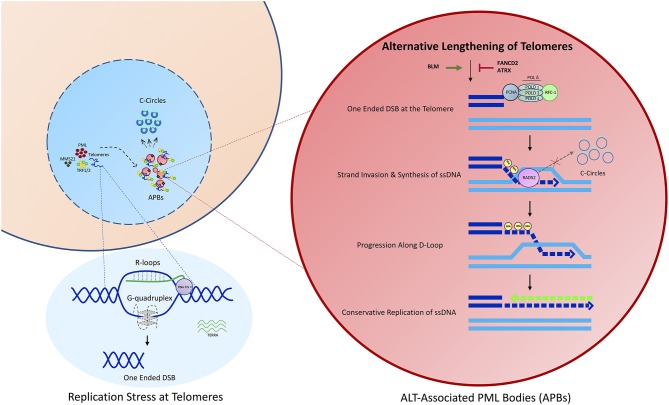
Achieving replicative immortality is a crucial step in tumorigenesis and requires both bypassing cell cycle checkpoints and the extension of telomeres, sequences that protect the distal ends of chromosomes during replication. In the majority of cancers this is achieved through the enzyme telomerase, however a subset of cancers instead utilize a telomerase-independent mechanism of telomere elongation-the Alternative Lengthening of Telomeres (ALT) pathway. Recent work has aimed to decipher the exact mechanism that underlies this pathway. To this end, this pathway has now been shown to extend telomeres through exploitation of DNA repair machinery in a unique process that may present a number of druggable targets. The identification of such targets, and the subsequent development or repurposing of therapies to these targets may be crucial to improving the prognosis for many ALT-positive cancers, wherein mean survival is lower than non-ALT counterparts and the cancers themselves are particularly unresponsive to standard of care therapies. In this review we summarize the recent identification of many aspects of the ALT pathway, and the therapies that may be employed to exploit these new targets.
实现复制性永生是肿瘤发生过程中的关键一步,这需要绕过细胞周期检查点并延长端粒,端粒是在复制过程中保护染色体末端的序列。在大多数癌症中,这是通过端粒酶实现的,然而,一部分癌症反而利用了一种不依赖端粒酶的端粒延长机制——端粒替代延长(ALT)途径。最近的研究旨在破译该途径背后的确切机制。为此,现已证明该途径通过在一个独特的过程中利用DNA修复机制来延长端粒,这个过程可能存在许多可成药靶点。识别这些靶点,以及随后开发针对这些靶点的疗法或重新利用现有疗法,对于改善许多ALT阳性癌症的预后可能至关重要,在这些癌症中,平均生存期低于非ALT阳性癌症,并且这些癌症本身对标准治疗疗法特别不敏感。在这篇综述中,我们总结了最近对ALT途径诸多方面的认识,以及可用于利用这些新靶点的疗法。