Li Rui, Hornberger Kathlyn, Dutton James R, Hubel Allison
Department of Biomedical Engineering, University of Minnesota, Minneapolis, MN, United States.
Stem Cell Institute, University of Minnesota, Minneapolis, MN, United States.
Front Bioeng Biotechnol. 2020 Jan 22;8:1. doi: 10.3389/fbioe.2020.00001. eCollection 2020.
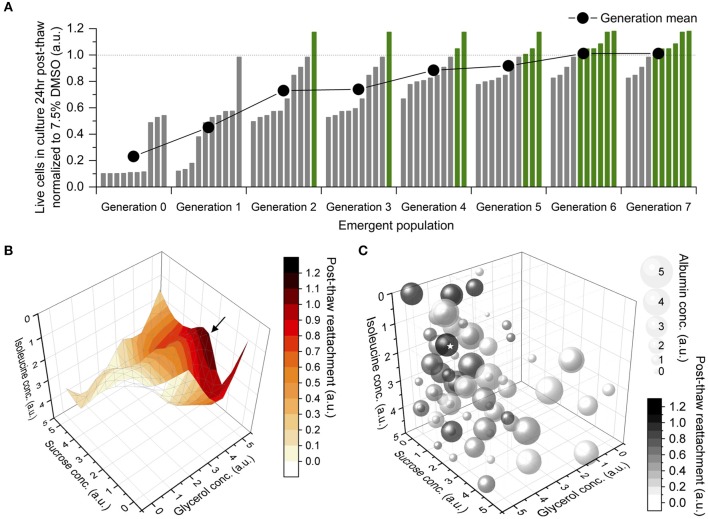
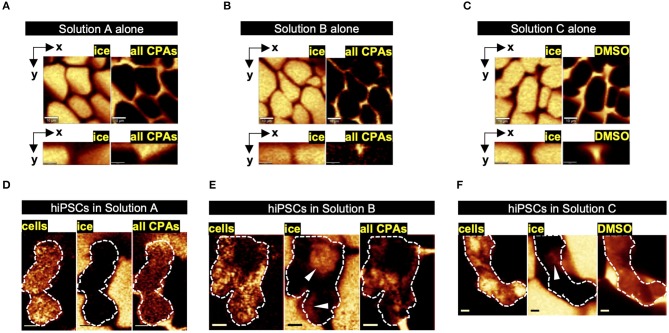
Human induced pluripotent stem cells (hiPSCs) are an important cell source for regenerative medicine products. Effective methods of preservation are critical to their clinical and commercial applications. The use of a dimethyl sulfoxide (DMSO)-free solution containing all non-toxic molecules offers an effective alternative to the conventional DMSO and alleviates pain points associated with the use of DMSO in the cryopreservation of hiPSCs. Both hiPSCs and cells differentiated from them are commonly multicellular systems, which are more sensitive to stresses of freezing and thawing than single cells. In this investigation, low-temperature Raman spectroscopy visualized freezing behaviors of hiPSC aggregates in different solutions. These aggregates exhibited sensitivity to undercooling in DMSO-containing solutions. We demonstrated the ability to replace DMSO with non-toxic molecules, improve post-thaw cell survival, and reduce sensitivity to undercooling. An accelerated optimization process capitalized on the positive synergy among multiple DMSO-free molecules, which acted in concert to influence ice formation and protect cells during freezing and thawing. A differential evolution algorithm was used to optimize the multi-variable, DMSO-free preservation protocol in 8 experiments. hiPSC aggregates frozen in the optimized solution did not exhibit the same sensitivity to undercooling as those frozen in non-optimized solutions or DMSO, indicating superior adaptability of the optimized solution to different freezing modalities and unplanned deviations. This investigation shows the importance of optimization, explains the mechanisms and advantages of a DMSO-free solution, and enables not only improved cryopreservation of hiPSCs but potentially other cell types for translational regenerative medicine.
人诱导多能干细胞(hiPSC)是再生医学产品的重要细胞来源。有效的保存方法对其临床和商业应用至关重要。使用含有所有无毒分子的无二甲亚砜(DMSO)溶液为传统的DMSO提供了一种有效的替代方案,并缓解了在hiPSC冷冻保存中使用DMSO相关的痛点。hiPSC及其分化的细胞通常是多细胞系统,比单细胞对冻融应激更敏感。在本研究中,低温拉曼光谱可视化了hiPSC聚集体在不同溶液中的冷冻行为。这些聚集体在含DMSO的溶液中表现出对过冷的敏感性。我们证明了用无毒分子替代DMSO的能力,提高了冻融后细胞的存活率,并降低了对过冷的敏感性。一个加速优化过程利用了多种无DMSO分子之间的正协同作用,这些分子协同作用以影响冰的形成并在冻融过程中保护细胞。在8次实验中使用差分进化算法优化多变量无DMSO保存方案。在优化溶液中冷冻的hiPSC聚集体对过冷没有表现出与在非优化溶液或DMSO中冷冻的聚集体相同的敏感性,表明优化溶液对不同冷冻方式和意外偏差具有卓越的适应性。本研究表明了优化的重要性,解释了无DMSO溶液的机制和优势,不仅能够改善hiPSC的冷冻保存,还可能改善用于转化再生医学的其他细胞类型的冷冻保存。