Driesen Ronald B, Hilkens Petra, Smisdom Nick, Vangansewinkel Tim, Dillen Yörg, Ratajczak Jessica, Wolfs Esther, Gervois Pascal, Ameloot Marcel, Bronckaers Annelies, Lambrichts Ivo
Faculty of Medicine, Hasselt University, Diepenbeek, Belgium.
Laboratory of Morphology, Biomedical Research Institute, Hasselt University, Diepenbeek, Belgium.
Front Cell Dev Biol. 2020 Jan 21;7:389. doi: 10.3389/fcell.2019.00389. eCollection 2019.
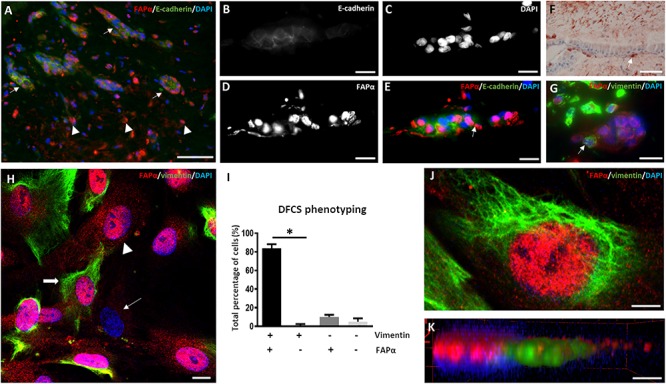
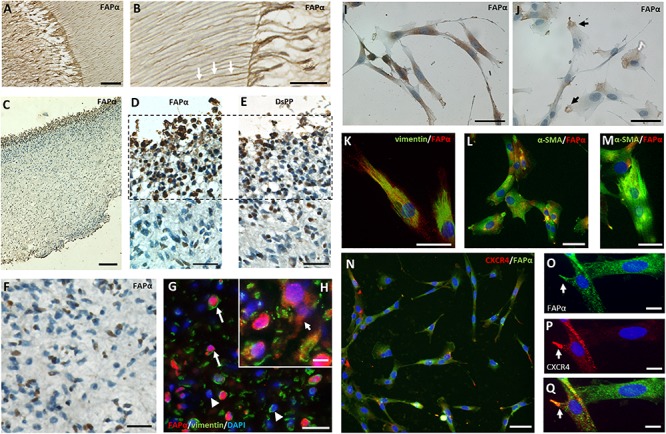
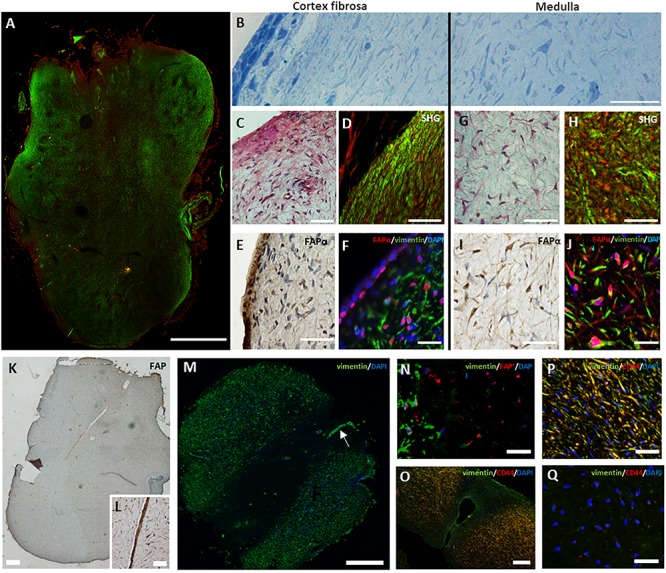
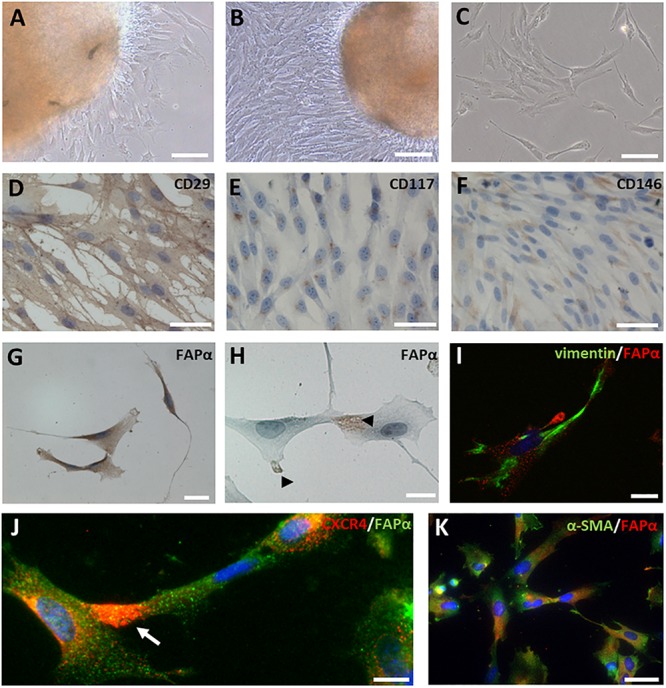
Fibroblast activation protein-α (FAPα) is a membrane protein with dipeptidyl-peptidase and type I collagenase activity and is expressed during fetal growth. At the age of adolescence, FAPα expression is greatly reduced, only emerging in pathologies associated with extracellular matrix remodeling. We determined whether FAPα is expressed in human dental tissue involved in root maturation i.e., dental follicle and apical papilla and in dental pulp tissue. The dental follicle revealed a high concentration of FAPα and vimentin-positive cells within the stromal tissue. A similar observation was made in cell culture and FACS analysis confirmed these as dental follicle stem cells. Within the remnants of the Hertwigs' epithelial root sheath, we observed FAPα staining in the E-cadherin positive and vimentin-negative epithelial islands. FAPα- and vimentin-positive cells were encountered at the periphery of the islands suggesting an epithelial mesenchymal transition process. Analysis of the apical papilla revealed two novel histological regions; the periphery with dense and parallel aligned collagen type I defined as cortex fibrosa and the inner stromal tissue composed of less compacted collagen defined as medulla. FAPα expression was highly present within the medulla suggesting a role in extracellular matrix remodeling. Dental pulp tissue uncovered a heterogeneous FAPα staining but strong staining was noted within odontoblasts. studies confirmed the presence of FAPα expression in stem cells of the apical papilla and dental pulp. This study identified the expression of FAPα expression in dental stem cells which could open new perspectives in understanding dental root maturation and odontoblast function.
成纤维细胞活化蛋白-α(FAPα)是一种具有二肽基肽酶和I型胶原酶活性的膜蛋白,在胎儿生长过程中表达。在青春期时,FAPα表达大幅降低,仅在与细胞外基质重塑相关的病理状态下出现。我们确定FAPα是否在参与牙根成熟的人牙组织中表达,即牙囊和根尖乳头以及牙髓组织。牙囊中基质组织内显示出高浓度的FAPα和波形蛋白阳性细胞。在细胞培养中也有类似观察结果,流式细胞术分析证实这些细胞为牙囊干细胞。在赫特维希上皮根鞘的残余部分中,我们在E-钙黏蛋白阳性且波形蛋白阴性的上皮岛中观察到FAPα染色。在这些岛的周边遇到FAPα和波形蛋白阳性细胞,提示存在上皮-间充质转化过程。对根尖乳头的分析揭示了两个新的组织学区域;周边有密集且平行排列的I型胶原,定义为纤维性皮质,内部基质组织由排列较疏松的胶原组成,定义为髓质。FAPα表达在髓质中高度存在,提示其在细胞外基质重塑中的作用。牙髓组织显示出异质性的FAPα染色,但在成牙本质细胞内有强染色。研究证实根尖乳头和牙髓干细胞中存在FAPα表达。本研究确定了FAPα在牙干细胞中的表达,这可能为理解牙根成熟和成牙本质细胞功能开辟新的视角。