Department of Movement Disorders and Neuromodulation, University of California San Francisco, San Francisco, California, USA.
Medical Research Council Brain Network Dynamics Unit at the University of Oxford, Oxford, United Kingdom.
Mov Disord. 2020 Apr;35(4):555-561. doi: 10.1002/mds.27996. Epub 2020 Feb 10.
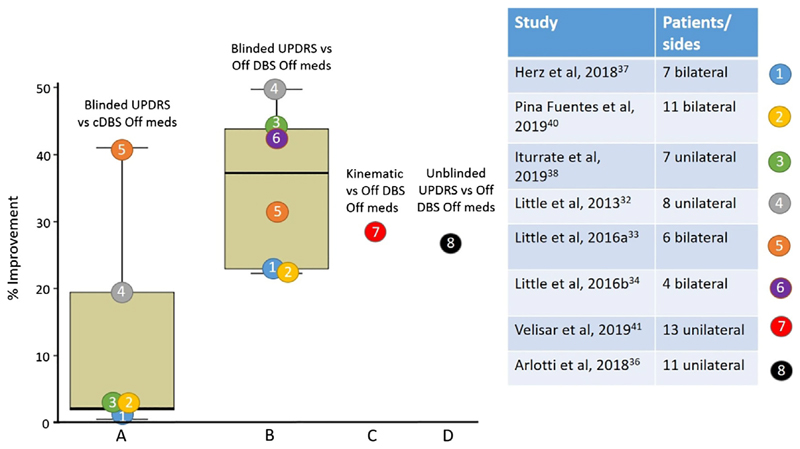
Deep brain stimulation (DBS) is a successful treatment for patients with Parkinson's disease. In adaptive DBS, stimulation is titrated according to feedback about clinical state and underlying pathophysiology. This contrasts with conventional stimulation, which is fixed and continuous. In acute trials, adaptive stimulation matches the efficacy of conventional stimulation while delivering about half the electrical energy. The latter means potentially fewer side-effects. The next step is to determine the long-term efficacy, efficiency, and side-effect profile of adaptive stimulation, and chronic trials are currently being considered by the medical devices industry. However, there are several different approaches to adaptive DBS, and several possible limitations have been highlighted. Here we review the findings to date to ascertain how and who to stimulate in chronic trials designed to establish the long-term utility of adaptive DBS. © 2020 International Parkinson and Movement Disorder Society.
脑深部电刺激(DBS)是治疗帕金森病患者的有效方法。在适应性 DBS 中,根据临床状态和潜在病理生理学的反馈来调整刺激。这与传统的刺激形成对比,传统刺激是固定和持续的。在急性试验中,适应性刺激与传统刺激的疗效相匹配,同时只输送大约一半的电能。这意味着潜在的副作用更少。下一步是确定适应性刺激的长期疗效、效率和副作用特征,医疗器械行业目前正在考虑进行慢性试验。然而,适应性 DBS 有几种不同的方法,已经强调了几种可能的局限性。在这里,我们回顾迄今为止的研究结果,以确定在旨在确定适应性 DBS 长期效用的慢性试验中如何以及对谁进行刺激。 © 2020 国际帕金森病和运动障碍学会。