Liang Jun, Li Ying, Zhang Zhongan, Shen Dongxia, Xu Jie, Yu Gang, Dai Siqi, Ge Fangmin, Lei Jianbo
IT Center, Second Affiliated Hospital, School of Medicine, Zhejiang University, Hangzhou, China.
Department of Burn and Plastic Surgery, Affiliated Hospital of Southwest Medical University, Luzhou, China.
JMIR Med Inform. 2020 Feb 10;8(2):e17006. doi: 10.2196/17006.
To achieve universal access to medical resources, China introduced its second health care reform in 2010, with health information technologies (HIT) as an important technical support point.
This study is the first attempt to explore the unique contributions and characteristics of HIT development in Chinese hospitals from the three major aspects of hospital HIT-human resources, funding, and materials-in an all-around, multi-angled, and time-longitudinal manner, so as to serve as a reference for decision makers in China and the rest of the world when formulating HIT development strategies.
A longitudinal research method is used to analyze the results of the CHIMA Annual Survey of Hospital Information System in China carried out by a Chinese national industrial association, CHIMA, from 2007 to 2018. The development characteristics of human resources, funding, and materials of HIT in China for the past 12 years are summarized. The Bass model is used to fit and predict the popularization trend of EMR in Chinese hospitals from 2007 to 2020.
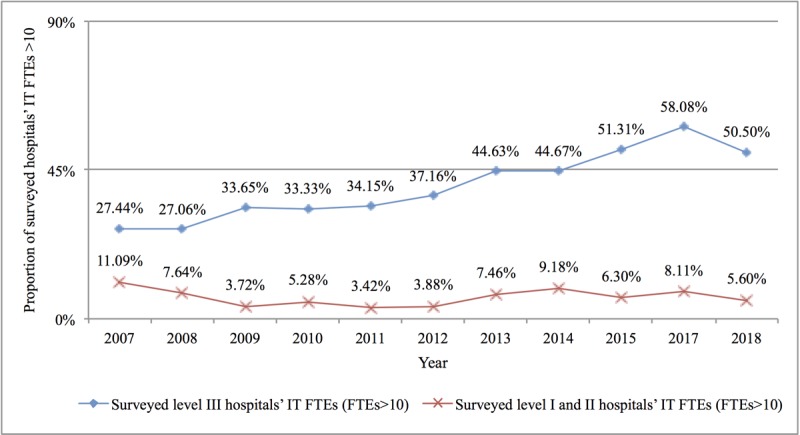
From 2007 to 2018, the CHIMA Annual Survey interviewed 10,954 hospital CIOs across 32 administrative regions in Mainland China. Compared with 2007, as of 2018, in terms of human resources, the average full time equivalent (FTE) count in each hospital's IT center is still lower than the average level of US counterparts in 2014 (9.66 FTEs vs. 34 FTEs). The proportion of CIOs with a master's degree or above was 25.61%, showing an increase of 18.51%, among which those with computer-related backgrounds accounted for 64.75%, however, those with a medical informatics background only accounted for 3.67%. In terms of funding, the sampled hospitals' annual HIT investment increased from ¥957,700 (US $136,874) to ¥6.376 million (US $911,261), and the average investment per bed increased from ¥4,600 (US $658) to ¥8,100 (US $1158). In terms of information system construction, as of 2018, the average EMR implementation rate of the sampled hospitals exceeded the average level of their US counterparts in 2015 and their German counterparts in 2017 (85.26% vs. 83.8% vs. 68.4%, respectively). The results of the Bass prediction model show that Chinese hospitals will likely reach an adoption rate of 91.4% by 2020 (R=0.95).
In more than 10 years, based on this top-down approach, China's medical care industry has accepted government instructions and implemented the unified model planned by administrative intervention. With only about one-fifth of the required funding, and about one-fourth of the required human resources per hospital as compared to the US HITECH project, China's EMR coverage in 2018 exceeded the average level of its US counterparts in 2015 and German counterparts in 2017. This experience deserves further study and analysis by other countries.
为实现医疗资源的全民可及,中国于2010年启动了第二次医疗改革,将卫生信息技术(HIT)作为重要的技术支撑点。
本研究首次全面、多角度且纵向地从医院HIT的人力资源、资金和物资这三个主要方面,探索中国医院HIT发展的独特贡献和特点,为中国及世界其他国家的决策者制定HIT发展战略提供参考。
采用纵向研究方法,分析中国国家行业协会中国医院协会(CHIMA)在2007年至2018年开展的中国医院信息系统年度调查结果。总结过去12年中国HIT在人力资源、资金和物资方面的发展特点。使用巴斯模型对2007年至2020年中国医院电子病历(EMR)的普及趋势进行拟合和预测。
2007年至2018年,CHIMA年度调查共采访了中国大陆32个行政区的10954位医院首席信息官(CIO)。与2007年相比,截至2018年,在人力资源方面,各医院信息中心的平均全职等效人员(FTE)数量仍低于2014年美国同行的平均水平(9.66 FTE对34 FTE)。硕士及以上学历的CIO占比为25.61%,增长了18.51%,其中计算机相关背景的占64.75%,而医学信息学背景的仅占3.67%。在资金方面,抽样医院的年度HIT投资从95.77万元人民币(13.6874万美元)增至637.6万元人民币(91.1261万美元),每张床位的平均投资从4600元人民币(658美元)增至8100元人民币(1158美元)。在信息系统建设方面,截至2018年,抽样医院的平均EMR实施率超过了2015年美国同行和2017年德国同行的平均水平(分别为85.26%对83.8%对68.4%)。巴斯预测模型的结果显示,到2020年中国医院的采用率可能达到91.4%(R = 0.95)。
在十多年的时间里,基于这种自上而下的方式,中国医疗行业接受政府指令,通过行政干预实施统一模式。与美国HITECH项目相比,中国仅用了约五分之一的所需资金以及每家医院约四分之一的所需人力资源,2018年的EMR覆盖率就超过了2015年美国同行和2017年德国同行的平均水平。这一经验值得其他国家进一步研究和分析。