Department of Biology, Johns Hopkins University, Baltimore, Maryland 21218, USA.
Department of Biophysics, Johns Hopkins University, Baltimore, Maryland 21218, USA; email:
Annu Rev Biophys. 2020 May 6;49:247-265. doi: 10.1146/annurev-biophys-052118-115508. Epub 2020 Feb 10.
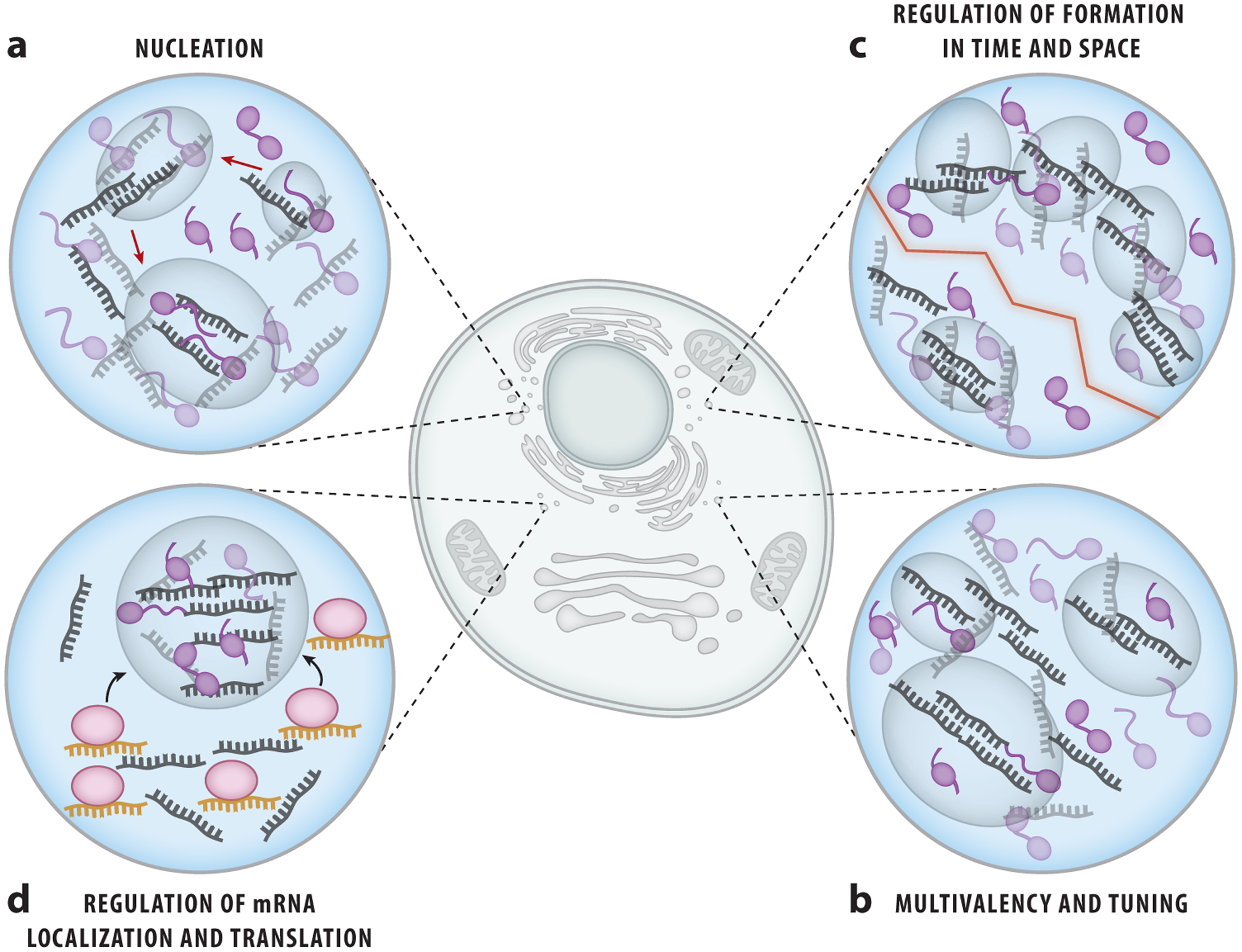
Liquid-liquid phase separation is emerging as the universal mechanism by which membraneless cellular granules form. Despite many previous studies on condensation of intrinsically disordered proteins and low complexity domains, we lack understanding about the role of RNA, which is the essential component of all ribonucleoprotein (RNP) granules. RNA, as an anionic polymer, is inherently an excellent platform for achieving multivalency and can accommodate many RNA binding proteins. Recent findings have highlighted the diverse function of RNA in tuning phase-separation propensity up or down, altering viscoelastic properties and thereby driving immiscibility between different condensates. In addition to contributing to the biophysical properties of droplets, RNA is a functionally critical constituent that defines the identity of cellular condensates and controls the temporal and spatial distribution of specific RNP granules. In this review, we summarize what we have learned so far about such roles of RNA in the context of in vitro and in vivo studies.
液-液相分离正成为无膜细胞颗粒形成的通用机制。尽管之前有许多关于无序蛋白和低复杂度结构域凝聚的研究,但我们对 RNA 的作用仍缺乏了解,而 RNA 是所有核糖核蛋白(RNP)颗粒的基本组成部分。RNA 作为一种阴离子聚合物,本身就是实现多价性的绝佳平台,并且可以容纳许多 RNA 结合蛋白。最近的研究结果强调了 RNA 在调节相分离倾向方面的多样化功能,即向上或向下调节,改变粘弹性特性,从而驱动不同凝聚物之间的不混溶性。除了对液滴的生物物理特性有贡献外,RNA 还是一个功能关键成分,它定义了细胞凝聚物的身份,并控制特定 RNP 颗粒的时空分布。在这篇综述中,我们总结了迄今为止在体外和体内研究中关于 RNA 这些作用的认识。