Department of Biosystems Science and Engineering, ETH Zurich, Basel, Switzerland.
SIB Swiss Institute of Bioinformatics, Basel, Switzerland.
PLoS Comput Biol. 2020 Feb 10;16(2):e1007587. doi: 10.1371/journal.pcbi.1007587. eCollection 2020 Feb.
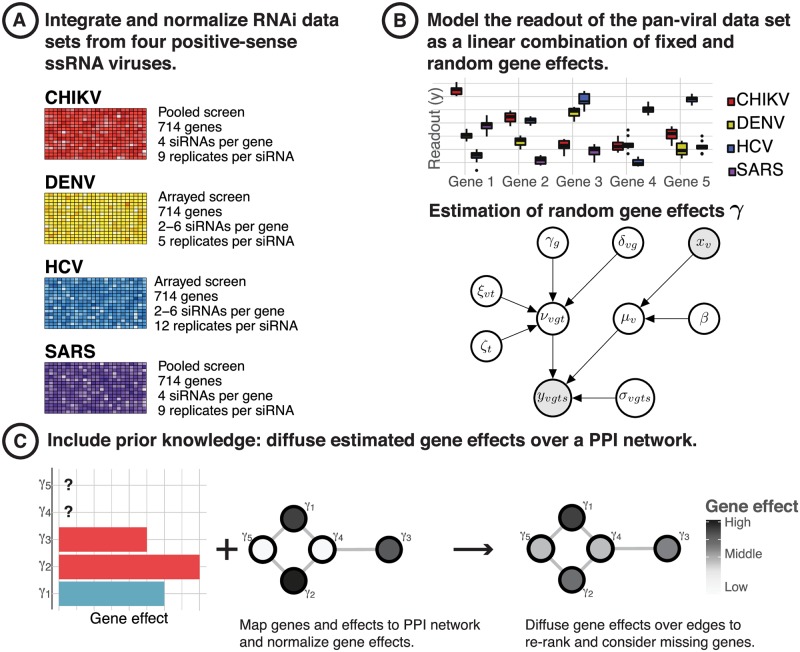
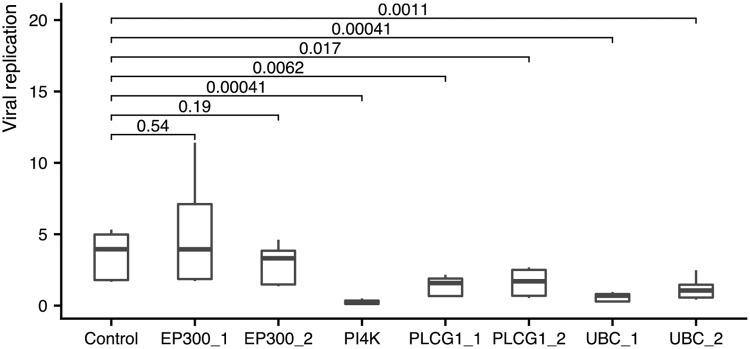
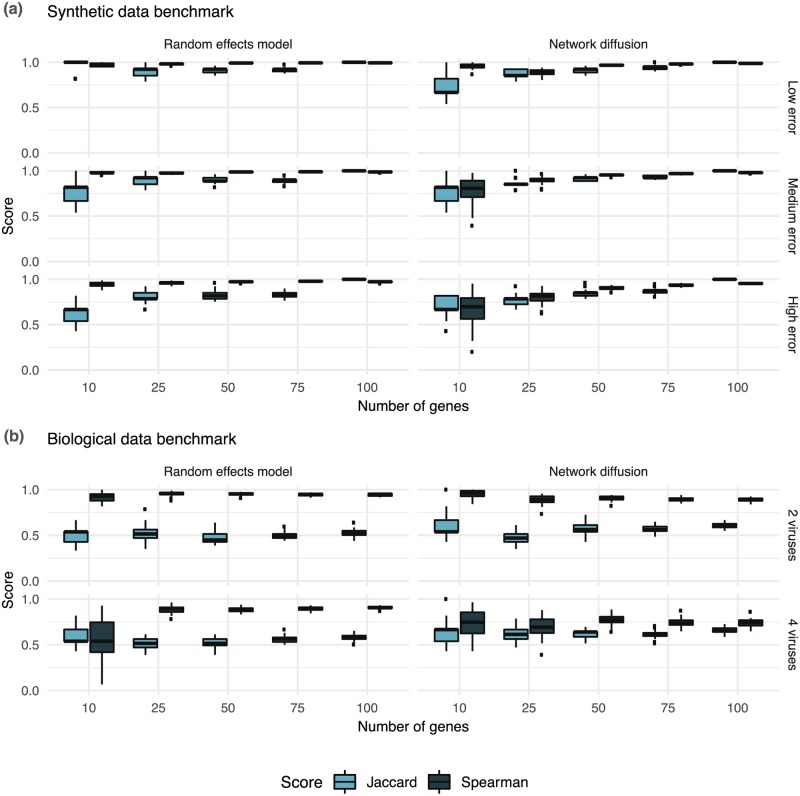
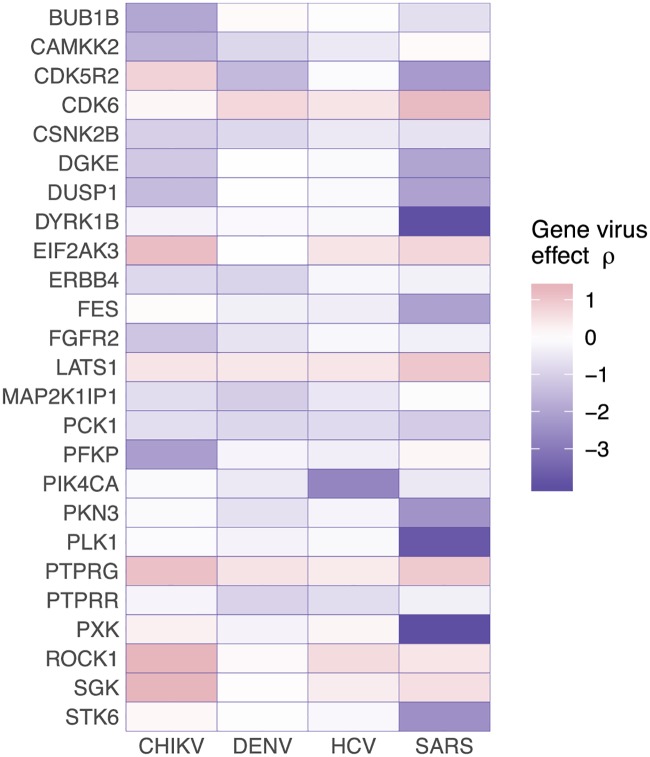
Genetic perturbation screens using RNA interference (RNAi) have been conducted successfully to identify host factors that are essential for the life cycle of bacteria or viruses. So far, most published studies identified host factors primarily for single pathogens. Furthermore, often only a small subset of genes, e.g., genes encoding kinases, have been targeted. Identification of host factors on a pan-pathogen level, i.e., genes that are crucial for the replication of a diverse group of pathogens has received relatively little attention, despite the fact that such common host factors would be highly relevant, for instance, for devising broad-spectrum anti-pathogenic drugs. Here, we present a novel two-stage procedure for the identification of host factors involved in the replication of different viruses using a combination of random effects models and Markov random walks on a functional interaction network. We first infer candidate genes by jointly analyzing multiple perturbations screens while at the same time adjusting for high variance inherent in these screens. Subsequently the inferred estimates are spread across a network of functional interactions thereby allowing for the analysis of missing genes in the biological studies, smoothing the effect sizes of previously found host factors, and considering a priori pathway information defined over edges of the network. We applied the procedure to RNAi screening data of four different positive-sense single-stranded RNA viruses, Hepatitis C virus, Chikungunya virus, Dengue virus and Severe acute respiratory syndrome coronavirus, and detected novel host factors, including UBC, PLCG1, and DYRK1B, which are predicted to significantly impact the replication cycles of these viruses. We validated the detected host factors experimentally using pharmacological inhibition and an additional siRNA screen and found that some of the predicted host factors indeed influence the replication of these pathogens.
利用 RNA 干扰 (RNAi) 的遗传干扰筛选已成功用于鉴定对细菌或病毒生命周期至关重要的宿主因子。到目前为止,大多数已发表的研究主要鉴定了单一病原体的宿主因子。此外,通常仅靶向一小部分基因,例如编码激酶的基因。在泛病原体水平上鉴定宿主因子,即对多种病原体复制至关重要的基因,尽管这种常见的宿主因子对于设计广谱抗病原体药物非常重要,但相对较少受到关注。在这里,我们提出了一种使用随机效应模型和马尔可夫随机游走在功能相互作用网络上的两阶段新方法,用于鉴定不同病毒复制中涉及的宿主因子。我们首先通过联合分析多个扰动筛选来推断候选基因,同时调整这些筛选中固有的高方差。随后,推断的估计值会在功能相互作用网络上传播,从而允许分析生物学研究中缺失的基因,平滑先前发现的宿主因子的效应大小,并考虑网络边缘定义的先验途径信息。我们将该程序应用于四种不同的正链单链 RNA 病毒(丙型肝炎病毒、基孔肯雅热病毒、登革热病毒和严重急性呼吸系统综合征冠状病毒)的 RNAi 筛选数据中,检测到了新的宿主因子,包括 UBC、PLCGl 和 DYRK1B,它们被预测会显著影响这些病毒的复制周期。我们使用药理学抑制和额外的 siRNA 筛选实验验证了检测到的宿主因子,并发现一些预测的宿主因子确实会影响这些病原体的复制。