Department of Radiation Oncology, Hannover Medical School, Carl-Neuberg-Str. 1, 30625, Hanover, Germany.
Institute for Environmental Economics and World Trade, Leibniz University, Königsworther Platz 1, 30167, Hanover, Germany.
Strahlenther Onkol. 2020 Jul;196(7):598-607. doi: 10.1007/s00066-020-01589-w. Epub 2020 Feb 10.
This retrospective study aims at investigating the effects of moderately hypofractionated radiation therapy (HRT) on acute and late toxicities as well as on early biochemical control and therapeutic efficiency compared to conventional radiation therapy (CRT) in prostate cancer.
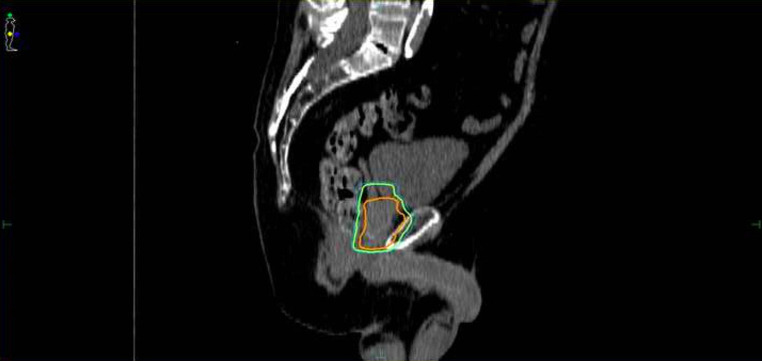
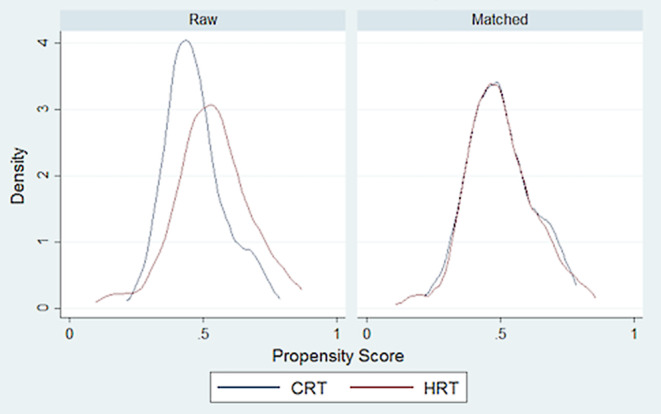
We analyzed 55 HRT patients irradiated with the total dose of 60 Gy in 20 fractions delivered over 4 weeks. These patients were compared to a control group of 55 patients who received CRT with a total of <78 Gy in 37-39 fractions delivered over circa 8 weeks. External beam radiation therapy (EBRT) was conducted using daily image-guided (cone beam CT) volumetric modulated arc therapy (VMAT) and a simultaneously integrated boost (SIB) for both groups to protect the rectum. Acute toxicities were evaluated according to Common Terminology Criteria for Adverse Events (CTCAE) v5, whereas chronic toxicities were assessed in accordance with LENT-SOMA. Patient traits were compared by implementing t‑tests and Wilcoxon-Whitney tests for continuous variables, whereas discrete characteristics were evaluated by applying two-tailed Fisher's exact tests. In addition, we calculated average treatment effects (ATE). Thereby, propensity score matching (PSM) based on nearest-neighbor matching considering age, comorbidities, and risk stratification as covariates was applied. The statistical analysis was conducted using Stata 14.2 (StataCorp LLC, TX, USA).
As confirmed by the descriptive tests, the ATE revealed that the intensity and occurrence of urinary frequency (p = 0.034) and proctitis (p = 0.027) significantly decreased for the HRT group, whereas all other acute toxicities did not differ significantly between the HRT and CRT groups. For late toxicities, neither statistical tests nor ATE estimation showed significant differences. Also, no significant difference was found regarding the decrease in prostate specific antigen (PSA) after a median follow-up of 13 months (range 2-28 months), which indicates biochemical freedom from progression.
HRT offers several medical and economic advantages and should therefore be considered as a useful alternative to CRT.
本回顾性研究旨在探讨与常规放疗(CRT)相比,前列腺癌中度低分割放疗(HRT)在急性和迟发性毒性、早期生化控制和治疗效果方面的影响。
我们分析了 55 例接受 60 Gy 总剂量、20 次分割、4 周内完成的 HRT 患者。这些患者与对照组 55 例患者进行比较,对照组接受的 CRT 总剂量<78 Gy,37-39 次分割,8 周内完成。两组均采用每日图像引导(锥形束 CT)容积调强弧形治疗(VMAT)和同时整合增敏(SIB)进行外照射放疗(EBRT),以保护直肠。急性毒性根据通用不良事件术语标准(CTCAE)v5 进行评估,而慢性毒性根据 LENT-SOMA 进行评估。通过实施 t 检验和 Wilcoxon-Whitney 检验比较连续变量,通过应用双侧 Fisher 精确检验评估离散特征。此外,我们还计算了平均治疗效果(ATE)。为此,采用基于最近邻匹配的倾向评分匹配(PSM),考虑年龄、合并症和风险分层作为协变量。统计分析采用 Stata 14.2(StataCorp LLC,TX,USA)进行。
描述性检验证实,ATE 表明 HRT 组的尿频(p=0.034)和直肠炎(p=0.027)的强度和发生率显著降低,而 HRT 和 CRT 组之间的所有其他急性毒性无显著差异。对于迟发性毒性,无论是统计学检验还是 ATE 估计均未显示出显著差异。此外,在中位随访 13 个月(范围 2-28 个月)后前列腺特异性抗原(PSA)下降方面也未发现显著差异,这表明生化无进展。
HRT 具有许多医学和经济优势,因此应被视为 CRT 的有用替代方案。